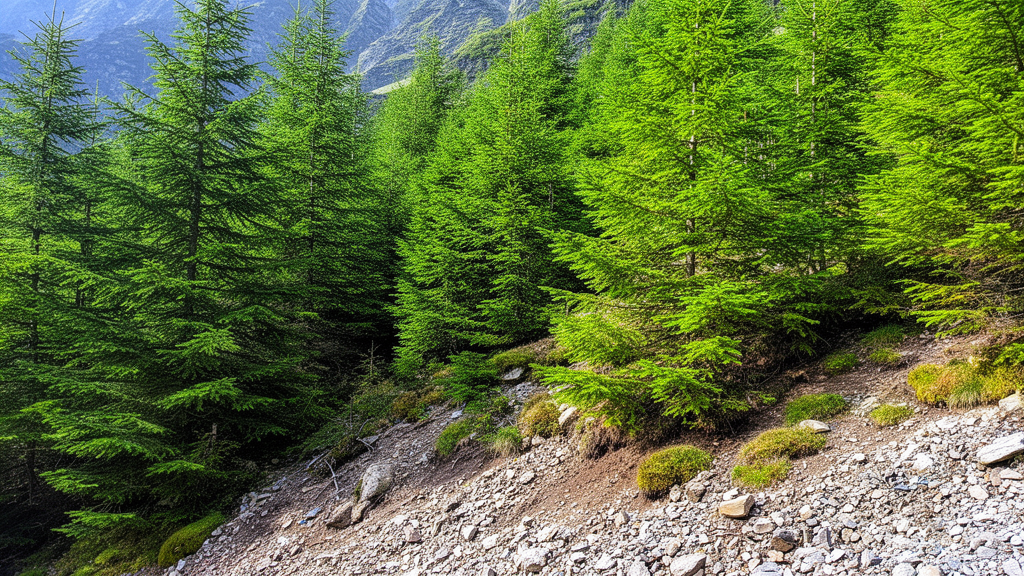
Spontaneous forest regeneration following agricultural land abandonment across the Italian Alps substantially increases total ecosystem carbon storage over an eighty-year timeline, driven almost entirely by the accumulation of living vegetation biomass while soil organic carbon stocks remain essentially stationary. According to an extensive investigation surveying post-agricultural secondary succession across northern Italy, natural woodland re-establishment sequesters significant quantities of atmospheric carbon dioxide without requiring active tree planting initiatives. By tracking major ecosystem compartments across four distinct Alpine ecoregions, researchers found that total carbon pools in the oldest regenerating secondary stands reached levels comparable to mature temperate forests. However, this progressive accumulation revealed a pronounced structural decoupling between aboveground and belowground carbon reservoirs. While woody vegetation expanded vigorously with time since abandonment, mineral and organic soil horizons showed no statistically significant temporal increase across eighty years of natural succession, demonstrating that carbon recovery trajectories differ fundamentally among distinct forest ecosystem compartments.
The widespread abandonment of marginal farmland has become a defining ecological trend throughout rural Europe during recent decades, triggered by rural depopulation, changing socioeconomic conditions, and the intensification of farming in more productive lowland areas. Between 1990 and 2020, European forest cover expanded by roughly fourteen million hectares, representing a ten percent increase, while demographic and economic projections suggest that tens of millions of additional agricultural hectares could be abandoned in coming decades. As managed fields cease operations, secondary ecological succession initiates passive rewilding, creating self-organizing ecosystems that bridge managed agricultural territory and continuous native forest. Secondary forest expansion has therefore emerged as an attractive, low-cost Nature-based Solution capable of mitigating climate change by sequestering carbon across standing biomass, woody debris, surface litter, and subterranean soils. Nevertheless, comprehensive assessments evaluating how distinct carbon pools recover simultaneously across environmental gradients have remained limited, particularly regarding how past land management legacies and regional climates modulate recovery over multi-decadal timescales.
To resolve these ecological questions across contrasting environmental settings, the research team focused on the Italian Alpine territory, examining four distinct administrative subsections designated under national statistical frameworks. These subsections comprised the Western Alps (classified as subsection 1A1b, or ecoregion A), the Central Alps (subsection 1A2c, or ecoregion B), the Eastern Alps (subsection 1A2b, or ecoregion C), and the Prealps (subsection 1A2a, or ecoregion D). The geographical arc of the Alps encompasses pronounced climatic heterogeneity shaped by sharp altitudinal ranges and intersecting continental, Mediterranean, and oceanic air systems. In the Western Alps, annual precipitation spans from approximately 500 to 2,200 millimeters per year, whereas the Central and Eastern sections exhibit broader variation spanning from 570 to 2,600 millimeters per year, culminating in the highest moisture levels within the Prealps. Mean annual temperatures range from 5 to 8 degrees Celsius in western valleys to between 7 and 10 degrees Celsius across eastern and prealpine sectors at comparable elevations.
The researchers established a balanced chronosequence sampling framework encompassing one hundred and twenty survey sites to reconstruct eighty years of ecological recovery without waiting nearly a century for real-time forest succession. Across each of the four ecoregions, the study examined two distinct land-use transitions: cropland transitioning to forest, and managed meadow transitioning to forest. Each historical pathway was represented by three independent, geographically replicated chronosequences comprising five nominal chronological phases of secondary development: actively managed agricultural land representing baseline conditions (designated class zero), and stands established between 2000 and 2020 (class twenty), between 1980 and 2000 (class forty), between 1954 and 1980 (class sixty), and prior to 1954 (class eighty). Sites were identified using historical orthophotographs provided by the Italian Military Geographic Institute and aligned in geographic information systems using Thin Plate Spline transformations with ground control points, followed by on-site field validation to eliminate areas affected by recent logging or natural disturbances.
Field inventory protocols quantified every major ecosystem carbon compartment using standardized biometric methodologies within circular plots of thirteen-meter radius. All living trees and tall shrubs reaching or exceeding 1.3 meters in height were identified to species, tagged, and spatially mapped. Individual trunk diameter at breast height was recorded with precision tree calipers, while total tree height was determined with ultrasonic Vertex hypsometers. Individual stem volume and biomass were derived using allometric equations curated in the allodb analytical library, which combines 570 equations representing 701 temperate and extra-tropical woody species. When species-specific formulas were unavailable, taxonomic fallback protocols assigned equations from the corresponding genus, such as applying Salix genus parameters for Salix caprea, or broader botanical families, such as employing Rosaceae family formulations for Sorbus aucuparia. Standing dead trees were quantified by calculating geometric cylinder volume using a standard form factor of 0.5, modified by decay-class wood density reduction factors, with belowground root mass estimated via root-to-shoot ratios.
Dead organic material and ground-level understory vegetation were inventoried using complementary sampling procedures established within each plot. Downed coarse woody debris possessing a lower-end diameter of at least ten centimeters and length exceeding one meter underwent a comprehensive census, converting truncated cone volumes to biomass using decay-specific densities. Fine woody debris measuring between 2.5 and 10 centimeters was surveyed along three ten-meter transects arranged in an equilateral triangle around the plot center using line-intercept protocols. Square frames measuring forty by forty centimeters placed along transects collected the surface litter layer, consisting of leaves, twigs, dead moss, and debris fragments under 2.5 centimeters. Understory shrubs under 1.3 meters and herbaceous grasses were recorded along transects at two-meter intervals to calculate cover and height-derived biomass, with grass root biomass calculated using a root-to-shoot ratio of 4. Total vegetative biomass was converted to elemental carbon stocks using standard carbon concentration factors: 0.47 for living plant tissues, 0.475 for broadleaf deadwood, 0.505 for conifer deadwood, and 0.50 for dried surface litter.
Belowground carbon storage was assessed by extracting three thirty-centimeter soil cores per plot using split-tube corers of five-centimeter inner diameter, separating each core into distinct organic and mineral horizons based on soil color, mechanical texture, and the decomposition state of plant remnants. Samples were chilled at four degrees Celsius before laboratory processing, where litter fractions were oven-dried at 90 degrees Celsius for 48 hours to establish constant dry weight. Mineral and organic soil samples were sieved through a five-millimeter mesh and oven-dried at 70 degrees Celsius before being pulverized for elemental analysis. To prevent inorganic carbonates from skewing organic measurements, soil subsamples were treated overnight under fluxed conditions with hydrochloric acid at a one-to-two volumetric ratio. Organic carbon concentrations were measured in triplicate using a specialized combustion analyzer, combining measured carbon percentages with horizon thickness and dry bulk density to determine soil organic carbon stocks in megagrams of carbon per hectare.
Statistical evaluations performed in R version 4.2.3 utilized linear mixed-effects models fitted with the lme4 package to evaluate carbon dynamics across successional stages, ecoregions, and land-use histories. Individual carbon pools were grouped into three functional compartments: vegetation carbon (incorporating living stems, roots, snags, woody debris, litter, shrubs, and grasses), soil organic carbon across both soil horizons, and total ecosystem carbon. Because exploratory data checks indicated that non-linear models did not improve fit over linear frameworks, time since abandonment was modeled as a categorical factor with five levels, avoiding artificial constraints on temporal trajectories. Chronosequence identity was assigned as a random intercept to control for spatial clustering, while fixed factors included time since abandonment, ecoregion, previous land use, and their full interactions. Fixed effects were evaluated via Type III analysis of variance with Satterthwaite approximations of denominator degrees of freedom, accompanied by Tukey post-hoc tests and DHARMa simulated residual diagnostics.
The statistical modeling demonstrated that total ecosystem carbon increased significantly across successional ages, climbing from modest initial stocks to reach values exceeding 330 megagrams of carbon per hectare in the oldest stands. In the linear mixed-effects model for total ecosystem carbon, time since abandonment proved highly significant (F = 275.2, P < 0.001), while its interaction with ecoregion was also significant (F = 4.32, P = 0.006), alongside a significant interaction with previous land use (F = 7.67, P = 0.006). This overall rise was overwhelmingly powered by vegetation carbon accumulation, which exhibited a dramatic increase with successional time (F = 327.9, P < 0.001) as well as a significant main effect of ecoregion (F = 14.91, P < 0.001) and a significant time-by-ecoregion interaction (F = 5.33, P = 0.001). After eighty years, vegetation carbon reached roughly 282 megagrams per hectare in the Eastern Alps, compared to 193 in the Western Alps, 176 in the Central Alps, and 161 in the Prealps.
In contrast to aboveground biomass, soil carbon showed no significant temporal trend across eighty years (F = 0.92, P = 0.454), while differing significantly among ecoregions (F = 53.96, P < 0.001) and interacting with previous land use (F = 15.54, P < 0.001). This divergence radically shifted carbon allocation: recently abandoned sites were soil-dominated (80 to 85 percent of total carbon), whereas living trees became dominant after two to four decades, eventually comprising over 50 percent of total carbon in most ecoregions and nearly 85 to 90 percent in the Eastern Alps. Random Forest models confirmed time since abandonment as the primary predictor for vegetation and total ecosystem carbon (53 and 61 percent increase in mean squared error), while soil carbon was governed by topographic northness, mean temperature, and precipitation (~25 percent each). The authors concluded that while passive rewilding substantially increases carbon storage, shifting carbon into aboveground biomass increases vulnerability to wildfire and drought, requiring managers to balance carbon gains against disturbance exposure.
Subject of Research: Ecosystem carbon recovery and pool partitioning across post-agricultural Alpine forest chronosequences
Article Title: Not all carbon pools recover alike: contrasting vegetation and soil carbon trajectories following agricultural land abandonment in the Alpine forests
Article References: Panico, S. C., Ascoli, D., Berretti, R., Cadez, L., Foscari, A., Incerti, G., Moris, J. V., Orzan, L., Passamani, C., Piazza, N., Rossi, L. M. W., Spadoni, G. L., Tomao, A., Vacchiano, G., & Alberti, G. (2026). Not all carbon pools recover alike: contrasting vegetation and soil carbon trajectories following agricultural land abandonment in the Alpine forests. Frontiers in Forests and Global Change, 9, 2015175. https://doi.org/10.3389/ffgc.2026.2015175
Image Credits: AI Generated
DOI: 10.3389/ffgc.2026.2015175
Keywords: secondary succession, passive rewilding, agricultural land abandonment, Alpine forests, carbon sequestration, soil organic carbon, vegetation biomass, chronosequence, Eastern Alps, Western Alps, Central Alps, Prealps, deadwood, fine woody debris, linear mixed-effects models, Random Forest analysis, disturbance vulnerability
News Source: Alan Morgan. (November 26, 2026). Regenerating Alpine Forests Build Carbon in Vegetation While Soil Stocks Stall. Scienmag.