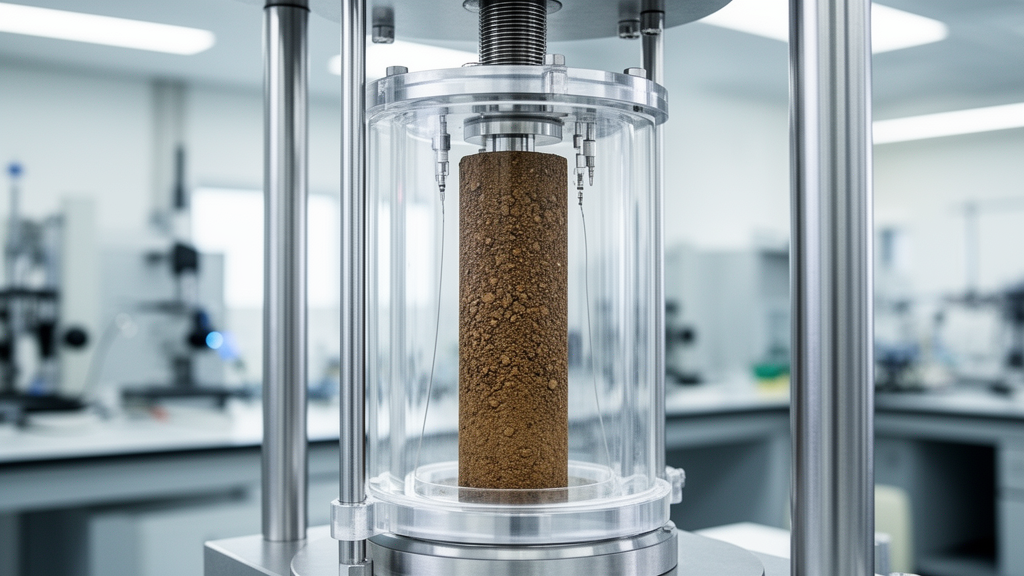
Geotechnical engineers evaluating the dynamic response of foundation soils and earth structures rely heavily on resonant column testing to establish fundamental stiffness and damping properties under oscillatory loading. In an investigation published in the International Journal of Geo-Engineering, researchers Tien Hue Nguyen, Taebong Ahn, and Yujin Lim established that the conventional assumption of a fixed equivalent radius produces significant inaccuracies across varied deformation amplitudes. Operating a Stokoe-type resonant column apparatus involves subjecting a cylindrical specimen to torsional excitation to measure resonant frequency, wave velocity, and torque-twist relationships. However, torsional deformation generates non-uniform shearing stress and strain fields that vary radially from zero along the central specimen axis to a maximum value at the specimen perimeter. To transform macroscopic torque and rotation readings into representative shear stress-strain relationships and modulus reduction curves, standard engineering practice relies on an equivalent radius factor, designated as Req. The authors demonstrated that treating this parameter as an invariable constant fails across wide strain intervals, particularly at small strains below 0.01 percent.
The mechanics of the resonant column test depend on wave propagation through cylindrical visco-elastic rods under torsional vibration, idealizing the soil specimen as a single degree of freedom system. Testing systems operating in fixed-free boundary configurations restrain the base of the specimen against a rigid reaction block while applying cyclic torque to an active top driving body. This top assembly consists of cross-arms, magnets, counterbalances, accelerometers, and an end cap that function together as a lumped polar mass moment of inertia denoted as I0. Torsional wave velocities derived from measured resonant frequencies enable engineers to compute the equivalent linear elastic shear modulus, Geq, alongside specimen damping ratios. From the recorded torsional vibration amplitudes, the secant stiffness governs the relation between the applied torque and the twist angle per unit specimen length. Converting these raw dynamic response measurements into authentic constitutive curves requires an exact spatial radius at which the calculated shearing strain authentically represents the complex, non-uniform internal stress distribution of the entire twisting column.
Historically, laboratory interpretation methodologies addressed this radial non-uniformity by adopting simplified geometric approximations or fixed empirical coefficients. Chen and Stokoe originally established the equivalent radius framework to account for spatial stress-strain variation, prompting testing standards such as ASTM D4015 to recommend setting the representative shear strain at 0.8 times the external sample radius. Earlier investigations, including recommendations by Kim and Hwang, recognized minor variations, advocating radius ratios ranging from 0.82 at strains under 0.001 percent down to 0.79 at strains reaching 0.1 percent. Although other formulations suggested taking average stress and strain values of two-thirds or one-half the outer radius based on linear elasticity or high-strain torsion tests, conventional laboratory protocols adhered to a static factor near 0.80. A previous effort termed the Stress Integration Approach Method sought to overcome these limitations by evaluating modulus across varying strain levels, yet lacked systematic theoretical calibration and thorough experimental validation across wide strain regimes.
To overcome these legacy constraints, the research team developed a rigorous analytical formulation grounded in a numerical stress integration framework combined with a theoretical modified hyperbolic soil model. Under torsional excitation, the applied torque represents the integral of the internal shear stress multiplied by the radial area element across the entire circular cross section of the cylinder. Because soil exhibits pronounced non-linear stress-strain behavior as deformations progress from medium to high strain thresholds, the radial distribution of shearing stress diverges markedly from the linear strain distribution predicted by elementary elasticity. By relating the mobilized shearing stress directly to the applied torque through cross-sectional integration, the researchers established a systematic mathematical route to track changing stiffness without enforcing arbitrary geometric assumptions along the cross-sectional plane.
The theoretical architecture incorporates a modified hyperbolic constitutive formulation defined by the maximum low-strain shear modulus, a reference shear strain, and a sensitivity exponent parameter denoted as a. Normalizing the shear strain by the reference strain allows the stress-strain relation and corresponding secant modulus degradation to be expressed through closed-form non-linear expressions. In this framework, the numerical integration of the stress-strain distribution over the specimen radius yields the theoretical torque-twist relation across continuous rotation increments. By mapping the effective shear modulus calculated from the integrated torque against the normalized rotation, the authors matched the degrading torsional stiffness with the theoretical modulus reduction curve. This comparison allowed the authors to isolate the exact normalized radius where the mobilized local shear strain matches the effective modulus, producing an explicit governing formulation for the equivalent radius as a function of normalized twist and normalized shear modulus.
Analytical sensitivity analyses confirmed that the exponent parameter a serves as the single dominant variable governing both the normalized stress-strain curvature and the resulting equivalent radius functions. When evaluating equivalent radius curves against normalized twist angles, the calculated radius factors ranged broadly from 0.40 to 0.78 depending on deformation magnitude and parameter values. Setting the exponent parameter a equal to 1.0 yielded an equivalent radius value approaching 0.60 at the smallest normalized rotation level of 0.001. However, theoretical linear elasticity dictates that a perfectly linear elastic cylindrical body under pure torsion exhibits an equivalent radius of exactly two-thirds, or approximately 0.67, at near-zero deformation. To resolve this discrepancy, the authors back-calculated the characteristic exponent against an ideal linear medium, determining an optimal best-fit value of 0.9326 that strictly aligns the integration model with classical mechanics at infinitesimal strain boundaries.
Through non-linear regression of the numerical integration results obtained using the back-calculated exponent of 0.9326, the investigators established an explicit empirical prediction equation for practical laboratory implementation. The resulting mathematical formula defines Req as 0.74 plus 0.126 multiplied by the normalized twist angle raised to the power of negative 0.33, minus 0.089 multiplied by the normalized twist angle raised to the power of negative 0.389. This refined formulation demonstrates that the equivalent radius is not a stable geometric constant, but a dynamic variable that declines steeply when shear strains decrease from 0.1 down to 0.001. In the intermediate normalized strain interval spanning 0.01 to 1.0, the predicted Req values stabilize within a narrow band between 0.77 and 0.80. At very low shear strains below 0.01, the dramatic descent toward 0.60 reveals why conventional standardized factors of 0.80 introduce systemic distortion into low-amplitude stiffness characterization.
To validate the proposed formulation on physical geomaterials, the team conducted experimental testing using a Medium-size Resonant Column apparatus capable of accommodating cylindrical specimens 10 centimeters in diameter and 20 centimeters in height. This testing capacity handles specimens twice the size of standard 5-centimeter by 10-centimeter laboratory samples, allowing accurate evaluation of coarse aggregate gradations. Experimental specimens were prepared from three distinct unbound crushed stone materials utilized in railway trackbed foundation top layers, sampled from active production sites located across three administrative regions in South Korea: Gyeongsang province, Gangwon province, and Chungcheong province. Petrographic origins differed among the sources, with the Gyeongsang and Gangwon aggregates classified as metamorphic rocks, whereas the Chungcheong materials consisted of granite gneiss. All crushed stone materials were compacted to at least 95 percent of maximum dry density at optimum moisture content and sieved to match uniform grain size distributions conforming to optimized gradation curves, analogous to simulated lunar granular soils.
Dynamic testing evaluated the crushed aggregate specimens under varied confining pressures across wide cyclic strain ranges to verify the practical data-reduction workflow. By applying the hyperbolic model to the raw effective modulus and outer-bound shear strain data, the reference strain was estimated by scaling outer-bound reference values by a factor of 0.78, corresponding to Req evaluated at unity normalized twist. Torque-twist relations calculated from the numerical integration framework exhibited excellent agreement with experimentally measured torque responses across all three material sources and confining stress states. Fitting the newly derived equivalent radius equation to the raw resonant column observations generated smooth, continuous shear modulus reduction curves that tracked empirical data points across both linear elastic and non-linear degradation ranges with high precision.
Comparative evaluations against historical interpretation procedures highlighted notable performance differences across the tested strain spectrum. The modulus reduction curves constructed using the refined Req prediction equation aligned closely with traditional curves calculated using Chen and Stokoe’s fixed 0.79 coefficient within the moderate strain regime. However, the refined integration results produced modulus reduction curves that plotted slightly higher than those obtained via the earlier Stress Integration Approach Method developed by Sasanakul. By properly accounting for the sharp decline in equivalent radius at micro-strain amplitudes, the new formulation eliminates the artificial underestimation of shear modulus that occurs when standard 0.80 factors are enforced on dynamic measurements at shear strains below 0.01 percent, providing more accurate maximum stiffness inputs for numerical soil modeling.
The authors emphasized that while their methodology was developed and validated using coarse unbound granular trackbed materials, the governing numerical integration framework possesses broader applicability across geotechnical engineering. Prior literature confirms that appropriately calibrated hyperbolic formulations can accurately capture the non-linear stiffness degradation of fine-grained soils, including cohesive clays and silts. Extending this strain-dependent equivalent radius model to cohesive soils requires careful laboratory calibration through cyclic triaxial or resonant column testing to establish soil-specific parameters. Furthermore, the researchers noted that complementary testing techniques, such as bender element measurements, dynamic simple shear devices, and in-situ pressuremeter unload-reload cycles, can provide independent validation data across extended strain ranges. Because only a limited suite of granular samples was tested, the team called for expanded laboratory campaigns covering diverse geomaterials and confining states to further refine and standardize dynamic equivalent radius calculations.
Subject of Research: Geotechnical dynamic soil characterization and strain-dependent equivalent radius formulation for resonant column testing
Article Title: A refined method for determining equivalent radius (Req) in resonant column tests across a wide strain range
Article References: Nguyen, T. H., Ahn, T., & Lim, Y. (2025). A refined method for determining equivalent radius (Req) in resonant column tests across a wide strain range. International Journal of Geo-Engineering, 16(1), Article 28. https://doi.org/10.1186/s40703-025-00258-0
Image Credits: AI Generated
DOI: 10.1186/s40703-025-00258-0
Keywords: resonant column testing, equivalent radius, shear modulus, soil dynamics, unbound granular materials, torsional vibration, stress integration, hyperbolic model, trackbed foundation, shear strain, medium-size resonant column, non-uniform strain distribution, secant stiffness, single degree of freedom, wave propagation, crushed stone
News Source: Denise Maddox. (November 21, 2026). Refined Resonant Column Method Adjusts Equivalent Radius Across Wide Soil Strain Ranges. Scienmag.