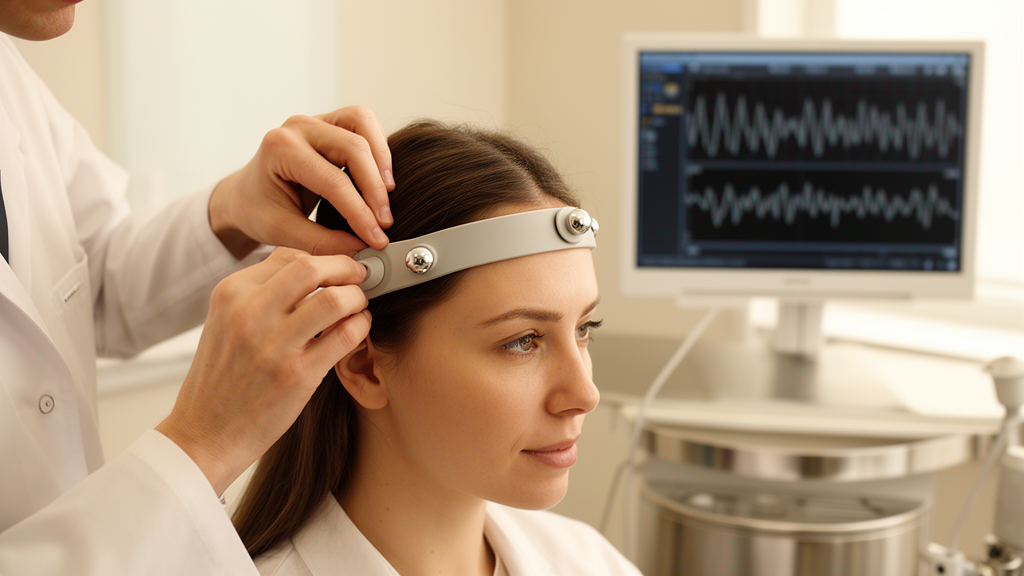
Researchers A. Aameer Arshath and D. Karthikeyan have developed a machine learning framework that classifies nine distinct types of seizures using only two temporal EEG channels, achieving an overall accuracy of 92.16%. Published in BioData Mining, the study demonstrates that reduced-channel electroencephalography, when combined with advanced signal decomposition and hybrid machine learning models, can effectively discriminate between complex seizure patterns. This approach addresses the significant challenges posed by the nonlinearity and class imbalance inherent in multi-seizure EEG data, offering a pathway toward more efficient and portable seizure monitoring devices.
The central challenge in automated seizure classification lies in the complexity of brain electrical activity. Seizures are sudden events of unusual electrical activity that can severely impact motor function, awareness, and quality of life. While EEG is the standard for measuring brain activity due to its non-invasive and cost-effective nature, the signals are extremely non-linear and non-stationary. Differentiating between seizure types often relies on subtle waveform differences that are difficult to interpret manually, particularly when signals are contaminated by muscle activity or movement artifacts. The proposed method aims to overcome these hurdles by leveraging specific temporal channels that are strongly linked to epileptiform abnormalities.
The study utilized the Temple University Seizure Corpus (TUSZ) v2.0.3 dataset, a comprehensive open-access repository containing scalp EEG recordings and annotations from 24 patients. The researchers focused exclusively on the T3 and T4 temporal EEG channels, selected because these areas have a high likelihood of significant rhythmic spike discharges during focal and temporal lobe seizures. By limiting the analysis to these two channels, the framework evaluates whether discriminative information contained in reduced-channel scenarios is sufficient for multi-class seizure classification, a critical consideration for designing lightweight, wearable monitoring systems.
To process the raw EEG signals, the team employed Variational Mode Decomposition (VMD), an adaptive signal decomposition technique well-suited for nonlinear and non-stationary data. VMD decomposes the EEG signals into five band-limited intrinsic mode functions (IMFs), which represent amplitude-modulated and frequency-modulated oscillatory components. Unlike traditional methods such as Empirical Mode Decomposition (EMD), VMD utilizes a variational optimization framework to iteratively extract modes at unique center frequencies. This process effectively mitigates mode mixing and provides a stable separation of discrete frequency bands, including delta, theta, alpha, beta, and gamma, which are essential for characterizing seizure-related brain activity.
From each of the five VMD-derived modes, the researchers extracted a diverse set of 769 features across three interrelated domains: time, frequency, and time-frequency. Time-domain features included statistical measures such as mean, variance, skewness, kurtosis, entropy, and Hjorth parameters, which provide indications of waveform shape and signal complexity. Frequency-domain features were derived from power spectral density, mapping each mode to closely related EEG bands. Time-frequency features, such as RMS energy, Teager-Kaiser energy, and spectral entropy, were used to capture transient oscillatory patterns and spectral irregularities. This multi-domain feature fusion creates a rich representation that encapsulates the holistic characteristics of seizures, overcoming the limitations of single-domain analysis.
To ensure the feature space was compact and discriminative, the study applied a hybrid feature selection scheme known as SelectKBest MI-RFE. This method combines Mutual Information (MI) with Recursive Feature Elimination (RFE) to identify the most informative attributes while removing redundancy. MI measures the statistical dependence between features and the seizure type labels, while RFE sequentially removes the least important features based on model performance. The selection process reduced the initial high-dimensional feature set to 15 highly discriminative features. This reduction is crucial for improving computational efficiency and preventing overfitting, particularly in high-dimensional EEG feature spaces where noise can obscure true signal patterns.
The classification task was performed using a two-stage stacked ensemble model incorporating LightGBM and Logistic Regression. LightGBM, a gradient boosting framework, was used as the first stage to capture complex nonlinear decision boundaries and output probabilistic class distributions. These probabilities were then used as meta-features for a second-stage Logistic Regression classifier, which applied L2 regularization to reshape the decision boundary and enhance generalization. This hybrid design balances the predictive power of gradient boosting with the interpretability and regularization benefits of linear models, providing a robust framework for multi-class seizure identification.
Addressing the severe class imbalance in the TUSZ dataset was a critical component of the methodology. The researchers employed the Synthetic Minority Over-sampling Technique (SMOTE) within a stratified K-fold cross-validation framework. To prevent data leakage, SMOTE was applied only to the training folds, while the test folds remained untouched. This fold-wise resampling ensured that synthetic samples were not created from the test set, thereby maintaining an unbiased performance evaluation. This approach improved the classifier’s sensitivity toward rare seizure classes, ensuring that the model did not skew toward majority classes due to uneven data distribution.
The experimental results demonstrated that the proposed LightGBM-Logistic Regression hybrid model outperformed other tested configurations, including LightGBM with Naive Bayes, Decision Tree, and Support Vector Machine, as well as XGBoost with Logistic Regression. The model achieved an overall classification accuracy of 92.16%, a weighted F1-score of 91.84%, and a Kappa statistic of 91.18%. In a separate experiment using a fixed 40:40:20 split for training, testing, and validation, the model maintained an average classification accuracy of 83.87%, with a precision of 83.08% and a recall of 83.87%. These results confirm the stability and generalizability of the framework under different validation settings.
Mode-wise analysis revealed that specific VMD components contributed more significantly to classification accuracy than others. Mode 3 yielded the highest individual accuracy of 97.66% with an F1-score of 0.8944, followed closely by Mode 2 at 97.11%. In contrast, lower-frequency modes such as Mode 4 showed relatively poorer performance, with an accuracy of 90.44%. This suggests that the crucial discriminating temporal and spectral features for seizure diagnosis are primarily captured in the mid-frequency bands. Ablation studies further confirmed that entropy-based and Teager energy features were vital for maintaining high accuracy, with the removal of specific entropy features causing a sharp decline in performance of up to 6.45%.
To enhance the transparency of the model, the researchers utilized Local Interpretable Model-Agnostic Explanations (LIME) to examine the contribution of individual predictors to specific predictions. The LIME analysis showed that features such as Mode3_MYSZ_Teager_Energy and Mode2_FNSZ_Entropy had strong positive contributions to the classifier’s confidence in predicting certain seizure classes. Conversely, features like Mode3_ABSZ_Mean and Mode5_GNSZ_Kurtosis displayed minor negative contributions. This explainable AI component provides clinicians with case-specific insights into which EEG-derived features drive the model’s decisions, thereby increasing the credibility and interpretability of the system for potential clinical use.
Despite the promising results, the study acknowledges several limitations. The framework relies on only two temporal EEG channels, which may not fully capture the spatial dynamics of generalized or extra-temporal focal seizures. While this reduction supports lightweight device design, adding more electrodes could potentially improve results. Additionally, the study was conducted on a single dataset, and the synthetic samples generated by SMOTE may not fully account for the complex physiological variations of minority seizure types. The computational burden of VMD and multi-domain feature extraction also poses challenges for real-time deployment on resource-constrained platforms. Future work will focus on validating the framework on other datasets, such as CHB-MIT, and evaluating its real-time performance for wearable EEG monitoring applications.
Subject of Research: Multi-class seizure classification using reduced-channel EEG and hybrid machine learning
Article Title: Multi-domain feature fusion with variational mode decomposition and hybrid LightGBM-Logistic Regression for multi-class seizure classification
Article References: Arshath, A. A., & Karthikeyan, D. (2026). Multi-domain feature fusion with variational mode decomposition and hybrid LightGBM-Logistic Regression for multi-class seizure classification. BioData Mining, 19(1), Article 73. https://doi.org/10.1186/s13040-026-00578-6
Image Credits: AI Generated
DOI: 10.1186/s13040-026-00578-6
Keywords: EEG, Seizure Classification, Machine Learning, Variational Mode Decomposition, LightGBM, Neuroscience, Signal Processing, TUSZ Dataset, Multi-domain, feature, fusion, variational
News Source: Gregory Coleman. (November 10, 2026). Reduced-Channel EEG Achieves 92% Seizure Classification Accuracy. Scienmag.