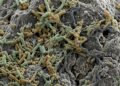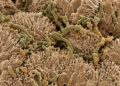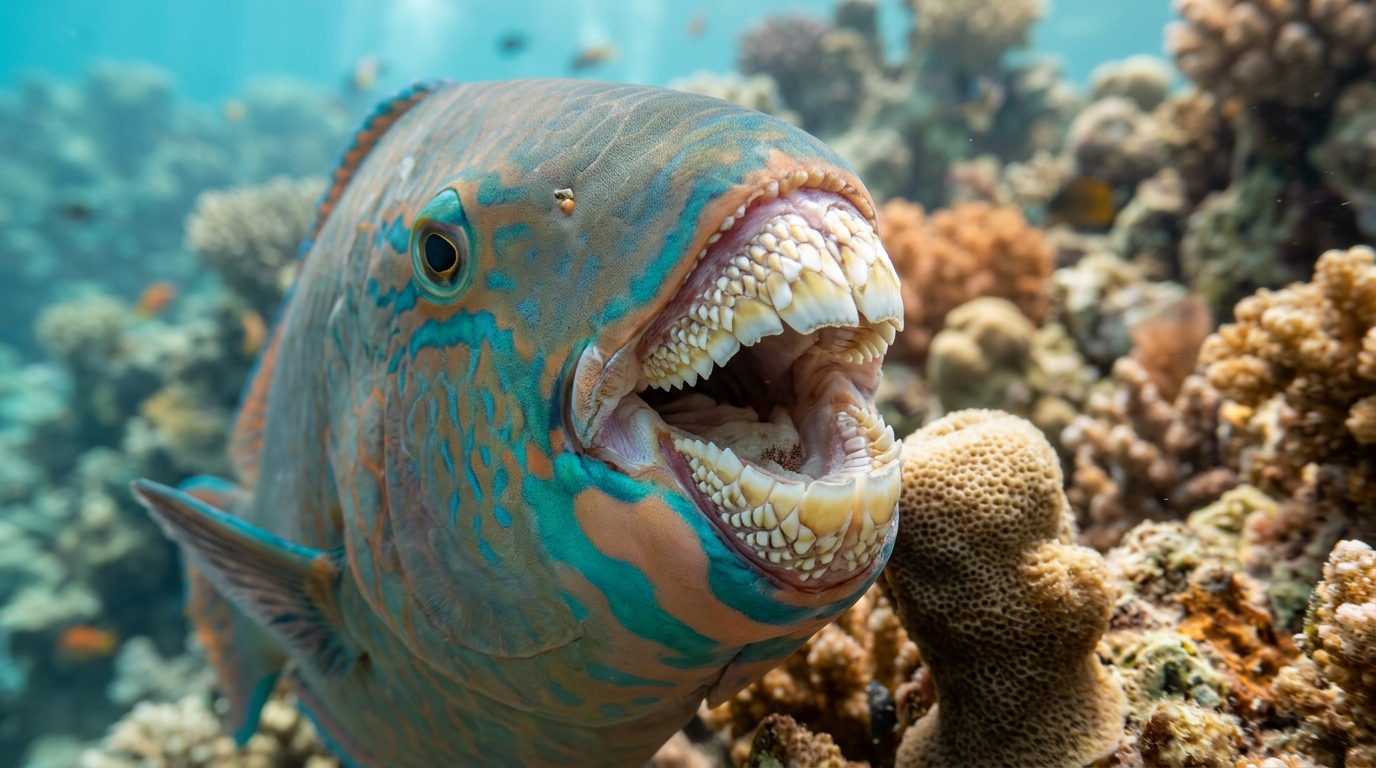
Fish teeth are more than simple feeding tools. In the Red Sea, the shape of a fish’s dentition tracks what it eats, and a new study links those visible differences to molecular changes in tooth-associated genes. Using scanning electron microscopy and comparative genomics, researchers examined tooth ultrastructure across six representative fish families and analyzed 130 tooth-associated genes across 25 teleost genomes representing herbivorous and carnivorous lineages.
The morphological survey revealed distinct dentition patterns between trophic groups. Herbivorous families, Scaridae and Siganidae, displayed incisiform, villiform, and molariform teeth suited to scraping and processing plant matter. Carnivorous families, including Sphyraenidae, Holocentridae, Serranidae, Lethrinidae, and Lutjanidae, showed sharp conical and canine-like dentition adapted for capturing prey. These patterns reflect ecological niches and dietary specialization within the Red Sea ecosystem, highlighting adaptive evolutionary responses to different feeding strategies.
The genomic side of the study asked whether these anatomical differences are mirrored in the evolution of genes involved in making teeth. Phylogenetic analyses of the 25 genomes recovered well-supported family-level clades and suggested independent origins of herbivory, consistent with convergent evolution. In other words, plant-eating appears to have arisen separately in different lineages rather than being inherited from a single common herbivorous ancestor.
Selection analyses detected widespread episodic positive selection across the tooth-associated genes, with 70 genes remaining significant after statistical correction. Branch-level analyses further identified reciprocal selection patterns between herbivorous and carnivorous lineages, meaning the two trophic groups show evidence of selection acting on different branches of the gene trees in opposing directions.
At the site level, the analyses detected adaptive codons that overlap predicted functional regions in two genes, lrp5 and pam. The low-density lipoprotein receptor-related protein 5 gene, lrp5, is known to participate in bone and skeletal biology, while pam encodes peptidylglycine alpha-amidating monooxygenase, an enzyme involved in processing peptide hormones. The study reports that the adaptive codons found in these genes coincide with predicted functional regions, suggesting that selection may have acted on parts of the proteins with biological activity.
Comparative tests between the trophic groups revealed contrasting selection pressures. Genes related to odontogenesis, the process of tooth formation, and skeletal development showed intensified selection in herbivores. Genes associated with growth factor signaling and neural processes were intensified in carnivores. This split suggests that the two dietary strategies have shaped different subsets of the dental genetic toolkit, potentially reflecting the different mechanical demands of grinding algae versus seizing mobile prey.
Together, the findings highlight the interplay between dietary ecology, tooth morphology, and molecular evolution in teleost fishes. The combination of ultrastructural imaging and genome-wide selection scans provides a framework for connecting form, function, and genes in a species-rich marine ecosystem where herbivorous and carnivorous fishes coexist.
The authors note that functional validation will be required to confirm these genomic predictions. The selection signals and adaptive codons reported here are computational inferences from comparative sequence analysis, and experimental work will be needed to establish whether the identified genes and codons directly influence tooth development or feeding performance in these fishes.
The study was published in the journal Frontiers in Zoology as open access research, with the accepted manuscript shared early to provide faster access to peer-reviewed work. It is citable and carries a permanent DOI, with a final Version of Record to follow. For now, the Red Sea’s grazing parrotfish relatives and its sharp-toothed hunters offer a paired case study in how diet can leave marks both on the teeth an animal grows and on the genes that build them.
Subject of Research: Tooth morphology and tooth-associated gene evolution in herbivorous and carnivorous Red Sea fishes
Article Title: Teeth morphology in Red Sea fishes and comparative evolution of tooth-associated genes in herbivorous and carnivorous
Article References: El-Nahass, E. E., Nagy, M., & Khalifa, A. E. (2026). Teeth morphology in Red Sea fishes and comparative evolution of tooth-associated genes in herbivorous and carnivorous. Frontiers in Zoology. https://doi.org/10.1186/s12983-026-00635-0
Image Credits: AI Generated
DOI: 10.1186/s12983-026-00635-0
Keywords: Red Sea, fish dentition, tooth morphology, herbivory, carnivory, convergent evolution, positive selection, teleost genomes, lrp5, pam, odontogenesis, scanning electron microscopy
News Source: Gavin Prescott. (November 5, 2026). Red Sea fish teeth reveal convergent evolution and selection on tooth genes. Scienmag.