Published in the journal Discover Bacteria in April 2025, the study details the isolation of this microorganism from abattoir wastewater and the optimization of conditions required to maximize pigment yield. The team, led by Ifeoluwa Victoria Daramola and Kehinde Olusayo Awojobi, characterized the pigment using advanced spectral analysis and evaluated its stability when applied to cotton and polyester fabrics. The findings suggest that microbial pigments derived from waste streams offer a cost-effective and eco-friendly alternative to synthetic colorants in the textile industry.
The study began with the collection of wastewater samples from a cattle abattoir in Ile-Ife, Nigeria. The researchers spread-plated the samples on nutrient agar and incubated them at 37 degrees Celsius for 24 hours to isolate red-pigmented colonies. Molecular characterization using 16S rRNA gene sequencing and BLASTN analysis confirmed the identity of the isolate as Deinococcus proteolyticus, showing a 99.16% similarity to the accession number NC_015161.1. This bacterium is part of the genus Deinococcus, which is known for its remarkable resistance to stressors such as radiation, desiccation, and extreme temperatures, as well as its efficient DNA repair mechanisms.
To determine the most efficient method for producing the red pigment, the researchers optimized several cultural parameters, including incubation period, agitation, inoculum volume, pH, and temperature. The optical density of the pigment was measured at a wavelength of 590 nm. The results indicated that the highest pigment production occurred after 60 hours of incubation, reaching an absorbance of 2.30. Agitation also played a significant role in yield; cultures placed in a rotary shaker at 120 rpm produced an absorbance of 1.551, significantly higher than the 0.657 observed under static conditions.
The optimal inoculum size was found to be 1% standardized inoculum, which yielded an absorbance of 1.551. Increasing the inoculum volume beyond this point, specifically to 1.5%, resulted in a decline in pigment production, likely due to the rapid transition of the bacteria into the stationary phase. This phase is characterized by nutrient limitation and the accumulation of toxic by-products. The pH of the culture medium was also critical, with the highest pigmentation observed at a neutral pH of 7, where the absorbance reached 1.347. No observable growth or pigment production was recorded at acidic pH levels between 3 and 6, or alkaline levels between 9 and 11, indicating that the metabolic activities of Deinococcus proteolyticus are highly sensitive to environmental acidity and alkalinity.
Temperature further influenced the production of the red pigment, with the optimum recorded at 25 degrees Celsius. Pigment production was observed across a range of temperatures from 25 to 45 degrees Celsius, but the yield was highest at the lower end of this spectrum. This finding aligns with previous reports that carotenoid synthesis is often activated transcriptionally under lower temperature conditions. The combination of these optimal parameters—1% standardized inoculum, pH 7, 25 degrees Celsius, and 60 hours of incubation at 120 rpm—provided the most robust conditions for bulk pigment production from the bacterial isolate.
Following bulk production, the researchers extracted the pigment using various organic solvents, including methanol, ethanol, acetone, and dimethyl sulfoxide. Ethanol was identified as the most efficient solvent, as it extracted the red pigment without altering its original color and allowed the extract to diffuse easily into agar media. In contrast, acetone and methanol showed limited extraction efficiency, while dimethyl sulfoxide produced a deeper shade but did not diffuse efficiently. The ethanolic extract was then subjected to spectral characterization to identify its chemical composition and functional groups.
UV-visible spectrophotometry revealed surface plasmon resonance peaks at 261 and 481 nm, suggesting that the pigment is associated with the carotenoid group, which typically absorbs light within the 400 to 500 nm range. Fourier Transform Infrared (FTIR) analysis indicated the presence of several functional groups, including alkyne C-H bend at 618.7 cm−1, skeletal C-C vibrations at 950.5 cm−1, and H-bonded OH stretch at 3347.1 cm−1. Gas Chromatography-Mass Spectrometry (GC-MS) detected 15 distinct compounds within the extract. The most abundant components were n-Hexadecanoic acid (19.27%), 9,12,15-Octadecatrien-1-ol (12.40%), Phytol (10.55%), and 9,12-Octadecadienoic acid ethyl ester (10.34%).
The researchers also tested the antibacterial activity of the extracted pigment using the agar-well diffusion method against ten bacterial isolates, including both Gram-positive and Gram-negative species. The results showed no antibacterial activity against any of the test cultures. This finding is consistent with previous studies that have reported limited or no antimicrobial effects from certain microbial pigments. The authors noted that some antimicrobial activities reported in other studies might be attributable to the solvents used for extraction rather than the pigments themselves, as control tests with solvents alone sometimes showed activity.
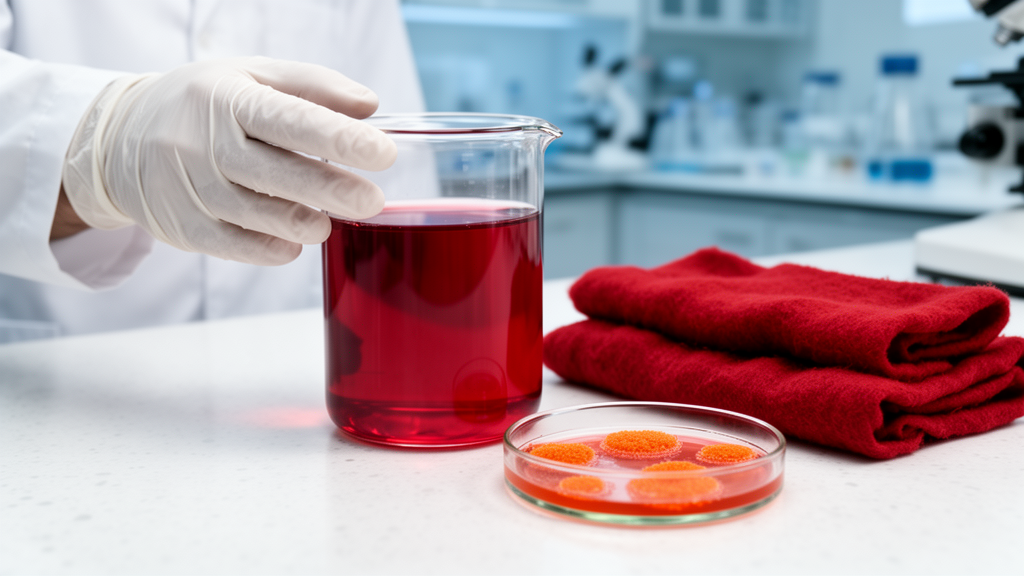
Despite the lack of antibacterial properties, the pigment demonstrated significant potential as a natural dye for fabrics. Cotton and polyester samples were soaked in the ethanolic extract for 48 hours and then treated with acidic mordant (0.1 M HCl), alkaline mordant (0.1 M NaOH), and soap solution. The fabrics treated with the alkaline mordant retained their color effectively, while those treated with the acidic mordant showed a slight change to a light-red shade. In contrast, 90% of the pigment was washed off when the fabrics were treated with soap solution. This indicates that the pigment has good color fastness in alkaline conditions, which is a crucial factor for industrial textile applications.
The study highlights the importance of optimizing culture conditions for the bioproduction of microbial pigments. By identifying the specific parameters that maximize yield, the researchers provided a framework for the scalable production of natural dyes from waste-derived bacteria. The use of abattoir wastewater as a source for pigment-producing bacteria also underscores the potential for circular economy approaches in industrial biotechnology, where waste streams are repurposed to generate valuable bio-products.
The findings of this study contribute to the growing body of evidence supporting the use of microbial pigments as sustainable alternatives to synthetic dyes. The textile industry faces increasing pressure to adopt environmentally friendly practices, and natural pigments offer a viable solution that reduces reliance on petrochemical-based colorants. The ability to produce high-quality red pigment from Deinococcus proteolyticus under controlled laboratory conditions suggests that this approach could be adapted for larger-scale industrial applications.
In conclusion, the red pigment produced by Deinococcus proteolyticus isolated from abattoir wastewater shows promising characteristics for use as a natural dye in the textile industry. The optimization of production conditions and the spectral characterization of the pigment provide a solid foundation for future studies aimed at developing sustainable industrial applications. The study demonstrates that microbial resources can be harnessed to produce eco-friendly materials that meet the demands of the modern textile market.
Subject of Research: Bioproduction, optimisation, and spectral characterisation of red pigment from Deinococcus proteolyticus as a sustainable natural pigment for industrial applications
Article Title: Bioproduction, optimisation, and spectral characterisation of red pigment from Deinococcus proteolyticus as a sustainable natural pigment for industrial applications
Article References: Daramola, I. V., & Awojobi, K. O. (2025). Bioproduction, optimisation, and spectral characterisation of red pigment from Deinococcus proteolyticus as a sustainable natural pigment for industrial applications. Discover Bacteria, 2(1), Article 9. https://doi.org/10.1007/s44351-025-00020-y
Image Credits: AI Generated
DOI: 10.1007/s44351-025-00020-y
Keywords: Bioproduction, optimisation, spectral, characterisation, pigment, Deinococcus, proteolyticus, sustainable, natural, industrial, applications
News Source: Drew Townsend. (November 12, 2026). Red pigment from Deinococcus proteolyticus shows dye potential. Scienmag.