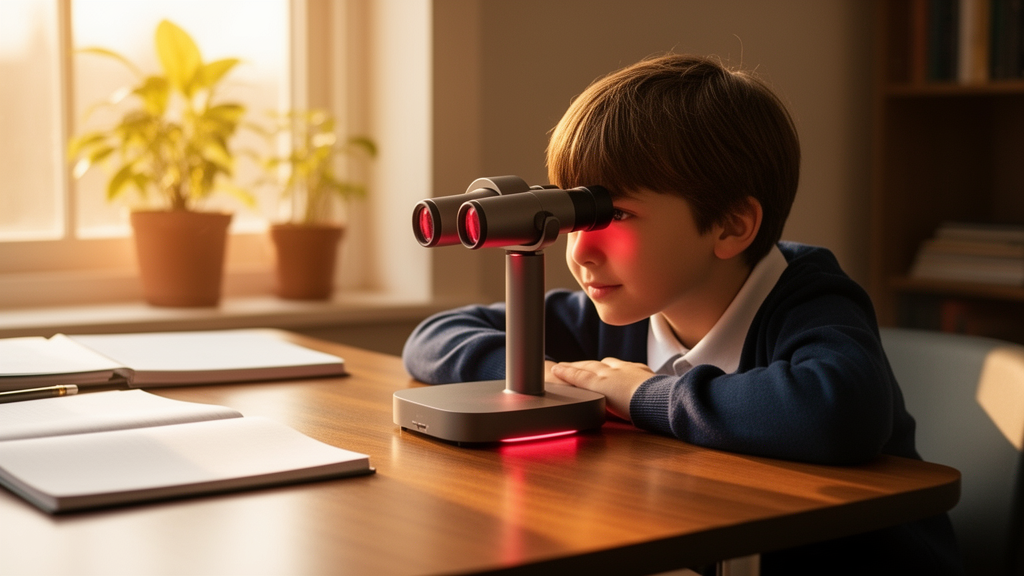
Repeated low-level red-light therapy combined with single-vision spectacles effectively controlled myopia progression in school-age children over a six-month period, according to a clinical assessment published in BMC Ophthalmology. The retrospective, non-randomized investigation evaluated changes in ocular dimensions and refractive indicators among children aged 7 to 12 years receiving the intervention, alongside comparative spectacle modalities, reporting that the red-light protocol achieved treatment effects without any observed ocular adverse events.
The study cohort comprised a total of 101 pediatric patients diagnosed with myopia, divided into three specific clinical management groups. The primary treatment group received repeated low-level red-light therapy paired with single-vision spectacles, abbreviated as RLRL + SVS, and included 36 children. For comparative assessment, a second group of 38 participants was treated with highly aspherical lenslet target spectacles, known as HALT, while a third control cohort consisting of 27 children wore conventional single-vision spectacles alone.
To monitor ocular changes and comparative efficacy, the research team instituted distinct measurement schedules across the intervention arms. In the RLRL + SVS cohort, axial length was documented at baseline prior to treatment and subsequently reassessed at post-treatment intervals of one month, three months, and six months. Spherical equivalent refraction and subfoveal choroidal thickness were also evaluated in this red-light group before treatment and at the six-month mark. For both the HALT and single-vision spectacles groups, axial length measurements were recorded at baseline and at the concluding six-month evaluation.
Within the group receiving repeated red-light therapy with single-vision spectacles, axial length exhibited short-term reductions before stabilizing. Compared to pre-treatment baseline levels, axial length significantly decreased at one month and three months post-treatment, with statistical analyses indicating a value of P < 0.001 for both earlier intervals. By six months post-treatment, however, the observed axial length measurements in the RLRL + SVS group no longer differed significantly from baseline, yielding a value of P = 0.230.
The investigators also identified significant shifts in secondary ocular parameters within the RLRL + SVS group at the conclusion of the six-month study window. The participants’ spherical equivalent refraction changed from a baseline average of −2.40 ± 1.02 diopters to −2.27 ± 1.05 diopters at six months. Over the same timeframe, subfoveal choroidal thickness demonstrated a marked increase, expanding from 234.87 ± 40.57 micrometers prior to treatment to 253.86 ± 45.34 micrometers at six months, with both parameter modifications confirmed to be statistically significant.
Comparative analyses across all three cohorts demonstrated substantial divergence in axial elongation control over the six-month observation span. Mean axial length changes from baseline to six months were −0.03 ± 0.11 millimeters in the RLRL + SVS group, 0.02 ± 0.14 millimeters in the HALT group, and 0.22 ± 0.12 millimeters in the group wearing single-vision spectacles alone, representing a statistically significant overall variation (P < 0.001). Pairwise statistical comparisons revealed that axial elongation control in both the RLRL + SVS and HALT cohorts differed significantly from the single-vision spectacles group (P < 0.001), while no statistically significant difference was detected between RLRL + SVS and HALT (P = 0.270). The authors highlighted the non-randomized, retrospective nature of the study while noting that no ocular adverse events occurred during the trial.
Subject of Research: Repeated low-level red-light therapy for myopia progression in school-age children
Article Title: Impact of repeated low-level red-light therapy on myopia progression in the school-age population: a clinical assessment
Article References: Tang, F., Liang, Y., Chen, D., Du, Q., & Chen, J. (2026). Impact of repeated low-level red-light therapy on myopia progression in the school-age population: a clinical assessment. BMC Ophthalmology. https://doi.org/10.1186/s12886-026-05496-z
Image Credits: AI Generated
DOI: 10.1186/s12886-026-05496-z
Keywords: myopia, red-light therapy, axial length, ophthalmology, children, refractive error, choroidal thickness, spectacles, Impact, repeated, low-level, red-light
News Source: Ophelia Keating. (November 10, 2026). Red-Light Therapy Controls School-Age Myopia Progression in Six-Month Retrospective Study. Scienmag.