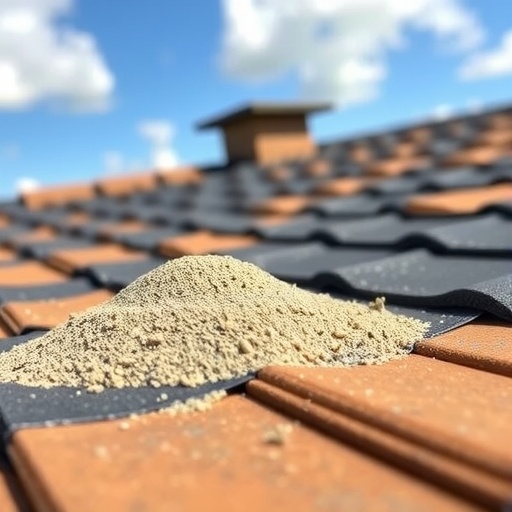
Every year, mountains of old roofing membranes — the tough, waterproof sheets stripped from homes and commercial buildings during renovations and demolitions — end up in landfills, where they persist for decades as part of the growing construction and demolition waste crisis. Now, a team of researchers at a Canadian university has demonstrated that this cumbersome waste stream can be given a second life in an unexpected place: the asphalt that paves our roads. In a study published in Case Studies in Construction Materials, Elaheh Nasiriamiri and Pejoohan Tavassoti show that a polymer powder recovered from recycled roofing membranes, dominated by polyvinyl chloride (PVC), can be blended into asphalt binders to meaningfully improve fatigue resistance, low-temperature flexibility, and workability — provided the dosage is carefully optimized. The work is one of the first to fully characterize a heterogeneous roofing waste material before using it in pavement, and the first to systematically map its performance trade-offs across the entire temperature range an asphalt binder must endure, from scorching summer heat to brutal winter cold.
The motivation is rooted in one of the most stubborn environmental challenges of our time. Global plastic production has risen dramatically over recent decades, yet only a small fraction of that plastic is ever effectively recycled. The rest is landfilled, incinerated, or broken down into microplastics that contaminate ecosystems and threaten public health. Asphalt pavement has emerged as an attractive destination for waste plastics because plastics and asphalt share hydrocarbon-based structures, allowing many polymers to disperse within the binder and improve mechanical and rheological properties such as rutting resistance, stiffness, and durability. Since the 1990s, researchers have experimented with high-density polyethylene, polypropylene, PET, ethylene-vinyl acetate, and PVC, among others, with generally encouraging results. But the reported gains depend heavily on the polymer type, the waste source, the blending conditions, and the dosage — a dependency that has produced contradictory findings across the literature and, until now, has left certain waste streams, including roofing membranes, largely unexplored.
Roofing membranes are not the clean, uniform PVC of pipes or cables that previous studies typically examined. They are complex multi-polymer systems, and that heterogeneity matters when the material is destined for a pavement. To understand exactly what they were working with, the researchers deployed Laser Direct Infrared (LDIR) analysis, a cutting-edge microplastics identification technique that has rarely been applied to asphalt modification research. Roughly one milligram of the sifted roofing powder — ground to pass a No. 50 sieve — was dispersed in isopropanol, deposited on a slide, and scanned. Of 330 particles detected, 219 met the quality threshold for analysis. The verdict: PVC was by far the dominant constituent, accounting for about 67 percent of the identified mass, followed by rubber-based particles at roughly 18 percent, cellulose fibers, PET, polyamide, carbon black, and trace amounts of other polymers. In other words, the material is best described as a PVC-rich polymer blend rather than pure PVC — a fact that would shape everything that followed.
Before any blending, the team also characterized the powder’s thermal behavior. Thermogravimetric analysis under nitrogen revealed that the material begins to degrade at approximately 270 °C — a critical number, because PVC processing at excessive temperatures can release chlorine-containing compounds such as hydrogen chloride and dioxins. Differential scanning calorimetry pinpointed a melting transition near 170 °C. This gave the researchers a safe window: hot enough to melt and disperse the PVC, but comfortably below the degradation threshold. They then incorporated the powder at 2, 4, and 6 percent by weight of binder into two asphalt formulations — a conventional unmodified PG 58-28 binder widely used in Ontario and a polymer-modified PG 64-28 J binder already containing styrene-butadiene-styrene (SBS), the elastomeric workhorse of the asphalt industry. Mixing took place at 170 °C with a high-shear mixer spinning at 5000 rpm for 30 minutes, after which all samples were subjected to standard short-term and long-term laboratory aging to simulate years of field service.
The first surprise came from the chemistry. Attenuated total reflectance Fourier transform infrared spectroscopy revealed characteristic PVC signatures in the modified binders — carbon-hydrogen-chlorine stretching bands between 1282 and 1263 cm⁻¹ and carbon-chlorine stretching between 745 and 600 cm⁻¹ — along with a carbonyl peak near 1730 cm⁻¹ associated with plasticizers embedded in the roofing material. The persistence of these peaks points to genuine molecular-level interactions between the polymer and the asphalt matrix, likely involving hydrogen bonding and dipole interactions that can strengthen binder cohesion. Storage stability testing, in which modified binders are held at 163 °C for 48 hours and then examined for phase separation, delivered a clearer message about dosage. Binders containing up to 4 percent roofing powder passed the accepted stability criterion, with top-to-bottom complex modulus ratios between 0.8 and 1.2 and PG grade differences of less than half a degree. The 6 percent blend, however, failed outright, showing a modulus ratio of 0.77 and a 3.05 °C difference — unambiguous evidence of phase separation at high dosage.
Viscosity measurements told an equally nuanced story. At 135 °C, the temperature relevant to plant mixing, adding roofing powder actually lowered the viscosity of the SBS-modified binder slightly, from 872 to as low as 785 mPa·s at the 6 percent dose — a shift the authors attribute to altered phase dispersion or reduced molecular entanglement under shear. At 165 °C the differences grew more pronounced, with the 6 percent hybrid registering just 166 mPa·s, brushing the lower limit of the recommended mixing range. Lower viscosity generally means easier pumping, mixing, and compaction, which translates into real energy savings and improved workability at the hot-mix plant. Yet the same dose that eased production headaches would later prove problematic at service temperatures, underscoring the central lesson of the study: a modifier that helps at one stage of a pavement’s life can hurt at another.
That tension was laid bare in the high-temperature rutting tests. Dynamic shear rheometer measurements of the rutting parameter G*/sin(δ) showed that PVC-only modification actually reduced high-temperature performance, with 4 and 6 percent dosages falling below the Superpave minimum threshold at lower temperatures. The Multiple Stress Creep Recovery test, conducted on aged binders at 64 °C, confirmed the pattern: PVC addition produced a dose-dependent increase in non-recoverable creep compliance, meaning the binders accumulated more permanent deformation under traffic-like loading, while percent recovery — the elastic rebound that resists ruts — declined sharply at higher doses. The hybrids told a different story. Blends containing 2 and 4 percent roofing powder in the SBS binder performed close to the SBS-modified control, with SBS apparently cushioning the softening effect of the plastomeric PVC. But the 6 percent hybrid also deteriorated, indicating that excessive PVC can disrupt the elastic SBS polymer network itself. The conclusion is clear: PVC is not a rutting fighter on its own, and in hybrids, more is emphatically not better.
Where PVC truly shone was in fatigue and cold-temperature performance. In the Linear Amplitude Sweep test, which predicts fatigue life under repeated intermediate-temperature loading, PVC delivered dose-dependent improvements in both binder families. In the unmodified PG 58-28 group, the 6 percent blend reached approximately 770,000 predicted cycles at 2.5 percent strain — nearly double the unmodified binder’s 400,000. In the SBS-containing group, the 6 percent hybrid exceeded 35,000 cycles compared with 16,000 for the SBS binder alone. Notably, lower complex modulus under small-strain conditions did not translate into worse fatigue performance; instead, the softer, more flexible binder tolerated strain better and resisted damage accumulation, a finding the researchers link to changes in viscoelastic damage evolution and stress relaxation rather than stiffness alone.
The low-temperature results were arguably the most striking. Bending Beam Rheometer testing at −12, −18, and −24 °C showed that PVC progressively reduced creep stiffness and improved the m-value, a measure of stress relaxation, in both binder families. At −24 °C, the 6 percent SBS/PVC hybrid was the only binder of all tested to satisfy the Superpave stiffness criterion of less than 300 MPa, while the 4 and 6 percent hybrids also met the m-value requirement — a combination no other formulation achieved. The ΔTc parameter, a sensitive indicator of thermal cracking risk, improved steadily with PVC content, and the 6 percent hybrid recorded the best value of any binder tested. Master curves constructed from temperature-frequency sweeps using the Christensen–Anderson–Marasteanu model reinforced the picture: the 4 percent hybrid showed the highest stiffness when unaged, the 2 percent hybrid gained the most after oxidative aging, and the SBS/PVC blends consistently occupied the most favorable stiffness-elasticity balance across the viscoelastic spectrum.
Regression and analysis of variance across the rutting, fatigue, and low-temperature data converged on a clear optimum. The 2 and 4 percent dosages emerged as the sweet spot for SBS/PVC hybrid systems, balancing storage stability, workability, elastic recovery, fatigue durability, and thermal cracking resistance, while 6 percent consistently pushed the binders past workable limits. The broader implications extend well beyond one laboratory. With plastic waste accumulating faster than any recycling system can absorb, and with pavement agencies under pressure to extend service lives in the face of heavier traffic and harsher climates, the ability to divert construction plastic waste into high-performance infrastructure represents a rare double win. The study also sets a methodological precedent: by pairing advanced compositional characterization like LDIR with a balanced, whole-temperature performance evaluation, it offers a template for responsibly vetting any heterogeneous recycled polymer before it touches a road — because in asphalt modification, what is in the powder matters almost as much as how much of it you add.
Subject of Research: Valorization of recycled roofing membrane polymer powder, characterized as PVC-rich through Laser Direct Infrared analysis, as a modifier in unmodified and SBS-modified asphalt binders through balanced performance-based optimization
Subject of Research: Technology and Engineering
Article Title: Valorization of recycled roofing membrane polymer powder in asphalt binders through balanced performance-based optimization
Article References: Nasiriamiri, E., & Tavassoti, P. (2026). Valorization of recycled roofing membrane polymer powder in asphalt binders through balanced performance-based optimization. Case Studies in Construction Materials, 25, Article e06476. https://doi.org/10.1016/j.cscm.2026.e06476
Image Credits: AI Generated
DOI: 10.1016/j.cscm.2026.e06476
Keywords: recycled PVC, waste roofing membrane, asphalt binder, SBS hybrid modification, LDIR characterization, storage stability, rutting resistance, fatigue life, low-temperature cracking, performance-based optimization
Cite Scienmag News
APA MLA Chicago
Denise Maddox. (September 10, 2026). Recycled roofing membrane powder optimizes asphalt binders for balanced performance. Scienmag. https://scienmag.com/recycled-roofing-membrane-powder-optimizes-asphalt-binders-for-balanced-performance/
Denise Maddox. “Recycled roofing membrane powder optimizes asphalt binders for balanced performance.” Scienmag, 10 September 2026, https://scienmag.com/recycled-roofing-membrane-powder-optimizes-asphalt-binders-for-balanced-performance/. Accessed 10 September 2026.
Denise Maddox. “Recycled roofing membrane powder optimizes asphalt binders for balanced performance.” Scienmag. September 10, 2026. https://scienmag.com/recycled-roofing-membrane-powder-optimizes-asphalt-binders-for-balanced-performance/
Copy citation Download RIS
Tags: asphalt binder modificationasphalt binder optimizationasphalt performance enhancementasphalt performance optimizationcold weather flexibility in asphaltconstruction and demolition waste recyclingconstruction demolition waste recyclingenvironmental impact of roofing wastefatigue resistance in asphalt pavementsfatigue resistance in road materialsinnovative uses of recycled plasticslow-temperature flexibility of asphaltpavement workability improvementsplastic waste repurposing in infrastructurepolymer additives for asphaltPVC recycling in pavementPVC waste recycling in pavementRecycled roofing membrane powdersustainable construction materialssustainable construction waste managementtemperature range performance of asphalt binderstemperature resilience in road materials