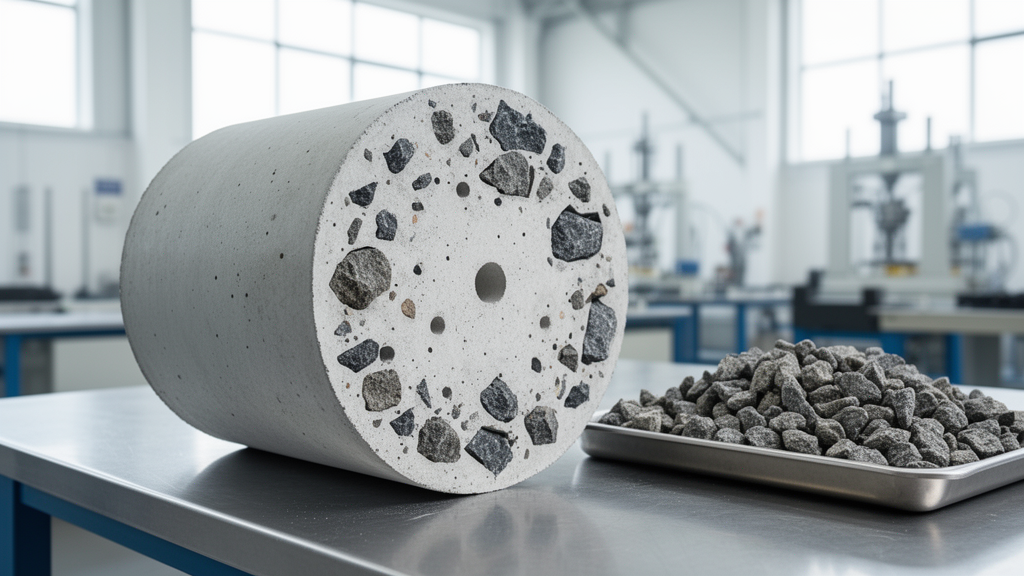
A preliminary study has demonstrated that minimally processed recycled concrete aggregate (RCA) offers a more favorable balance between reduced density and retained compressive strength than waste plastic or styrofoam when used as partial or complete replacements for natural aggregate in concrete. Published in Discover Civil Engineering, this preliminary experimental investigation evaluates three distinct waste-derived materials under comparable conditions, highlighting the potential of recycled construction debris to serve as a viable alternative to virgin natural aggregates in non-structural applications. The study addresses the growing need for sustainable building materials that can reduce the environmental impact of the construction industry while maintaining acceptable mechanical performance.
The primary objective of the research was to experimentally evaluate and compare the feasibility of RCA, recycled plastic, and styrofoam as partial or complete replacements for natural aggregate. The team prepared five concrete mixtures: a control mix using conventional crushed stone and sand, a plastic-modified mix, a styrofoam-modified mix, a 50% RCA mix, and a 100% RCA mix. In the plastic and styrofoam mixtures, both sand and crushed stone were partially replaced through equal-volume substitution corresponding to 20% of the original aggregate masses. For the RCA mixtures, the replacement levels were 50% and 100% of both sand and crushed stone. The effective water-to-cement ratio was maintained at 0.48 for all mixtures, and no supplementary cementitious materials or chemical admixtures were introduced to preserve the practical applicability of the findings for field uses.
The materials used in the study included potable water, silica sand with a specific gravity of 2.6, Ordinary Portland Cement Type I-II, and crushed stone with a nominal maximum size of 19 mm. The waste materials consisted of polyethylene terephthalate (PET) plastic, expanded polystyrene (styrofoam), and recycled concrete aggregate. The plastic was sourced from discarded water bottles, cleaned, air-dried, and mechanically shredded into fragments measuring approximately 25 mm by 6.25 mm by 0.003 mm. Styrofoam was obtained from electronic device packaging, wiped clean, and manually cut into segments of approximately 12 mm by 12 mm by 12 mm. The RCA was donated by a local heavy civil construction contractor and consisted of standard demolition debris from a building with a compressive strength of 28 MPa, screened to remove particles above 25 mm and below 150 micrometers.
Concrete cylinders with dimensions of 101 mm by 202 mm were cast for each mixture, with three specimens per mix to assess variability. The fresh concrete mixtures were prepared within 30 minutes, including slump testing, followed by cylinder casting within the subsequent 10 minutes. The cylinders were manually compacted and stored in a cabinet at a room temperature of 80.7 degrees Fahrenheit plus or minus 2.9 degrees and a relative humidity of 58.7% plus or minus 7% for 28 days. Due to laboratory facility limitations, standard curing conditions specified by ASTM C192 could not be maintained, but identical exposure was maintained for all mixtures to ensure consistency in comparative evaluation. This non-standard curing condition represents a limitation of the study but may provide insight into concrete performance under less-controlled summer conditions encountered in field applications.
After 28 days of curing, the compressive strength and dry density of the specimens were measured. The control mixture exhibited the highest compressive strength at 35.11 plus or minus 0.61 MPa and the highest density at 2374.42 plus or minus 42.77 kg/m³. The incorporation of plastic reduced the compressive strength to 15.50 plus or minus 0.38 MPa and the density to 2261.93 plus or minus 77.13 kg/m³. The styrofoam-modified mixture showed the most significant reductions, with a compressive strength of 12.01 plus or minus 1.30 MPa and a density of 1969.87 plus or minus 31.83 kg/m³. These results indicate a clear strength-density trade-off, where the substantial reduction in self-weight was accompanied by a marked decrease in compressive strength.
The recycled concrete aggregate mixtures demonstrated different performance characteristics. The 50% RCA mixture achieved a compressive strength of 23.72 plus or minus 1.62 MPa and a density of 2205.66 plus or minus 15.33 kg/m³. The 100% RCA mixture achieved a compressive strength of 19.21 plus or minus 0.79 MPa and a density of 2065.46 plus or minus 9.02 kg/m³. Compared to the control, the 50% RCA mixture retained approximately 68% of the control strength while reducing density by about 7.1%. The 100% RCA mixture showed a 45% reduction in compressive strength but a 13% reduction in density. These findings suggest that RCA provides a more favorable strength-density balance than plastic and styrofoam, particularly at the 50% replacement level.
The study also assessed the workability of the fresh concrete using the slump test. The measured slump values for the control, plastic-added, styrofoam-added, 50% RCA, and 100% RCA concrete mixes were 82.55 mm, 71.12 mm, 60.33 mm, 88.9 mm, and 66.04 mm, respectively. All mixes satisfied the target slump range of 50 to 100 mm, indicating acceptable workability and consistency for practical concrete placement and compaction. The plastic-modified mixture approached the International Building Code Section 1904.2 compressive-strength range for non-structural applications, which is 17.23 to 24.13 MPa, while both RCA mixtures fell within this range.
Statistical analysis of the test results revealed that the observed differences in compressive strength between the control concrete and all modified concrete mixtures were statistically significant at a significance level of alpha equals 0.05. The calculated t-statistics substantially exceeded the corresponding critical two-tailed value of 4.30, with associated two-tailed p-values ranging from 0.0008 to 0.0030. These findings demonstrate that the changes in concrete properties resulting from the incorporation of plastic, styrofoam, and RCA were unlikely to have arisen from random experimental variation alone. The coefficient of variation values indicated generally acceptable experimental consistency, with compressive strength coefficients of variation remaining below 11% and density coefficients of variation below 4%.
The researchers noted that the inclusion of waste-derived components can compromise the structural integrity and long-term durability of concrete, but the use of recycled materials fosters a circular economy and diminishes reliance on natural resources. The higher porosity of RCA, resulting from micro-cracks and residual cementitious material on the surface of the particles, contributes to the elevated water absorption capacity and reduction in overall density. The hydrophobic nature and relatively smooth surface of plastic can weaken adhesion with the cementitious matrix, particularly at higher replacement levels. Similarly, the cellular structure of styrofoam can significantly influence concrete strength and physical properties, leading to increased brittleness in the concrete matrix. These mechanisms were not experimentally verified in the present study and are therefore considered possible literature-supported explanations.
Preliminary cost and sustainability considerations were also evaluated. Based on an assumed natural aggregate price of $0.29 per kg, a concrete unit weight of 2400 kg/m³, and an aggregate content of approximately 80% by mass, the baseline aggregate cost was estimated at $556.80 per m³. Under the assumed material-cost scenario, the estimated aggregate costs of the 50% and 100% RCA mixtures were 32.8% and 65.5% lower than that of the conventional mixture, respectively. These estimates are preliminary and highly dependent on local material sourcing, collection, processing, and transportation conditions. The potential environmental benefits associated with waste utilization and reduced natural aggregate consumption were considered qualitatively rather than through a production-stage life-cycle assessment, which was outside the scope of this preliminary study.
The study has several limitations that should be considered when interpreting the results. The sample size was limited to three specimens per mixture, which may not provide sufficient statistical evidence to establish broad reproducibility. The RCA was obtained from a single source, so the findings may not represent RCA with different parent-concrete characteristics, compositions, or physical properties. The mechanical evaluation primarily focused on 28-day compressive strength, and systematic durability testing and performance beyond 28 days were outside the scope of the study. Microstructural analyses were not conducted, so interpretations regarding porosity, the interfacial transition zone, and aggregate-matrix bonding are based on previously reported mechanisms rather than direct experimental evidence.
Future research should optimize replacement levels and investigate long-term performance, with supplementary cementitious materials and nanomaterials as potential strategies to mitigate strength loss. The direct incorporation of minimally processed RCA, plastic, and styrofoam demonstrates their potential as alternative aggregate materials, reducing reliance on natural aggregates while providing a practical pathway for waste utilization. The findings provide a preliminary basis for identifying potential applications in secondary and non-structural concrete, while larger sample sizes and more comprehensive mechanical and durability evaluations are recommended for future validation.
Subject of Research: Preliminary experimental investigation of concrete incorporating minimally processed recycled concrete aggregate, waste plastic, and styrofoam
Article Title: Preliminary experimental investigation of concrete incorporating minimally processed recycled concrete aggregate, waste plastic, and styrofoam
Article References: Iffat, S. (2026). Preliminary experimental investigation of concrete incorporating minimally processed recycled concrete aggregate, waste plastic, and styrofoam. Discover Civil Engineering, 3(1), Article 244. https://doi.org/10.1007/s44290-026-00642-4
Image Credits: AI Generated
DOI: 10.1007/s44290-026-00642-4
Keywords: Preliminary, experimental, investigation, concrete, incorporating, minimally, processed, recycled, aggregate, waste, plastic, styrofoam
News Source: Denise Maddox. (November 12, 2026). Recycled Concrete Aggregate Outperforms Plastic and Styrofoam in Lightweight Mixes. Scienmag.