• HOME
  • NEWS
  • EXPLORE
    • CAREER
      • Companies
      • Jobs
    • EVENTS
    • iGEM
      • News
      • Team
    • PHOTOS
    • VIDEO
    • WIKI
  • BLOG
  • COMMUNITY
    • FACEBOOK
    • INSTAGRAM
    • TWITTER
Wednesday, May 13, 2026
BIOENGINEER.ORG
No Result
View All Result
  • Login
  • HOME
  • NEWS
  • EXPLORE
    • CAREER
      • Companies
      • Jobs
        • Lecturer
        • PhD Studentship
        • Postdoc
        • Research Assistant
    • EVENTS
    • iGEM
      • News
      • Team
    • PHOTOS
    • VIDEO
    • WIKI
  • BLOG
  • COMMUNITY
    • FACEBOOK
    • INSTAGRAM
    • TWITTER
  • HOME
  • NEWS
  • EXPLORE
    • CAREER
      • Companies
      • Jobs
        • Lecturer
        • PhD Studentship
        • Postdoc
        • Research Assistant
    • EVENTS
    • iGEM
      • News
      • Team
    • PHOTOS
    • VIDEO
    • WIKI
  • BLOG
  • COMMUNITY
    • FACEBOOK
    • INSTAGRAM
    • TWITTER
No Result
View All Result
Bioengineer.org
No Result
View All Result
Home NEWS Science News

Recognising fake images using frequency analysis

Bioengineer by Bioengineer
July 16, 2020
in Science News
Reading Time: 3 mins read
0
IMAGE
Share on FacebookShare on TwitterShare on LinkedinShare on RedditShare on Telegram

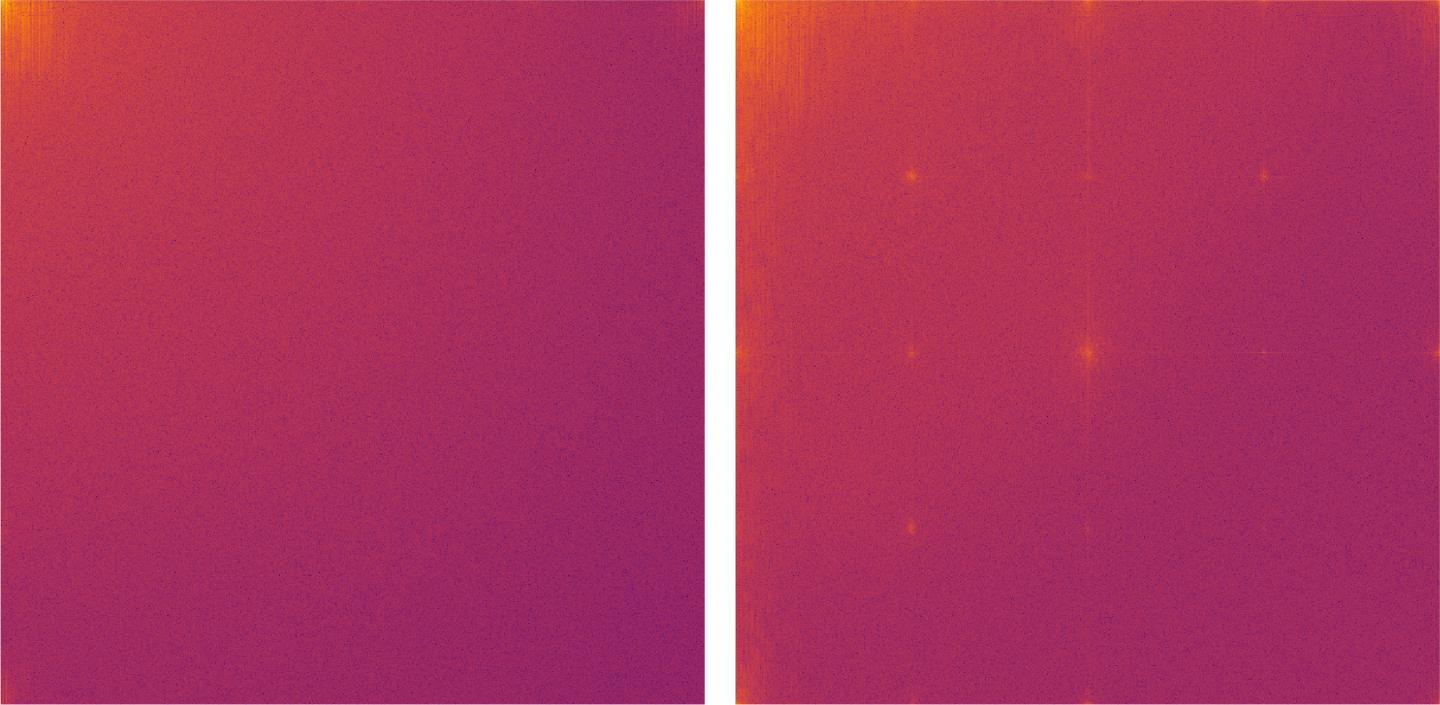
This method exposes fake images created by computer algorithms rather than by humans
IMAGE

Credit: © RUB, Lehrstuhl für Systemsicherheit

They look deceptively real, but they are made by computers: so-called deep-fake images are generated by machine learning algorithms, and humans are pretty much unable to distinguish them from real photos. Researchers at the Horst Görtz Institute for IT Security at Ruhr-Universität Bochum and the Cluster of Excellence “Cyber Security in the Age of Large-Scale Adversaries” (Casa) have developed a new method for efficiently identifying deep-fake images. To this end, they analyse the objects in the frequency domain, an established signal processing technique.

The team presented their work at the International Conference on Machine Learning (ICML) on 15 July 2020, one of the leading conferences in the field of machine learning. Additionally, the researchers make their code freely available online at https://github.com/RUB-SysSec/GANDCTAnalysis, so that other groups can reproduce their results.

Interaction of two algorithms results in new images

Deep-fake images – a portmanteau word from “deep learning” for machine learning and “fake” – are generated with the help of computer models, so-called Generative Adversarial Networks, GANs for short. Two algorithms work together in these networks: the first algorithm creates random images based on certain input data. The second algorithm needs to decide whether the image is a fake or not. If the image is found to be a fake, the second algorithm gives the first algorithm the command to revise the image – until it no longer recognises it as a fake.

In recent years, this technique has helped make deep-fake images more and more authentic. On the website http://www.whichfaceisreal.com, users can check if they’re able to distinguish fakes from original photos. “In the era of fake news, it can be a problem if users don’t have the ability to distinguish computer-generated images from originals,” says Professor Thorsten Holz from the Chair for Systems Security.

For their analysis, the Bochum-based researchers used the data sets that also form the basis of the above-mentioned page “Which face is real”. In this interdisciplinary project, Joel Frank, Thorsten Eisenhofer and Professor Thorsten Holz from the Chair for Systems Security cooperated with Professor Asja Fischer from the Chair of Machine Learning as well as Lea Schönherr and Professor Dorothea Kolossa from the Chair of Digital Signal Processing.

Frequency analysis reveals typical artefacts

To date, deep-fake images have been analysed using complex statistical methods. The Bochum group chose a different approach by converting the images into the frequency domain using the discrete cosine transform. The generated image is thus expressed as the sum of many different cosine functions. Natural images consist mainly of low-frequency functions.

The analysis has shown that images generated by GANs exhibit artefacts in the high-frequency range. For example, a typical grid structure emerges in the frequency representation of fake images. “Our experiments showed that these artefacts do not only occur in GAN generated images. They are a structural problem of all deep learning algorithms,” explains Joel Frank from the Chair for Systems Security. “We assume that the artefacts described in our study will always tell us whether the image is a deep-fake image created by machine learning,” adds Frank. “Frequency analysis is therefore an effective way to automatically recognise computer-generated images.”

###

Media Contact
Joel Frank
[email protected]

Original Source

https://news.rub.de/english/press-releases/2020-07-16-information-technology-recognising-fake-images-using-frequency-analysis

Tags: Robotry/Artificial IntelligenceSystem Security/HackersTechnology/Engineering/Computer Science
Share12Tweet8Share2ShareShareShare2

Related Posts

AI Predicts Hospital Admissions from Emergency Departments

May 13, 2026
Robust Magnetoelectric Backscatter System Boosts Bioelectronic Implants — Technology and Engineering

Robust Magnetoelectric Backscatter System Boosts Bioelectronic Implants

May 13, 2026

Anti-Nogo-A Treatment Alters Spinal Cord Structure Post-Injury

May 13, 2026

Older Adults’ Views on Medication After Hospital Discharge

May 13, 2026
Please login to join discussion

POPULAR NEWS

  • Research Indicates Potential Connection Between Prenatal Medication Exposure and Elevated Autism Risk

    842 shares
    Share 337 Tweet 211
  • New Study Reveals Plants Can Detect the Sound of Rain

    728 shares
    Share 290 Tweet 182
  • Salmonella Haem Blocks Macrophages, Boosts Infection

    62 shares
    Share 25 Tweet 16
  • Breastmilk Balances E. coli and Beneficial Bacteria in Infant Gut Microbiomes

    57 shares
    Share 23 Tweet 14

About

We bring you the latest biotechnology news from best research centers and universities around the world. Check our website.

Follow us

Recent News

AI Predicts Hospital Admissions from Emergency Departments

Robust Magnetoelectric Backscatter System Boosts Bioelectronic Implants

Anti-Nogo-A Treatment Alters Spinal Cord Structure Post-Injury

Subscribe to Blog via Email

Enter your email address to subscribe to this blog and receive notifications of new posts by email.

Join 82 other subscribers
  • Contact Us

Bioengineer.org © Copyright 2023 All Rights Reserved.

Welcome Back!

Login to your account below

Forgotten Password?

Retrieve your password

Please enter your username or email address to reset your password.

Log In
No Result
View All Result
  • Homepages
    • Home Page 1
    • Home Page 2
  • News
  • National
  • Business
  • Health
  • Lifestyle
  • Science

Bioengineer.org © Copyright 2023 All Rights Reserved.