The record-breaking laser intensity over 1023 W/cm2 enables us to explore novel physical phenomena occurring under extreme physical conditions
Credit: Institute for Basic Science
Recently, laser scientists at the Center for Relativistic Laser Science (CoReLS) within the Institute for Basic Science (IBS) in South Korea realized the unprecedented laser intensity of 1023 W/cm2. This has been a milestone that has been pursued for almost two decades by many laser institutes around the world.
An ultrahigh intensity laser is an important research tool in several fields of science, including those which explore novel physical phenomena occurring under extreme physical conditions. Since the demonstration of the 1022 W/cm2 intensity laser by a team at the University of Michigan in 2004, the realization of laser intensity over 1023 W/cm2 has been pursued for nearly 20 years.
In general, achieving such a level of ultra-high laser intensity requires two things: laser with extremely high power output, and focusing that laser to the smallest spot as possible. While continuous-wave lasers are limited to megawatt-scale intensity, far higher peak power output (on the order of petawatt) is possible in pulsed laser systems by delivering the energy in the time scale as short as femtoseconds. In order to reach the goal of developing the world’s most powerful laser, several ultrahigh power laser facilities with outputs of 10 PW and beyond, such as ELI (EU), Apollon (France), EP-OPAL (USA), and SEL (China), have been built or are being planned. A recent study from Osaka University even proposed a concept prototype for an exawatt class laser.
Meanwhile, the CoReLS laser team has been operating a 4-PW laser system since 2016. This year in April 2021, they have finally achieved the record-breaking milestone of 1023 W/cm2 by tightly focusing the multi-PW laser beam.
Several special techniques have been employed to achieve this feat. The power intensity was maximized by using a focusing optics called an off-axis parabolic mirror, which was used to focus a 28 cm laser beam down to a spot only 1.1 micrometers wide. Such a diffraction-limited tight focusing can be obtained only with a clean laser beam without wavefront distortion. The CoReLS laser team, thus, made its PW laser beam as clean as possible using a set of deformable mirrors to correct the wavefront distortion of the PW laser.
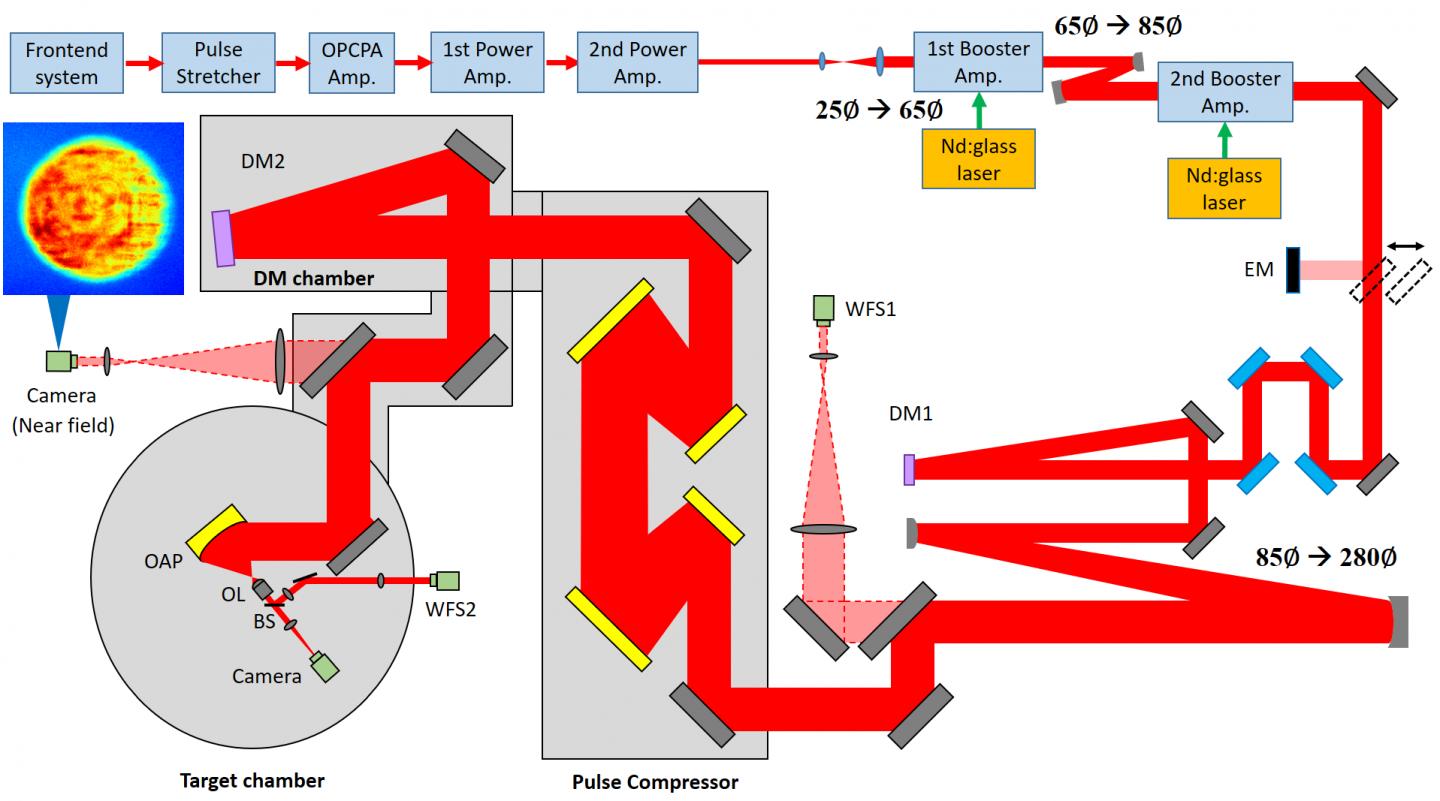
The CoReLS 4-PW laser is a femtosecond, ultrahigh power Ti:sapphire laser, based on the chirped pulse amplification (CPA) technique. The layout of the CoReLS 4-PW laser, including the experimental setup to control the wavefront and to measure the intensity, is given in Fig. 1. A low-energy femtosecond laser pulse from the front-end was stretched to a nanosecond pulse by the pulse stretcher. The initial laser pulse was then amplified to 4.5 J by the two power amplifiers and then up to 112 J by the two booster amplifiers. The size of the laser beam increased along the beam path by a series of beam expanders; 25 mm right after the power amplifiers, 65 mm at the entrance of the 1st booster amplifier, 85 mm at the entrance of the 2nd booster amplifier, and 280 mm at the entrance of the pulse compressor. In the pulse compressor, the laser pulse was recompressed to 20 fs (FWHM), which caused its peak power to become 4 PW after the compression.
In order to compensate for the wavefront distortion of the PW laser beam, two deformable mirrors were employed in the PW laser beamline. The first deformable mirror (DM1) with a diameter of 100 mm was installed after the final booster amplifier, with its role being to correct the wavefront distortion accumulated from the front end to the final beam expander. The second deformable mirror (DM2) with a diameter of 310 mm was installed after the pulse compressor, which corrects the additional aberrations induced from large aperture optics in the pulse compressor, the beam delivery line, and the target area. In the target chamber, the PW laser beam was tightly focused with an f /1.1 off-axis parabolic mirror, which possessed an effective focal length of 300 mm. For imaging and characterization of the focused spot, the focused beam was collimated by an objective lens. It was then divided into two beams with a beam splitter for the focal spot and wavefront characterization. A camera was used for the focal spot monitoring of the transmitted laser beam, and a wavefront sensor was used to measure the wavefront of the reflected laser beam. Figure 3 shows the 3-D focal spot image measured by the camera in the target chamber.
Prof. NAM Chang Hee, the Director of CoReLS, notes, “This work has shown that the CoReLS PW laser is the most powerful laser in the world. With the highest laser intensity achieved ever, we can tackle new challenging areas of experimental science, especially strong field quantum electrodynamics (QED) that has been dealt with mainly by theoreticians. We can explore new physical problems of electron-photon scattering (Compton scattering) and photon-photon scattering (Breit-Wheeler process) in the nonlinear regime. This kind of research is directly related to various astrophysical phenomena occurring in the universe and can help us to further expand our knowledge horizon.”
###
Media Contact
William I. Suh
[email protected]