Researchers investigating forest supply chain traceability have introduced the Biomtrace_extension image database, an open-access collection of 8,341 cross-sectional RGB photographs documenting 695 French oak logs under realistic field conditions. Published in the journal Annals of Forest Science, the experimental campaign was designed to evaluate the operational boundaries of automated biometric timber recognition as logs move from forest felling sites to primary industrial sawmills. Previous log identification studies relied primarily on stationary timber photographed under idealized conditions, producing near-perfect matching rates that obscured how real-world handling and environmental exposure alter wood surfaces. By subjecting biometric recognition algorithms to rigorous field trials involving mechanical transport, extended storage intervals, camera angle variations, dirt, and simulated wood tampering, the study provides a critical assessment of roundwood biometrics. The researchers demonstrated that practical operational factors significantly challenge automated identification, highlighting key technical hurdles that must be resolved before biometric timber tracking can be reliably deployed.
The motivation for developing robust biometric log tracking stems from stringent regulatory mandates and persistent vulnerabilities in traditional marking systems. In Europe, the European Union Deforestation Regulation requires companies to prove that timber products are deforestation-free, legally harvested, and traceable to the specific forest plot of origin. In France, sessile oak (Quercus petraea) and pedunculate oak (Quercus robur) represent nearly 700 million cubic metres of standing timber volume, carrying substantial commercial value. Although the Transformation UE label was created to encourage domestic processing and retain economic value within Europe, documented fraud has involved removing plastic marking tags from logs before loading them into export containers. Standing timber theft in private forests further illustrates the limitations of physical plastic markers, which are easily lost, damaged during transit, or deliberately falsified. Biometric identification seeks to eliminate reliance on external tags by using the unique wood anatomy visible on cross-sectional log ends as an unalterable natural fingerprint.
The research team previously established the original Biomtrace database, comprising 33,390 cross-sectional images representing 5,135 oak logs. When tested under those initial parameters, matching algorithms based on point-matching methodology demonstrated near-perfect performance, recording recognition rates of 100 percent in initial evaluations and above 99.9 percent across the broader image corpus. However, logs in that primary dataset were never moved between photo sessions, keeping perspective changes minimal and ensuring that the side embedded in soil remained unchanged. Furthermore, the elapsed time between photo sessions was comparatively brief, ranging from 25 to 63 days. Recognizing that operational roundwood logistics involve substantial mechanical disruption and prolonged storage durations, the scientific team established the Biomtrace_extension project as a targeted stress test. Combined with the initial database, the overall initiative provides a unified collection of 41,731 photographs representing 5,830 distinct oak logs, establishing the most comprehensive public empirical resource currently available for investigating automated roundwood biometrics.
To test biometric matching under genuine operational conditions, the researchers structured the extension database around three distinct field scenarios. The first case study evaluated log traceability before and after extraction, collecting 4,462 images across 422 logs sampled from seven sites in six forests. In this trial, operators captured initial photographs on the forest plot immediately after felling, recording four rotational images per cross-section and a fifth photo after affixing an identification label, alongside four photos of tree stumps for 140 logs. Following extraction to roadside storage yards, logs were re-photographed on a second date, and 49 logs were imaged on a third date. Because waterlogged ground delayed extraction operations at several sites, the time interval between felling and roadside imaging exceeded 100 days for three sites, reaching up to 146 days. During this prolonged delay, mechanical extraction rotated the logs, mud coated cross-sections, and warm spring weather triggered visible drying cracks.
When matching roadside images against a master search database of 5,830 unique reference logs, the point-matching algorithm suffered a substantial performance drop. Of the 1,792 roadside test images evaluated, the system correctly identified only 1,349 logs, resulting in a recognition accuracy of 75.3 percent and 443 identification errors. Most errors occurred during late retakes in May and June following episodes of spring warmth. The investigators determined that radial drying cracks were the primary cause of matching failures. Feature detection algorithms placed key-points directly along newly formed drying fissures rather than anatomical ring structures, preventing valid spatial correspondence with earlier crack-free images. To support future crack mitigation methods, the authors manually segmented drying cracks across 22 failed recognition images using ImageJ. They noted that contrastive learning approaches using triplet loss proved inadequate for these complex transformations, emphasizing that future point-matching systems must integrate dedicated crack-detection and infilling algorithms to maintain reliable traceability across seasonal weather transitions.
The second case study investigated the sensitivity of biometric matching to photo quality, focusing on variations in camera distance and shooting angles across 3,330 images from 222 logs in four forests. In operational logging, requiring field operators to bend their knees to photograph every cross-section directly straight-on causes physical fatigue. To assess ergonomic alternatives, technicians took reference shots at one meter while bending knees, followed by standing shots at one meter from waist and head heights to create strong vertical perspective. Operators then stepped back to two meters and three meters, capturing upright shots from waist height and taking side-angle photographs. A third session was conducted for 123 logs across two sites. Testing 3,066 successfully segmented images in the search database produced 14 failures, achieving a 99.5 percent recognition rate. This demonstrated that point-matching algorithms remain robust to substantial perspective shifts, confirming that operators can take reliable photographs while standing upright.
The third experimental scenario tested algorithm robustness against partial and complete log end trimming across 480 images from 40 logs at two sites. In each trial, four photos were taken of the intact log end, four after partially trimming the cross-section contour, and four after completely sawing off a disc approximately five centimeters thick. While partial contour modification posed little difficulty, yielding a 97.5 percent recognition rate, complete log end trimming caused total failure, dropping recognition to approximately 3 percent. Because key-points identified during initial imaging were physically removed with the severed disc, matching became impossible. The authors noted that in a comprehensive database, complete non-recognition of multiple logs within a batch would serve as an indicator of illicit end removal, triggering further investigation. Additional demonstration photographs were also gathered during public events, including the Salon International de l’Agriculture 2025 and a dedicated video shoot in Barbonville, providing further practical visual material.
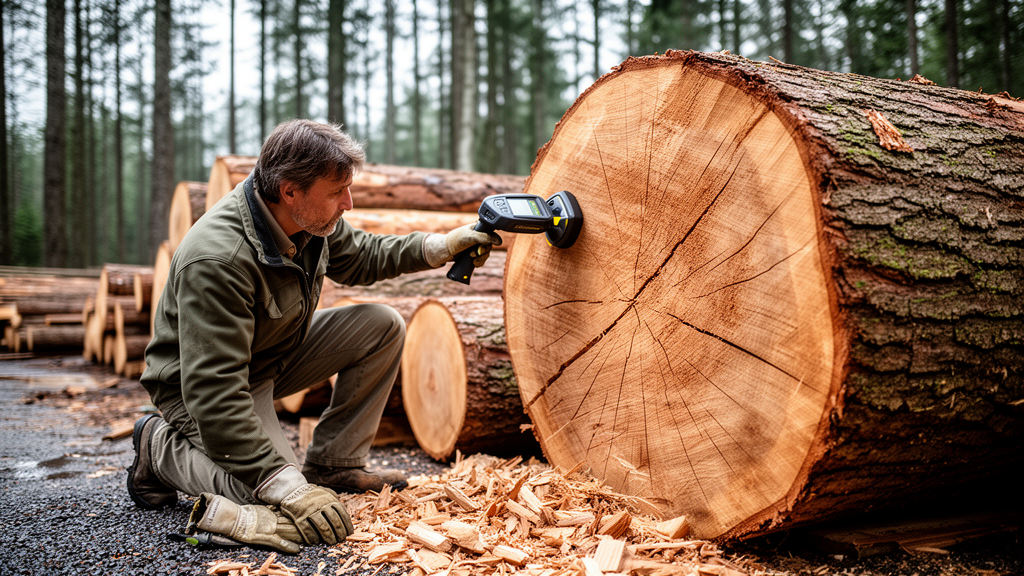
All photographic records in the Biomtrace_extension project were acquired using standard commercial smartphones, specifically an Apple iPhone 8 and a Samsung SM-G981U1. Field operators framed each shot to maximize cross-sectional area without cropping edges, storing images in JPG format with camera orientation data preserved in Exif metadata. To convert image measurements into absolute real-world units, operators positioned a black-and-white checkerboard pattern on each log, which was present in 8,122 of the 8,341 images. The team compared two checkerboard detection programs, detec_mire and pixel_grid, which shared a common detection routine but differed in how they numbered rows and columns. Both algorithms failed on 130 images due to severe angular distortion or small checkerboard size. For the 50 most divergent measurements, manual verification in ImageJ showed that pixel_grid was substantially more accurate than detec_mire, achieving a root mean square error of 0.0321 millimeters and a bias of negative 0.0245 millimeters, compared to 0.0508 millimeters and negative 0.0102 millimeters for detec_mire.
Isolating the cross-section from image backgrounds represents a critical preprocessing requirement before applying biometric traceability. The researchers evaluated deep learning segmentation models, contrasting Convolutional Neural Networks, which excel at identifying local visual patterns, with Vision Transformers, which evaluate global relationships across entire images. Testing architectures including U-Net, Mask R-CNN, PointRend, YOLOv11, and OneFormer across 1,537 manually delineated under-bark reference masks, the authors retained PointRend and OneFormer for full-database processing. Across the complete 8,341-image collection, PointRend failed to segment 34 images, all originating from Case Two perspective trials, while OneFormer failed on 15 images. Major segmentation divergences between the two models occurred primarily on irregular stump outlines and distorted, oblique shots. Because the training datasets contained neither stump imagery nor severe angular distortions, the authors suggested that expanding training data to include atypical views could resolve these segmentation errors, noting that slight perimeter inaccuracies do not necessarily prevent successful matching if the wood surface remains largely segmented.
In addition to photographic records and segmentation models, the database provides manual reference annotations to assist broader wood science and traceability investigations. These include manual markings of the anatomical pith across 2,400 cross-sections, with 2,395 from the initial Biomtrace repository and five from the extension. Locating the pith in oak is notably difficult because annual growth rings are frequently obscured by mud or plastic tags, yet accurate pith coordinates are valuable for normalizing cross-section orientation and guiding crack detection. All tabular records, site metadata, segmentation masks, and full-resolution images are openly accessible through the Recherche Data Gouv repository under DOI 10.57745/RKDTKY. By highlighting the operational impact of soil moisture delays, surface weathering, and drying cracks, the Biomtrace_extension dataset provides an essential empirical benchmark for researchers developing the next generation of robust computer vision tools for forest governance and international timber traceability.
Subject of Research: Biometric traceability database of oak log cross-sectional images under realistic field acquisition conditions
Article Title: A database of cross-sectional images for testing the biometric traceability of oak (Quercus petraea (Matt.) Liebl. and Quercus robur L.) logs under realistic acquisition conditions
Article References: Longuetaud, F., Mothe, F., Martinetto, D., Ngo, P., Rittié, D., Bordat, F., Jacquin, P., Vuidel, B., Piboule, A., Debled-Rennesson, I., Albert, A., & Richter, C. (2026). A database of cross-sectional images for testing the biometric traceability of oak (Quercus petraea (Matt.) Liebl. and Quercus robur L.) logs under realistic acquisition conditions. Annals of Forest Science, 83(1), Article 12. https://doi.org/10.1186/s13595-026-01330-0
Image Credits: AI Generated
DOI: 10.1186/s13595-026-01330-0
Keywords: biometric traceability, Biomtrace_extension, Quercus petraea, Quercus robur, cross-sectional imaging, roundwood tracking, timber supply chain, European Union Deforestation Regulation, drying cracks, PointRend, OneFormer, pixel_grid, detec_mire, log end trimming, pith location, image segmentation, timber theft prevention, Transformation UE
News Source: Alan Morgan. (November 12, 2026). Realistic Oak Log Image Database Exposes Field Limits of Biometric Timber Traceability. Scienmag.