(Santa Barbara, Calif.) — Discovering a new species is always exciting, but so is finding one alive that everyone assumed had been lost to the passage of time. A small clam, previously known only from fossils, has recently been found living at Naples Point, just up the coast from UC Santa Barbara. The discovery appears in the journal Zookeys.
“It’s not all that common to find alive a species first known from the fossil record, especially in a region as well-studied as Southern California,” said co-author Jeff Goddard, a research associate at UC Santa Barbara’s Marine Science Institute. “Ours doesn’t go back anywhere near as far as the famous Coelacanth or the deep-water mollusk Neopilina galatheae — representing an entire class of animals thought to have disappeared 400 million years ago — but it does go back to the time of all those wondrous animals captured by the La Brea Tar Pits.”
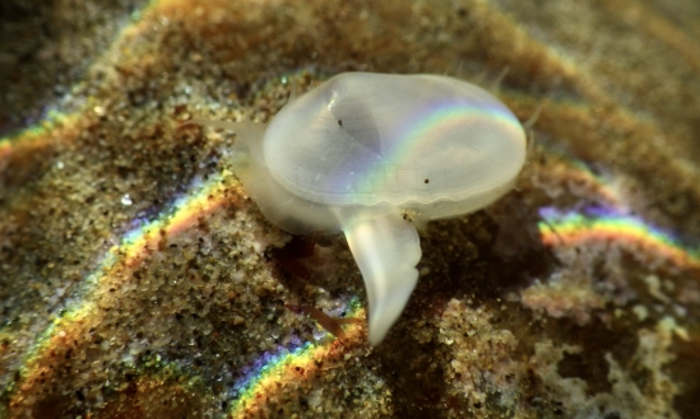
On an afternoon low tide in November 2018, Goddard was turning over rocks searching for nudibranch sea slugs at Naples Point, when a pair of small, translucent bivalves caught his eye. “Their shells were only 10 millimeters long,” he said. “But when they extended and started waving about a bright white-striped foot longer than their shell, I realized I had never seen this species before.” This surprised Goddard, who has spent decades in California’s intertidal habitats, including many years specifically at Naples Point. He immediately stopped what he was doing to take close-up photos of the intriguing animals.
With quality images in hand, Goddard decided not to collect the animals, which appeared to be rare. After pinning down their taxonomic family, he sent the images to Paul Valentich-Scott, curator emeritus of malacology at the Santa Barbara Museum of Natural History. “I was surprised and intrigued,” Valentich-Scott recalled. “I know this family of bivalves (Galeommatidae) very well along the coast of the Americas. This was something I’d never seen before.”
He mentioned a few possibilities to Goddard, but said he’d need to see the animal in-person to make a proper assessment. So, Goddard returned to Naples Point to claim his clam. But after two hours combing just a few square meters, he still hadn’t caught sight of his prize. The species would continue to elude him many more times.
Credit: Photo Credit: JEFF GODDARD
(Santa Barbara, Calif.) — Discovering a new species is always exciting, but so is finding one alive that everyone assumed had been lost to the passage of time. A small clam, previously known only from fossils, has recently been found living at Naples Point, just up the coast from UC Santa Barbara. The discovery appears in the journal Zookeys.
“It’s not all that common to find alive a species first known from the fossil record, especially in a region as well-studied as Southern California,” said co-author Jeff Goddard, a research associate at UC Santa Barbara’s Marine Science Institute. “Ours doesn’t go back anywhere near as far as the famous Coelacanth or the deep-water mollusk Neopilina galatheae — representing an entire class of animals thought to have disappeared 400 million years ago — but it does go back to the time of all those wondrous animals captured by the La Brea Tar Pits.”
On an afternoon low tide in November 2018, Goddard was turning over rocks searching for nudibranch sea slugs at Naples Point, when a pair of small, translucent bivalves caught his eye. “Their shells were only 10 millimeters long,” he said. “But when they extended and started waving about a bright white-striped foot longer than their shell, I realized I had never seen this species before.” This surprised Goddard, who has spent decades in California’s intertidal habitats, including many years specifically at Naples Point. He immediately stopped what he was doing to take close-up photos of the intriguing animals.
With quality images in hand, Goddard decided not to collect the animals, which appeared to be rare. After pinning down their taxonomic family, he sent the images to Paul Valentich-Scott, curator emeritus of malacology at the Santa Barbara Museum of Natural History. “I was surprised and intrigued,” Valentich-Scott recalled. “I know this family of bivalves (Galeommatidae) very well along the coast of the Americas. This was something I’d never seen before.”
He mentioned a few possibilities to Goddard, but said he’d need to see the animal in-person to make a proper assessment. So, Goddard returned to Naples Point to claim his clam. But after two hours combing just a few square meters, he still hadn’t caught sight of his prize. The species would continue to elude him many more times.
Nine trips later, in March 2019, and nearly ready to give up for good, Goddard turned over yet another rock and saw the needle in the haystack: A single specimen, next to a couple of small white nudibranchs and a large chiton. Valentich-Scott would get his specimen at last, and the pair could finally set to work on identification.
Valentich-Scott was even more surprised once he got his hands on the shell. He knew it belonged to a genus with one member in the Santa Barbara region, but this shell didn’t match any of them. It raised the exciting possibility that they had found a new species.
“This really started ‘the hunt’ for me,” Valentich-Scott said. “When I suspect something is a new species, I need to track back through all of the scientific literature from 1758 to the present. It can be a daunting task, but with experience it can go pretty quickly.”
The two researchers decided to check out an intriguing reference to a fossil species. They tracked down illustrations of the bivalve Bornia cooki from the paper describing the species in 1937. It appeared to match the modern specimen. If confirmed, this would mean that Goddard had found not a new species, but a sort of living fossil.
It is worth noting that the scientist who described the species, George Willett, estimated he had excavated and examined perhaps 1 million fossil specimens from the same location, the Baldwin Hills in Los Angeles. That said, he never found B. cooki himself. Rather, he named it after Edna Cook, a Baldwin Hills collector who had found the only two specimens known.
Valentich-Scott requested Willett’s original specimen (now classified as Cymatioa cooki) from the Natural History Museum of Los Angeles County. This object, called the “type specimen,” serves to define the species, so it’s the ultimate arbiter of the clam’s identification.
Meanwhile, Goddard found another specimen at Naples Point — a single empty shell in the sand underneath a boulder. After carefully comparing the specimens from Naples Point with Willett’s fossil, Valentich-Scott concluded they were the same species. “It was pretty remarkable,” he recalled.
Small size and cryptic habitat notwithstanding, all of this begs the question of how the clam eluded detection for so long. “There is such a long history of shell-collecting and malacology in Southern California — including folks interested in the harder to find micro-mollusks — that it’s hard to believe no one found even the shells of our little cutie,” Goddard said.
He suspects the clams may have arrived here on currents as planktonic larvae, carried up from the south during marine heatwaves from 2014 through 2016. These enabled many marine species to extend their distributions northward, including several documented specifically at Naples Point. Depending on the animal’s growth rate and longevity, this could explain why no one had noticed C. cooki at the site prior to 2018, including Goddard, who has worked on nudibranchs at Naples Point since 2002.
“The Pacific coast of Baja California has broad intertidal boulder fields that stretch literally for miles,” Goddard said, “and I suspect that down there Cymatioa cooki is probably living in close association with animals burrowing beneath those boulders.
Journal
ZooKeys
Article Title
A fossil species found living off southern California, with notes on the genus Cymatioa (Mollusca, Bivalvia, Galeommatoidea)