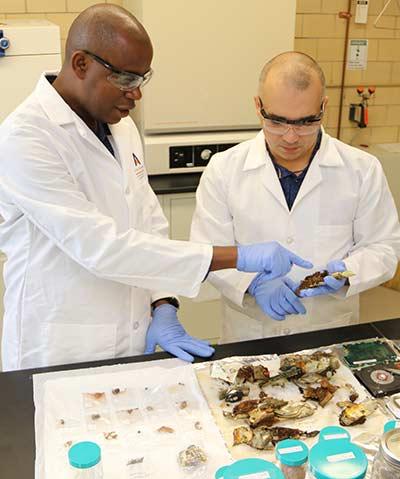
Credit: Ames Laboratory, U.S. Department of Energy
An acid-free dissolution rare-earth magnet recycling process has earned a 2018 Notable Technology Development Award from the Federal Laboratories Consortium (FLC).
Researchers at the Critical Materials Institute (CMI) and Ames Laboratory invented a magnet recycling process in which magnets are dissolved in water-based solutions, recovering more than 99 percent purity rare earth elements. Cobalt is also recovered from cobalt-containing magnet wastes. The rare earth materials recovered have been reused in making new magnets, and the recovered cobalt shows promise for use in making battery cathodes.
One of the panel judges commented, "Rare earths are used in industry, defense, and electronics. If they can be obtained through recycling rather than imported from a foreign country, this innovation is worthy of recognition."
This technology resulted from analyzing industrially generated wastes from three U.S. magnet manufacturing and processing companies. A U.S. hard disk drive shredding company supplied shredded HDDs. These collaborations ensured that materials used for this research are same as those generated in real-life situations. In addition, the Ames Laboratory Materials Preparation Center reduced the magnets from this research into metal ingots. Collaboration is on-going with a commercial partner, Infinium Metals, to produce metal ingots at larger scale.
The inventors of the process are Ikenna Nlebedim and Denis Prodius, both of Ames Laboratory; and Anja-Verena Mudring, formerly at Ames Laboratory but currently at Stockholm University. Patents for the process are filed. Information on this and other CMI inventions may be found at cmi.ameslab.com.
"A unique strength of this technology is that operational hazards and negative environmental impacts associated with acid-based dissolution process are eliminated without sacrificing purity, efficiency and potential economic impact" said Ikenna Nlebedim, the lead investigator for the research.
"We're extremely proud of this success, because it demonstrates the effectiveness of the Critical Materials Institute to deliver innovations that lessen our domestic reliance on imported specialty materials," said CMI Director Chris Haase. "We look forward to leveraging CMI's world-class technology, skills and network to enable timely, profitable and environmentally responsible technology deployments."
The award will be presented at the FLC Far West and Mid-Continent Regional Meeting held in Oklahoma City, Okla. Aug. 28-30. The Federal Laboratory Consortium for Technology Transfer (FLC) is the nationwide network of federal laboratories that provides the forum to develop strategies and opportunities for linking laboratory mission technologies and expertise with the marketplace.
###
The Critical Materials Institute is a Department of Energy Innovation Hub led by the U.S. Department of Energy's Ames Laboratory and supported by the Office of Energy Efficiency and Renewable Energy's Advanced Manufacturing Office, which supports early-stage research to advance innovation in U.S. manufacturing and promote American economic growth and energy security. CMI seeks ways to eliminate and reduce reliance on rare-earth metals and other materials critical to the success of clean energy technologies.
Ames Laboratory is a U.S. Department of Energy Office of Science national laboratory operated by Iowa State University. Ames Laboratory creates innovative materials, technologies and energy solutions. We use our expertise, unique capabilities and interdisciplinary collaborations to solve global problems.
Ames Laboratory is supported by the Office of Science of the U.S. Department of Energy. The Office of Science is the single largest supporter of basic research in the physical sciences in the United States, and is working to address some of the most pressing challenges of our time. For more information, please visit science.energy.gov.
Media Contact
Laura Millsaps
[email protected]
@Ames_Laboratory
http://www.external.ameslab.gov
Original Source
https://www.ameslab.gov/news/news-releases/rare-earth-magnet-recycling-tech-wins-innovation-award