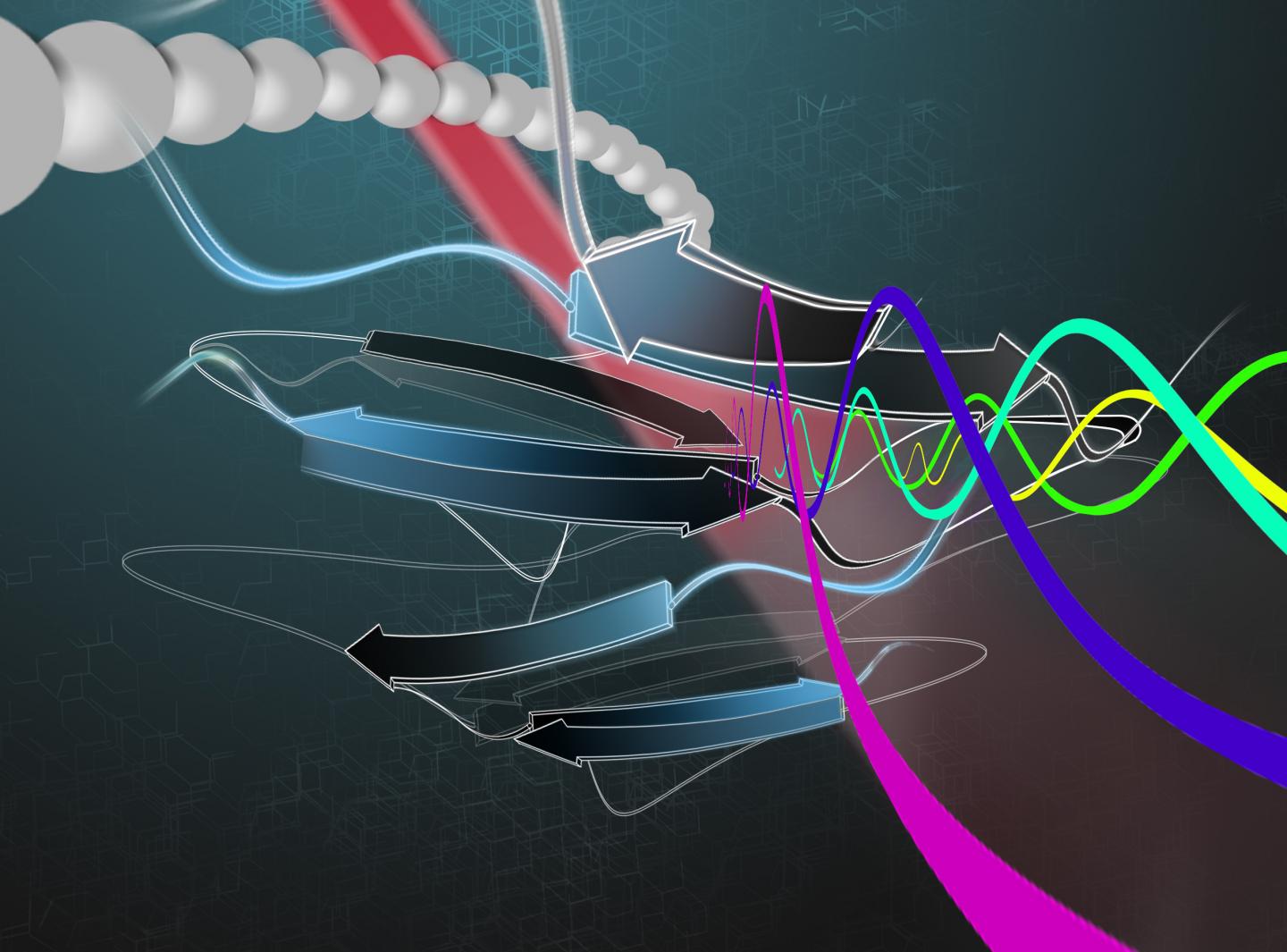
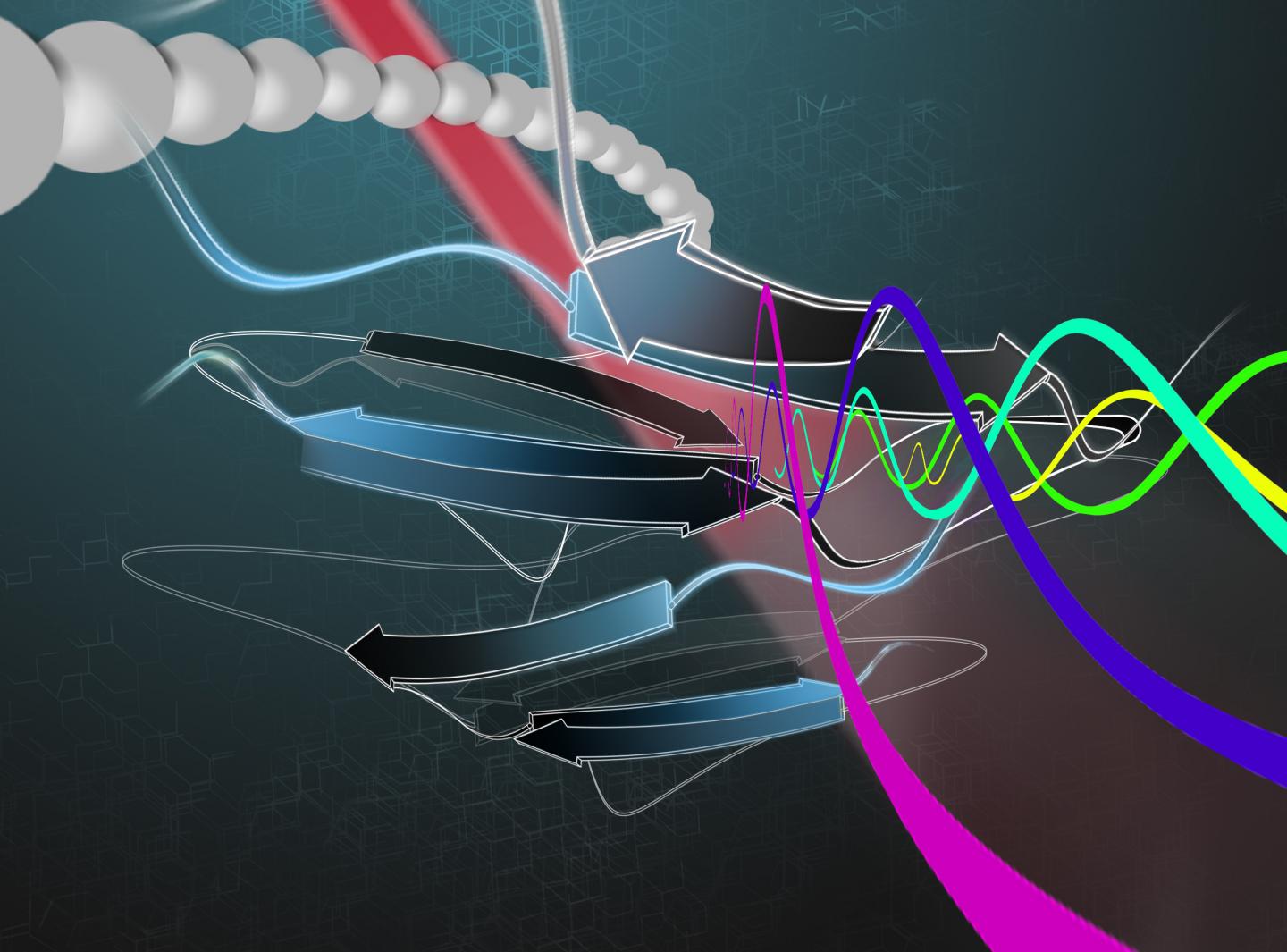
Credit: Nasim Motalebi
The structural properties of proteins that could eventually become important materials for manufacturing and medicine are revealed by a novel optical technique that works rapidly to sort through amino acid sequences even inside living bacteria, according to a team of engineers.
"There remains an urgent need for fast and efficient techniques that can screen the properties of large numbers of protein sequences with minimal sample volume or in living cells," the researchers report online in the journal Analyst.
Naturally occurring proteins like silk, collagen, wool and other natural fibers are a $40 billion industry.
"There are 30 to 40 natural structural proteins that we know of," said Melik C. Demirel, Pierce Development Professor and professor of engineering science and mechanics, Penn State. "Silk is very strong, but when it's placed in water it loses its strength. Squid ring teeth proteins have similar properties, but because they evolved in a wet environment, don't have that problem."
Finding variants of naturally occurring proteins with specific characteristics is only one approach.
"The problem is when we look at mechanical properties there is an area where no natural materials have those properties," said Demirel. "Either nature did not create proteins with those characteristics or they disappeared." The proteins that interest Demirel and his team are both natural and synthetic. They are semicrystalline and the properties the team is looking for can be characterized by their crystalline structure, but crystalline structure changes as a material heats up. Standard flow cytometry lasers produce too much heat for this use.
"The problem with light is that when you shine it on an object, the object eventually heats up," said Demirel. "If we are trying to measure crystallinity, we have to do it fast enough so that it doesn't get heated up and change the crystalline structure."
The researchers are doing flow cytometry, but are using femto and pico-second lasers to inspect the proteins as they flow past in single file. The chosen proteins can then be separated from the rest. The lasers, cycling as fast as they do, do not heat up the samples quickly, so researchers can probe for the information they need before the sample heats up and the structure changes. They use a process called time-domain thermo-transmission which enables screening of proteins in milliseconds and does not kill living cells.
Besides naturally occurring proteins, the researchers are looking at synthetic proteins, specifically adapted from squid ring teeth proteins. Bacteria produce these protein strands, so a non-lethal method of categorizing them is needed. This proof-of-concept research showed that this method does work.
Demirel received a recent grant, "High-throughput screening of evolutionary biological materials," from the Defense University Research Instrumentation Program to create a machine that can do this in larger amounts. DURIP funds can only be used for the acquisition of major equipment to augment current or to develop new research capabilities in support of Department of Defense relevant research. Squid ring teeth proteins, because they function in water, may be of importance in the marine environment.
###
Also working on this project from Penn State were Huihun Jung and Abdon Pena-Francesch, graduate students in engineering science and mechanics; and Benjamin Allen, research associate in biochemistry and molecular biology.
Others working on the project are Patrick Hopkins, associate professor of mechanical and aerospace engineering, Chester J. Szwejkowski, graduate student in mechanical and aerospace engineering, and John A. Tomko, graduate student in materials science and engineering, University of Virginia; and Sahin Kaya Ozdemir, research associate professor of electrical and systems engineering, Washington University. The Army Research Office supported this work.
Media Contact
A'ndrea Elyse Messer
[email protected]
814-865-9481
@penn_state
http://live.psu.edu
############
Story Source: Materials provided by Scienmag