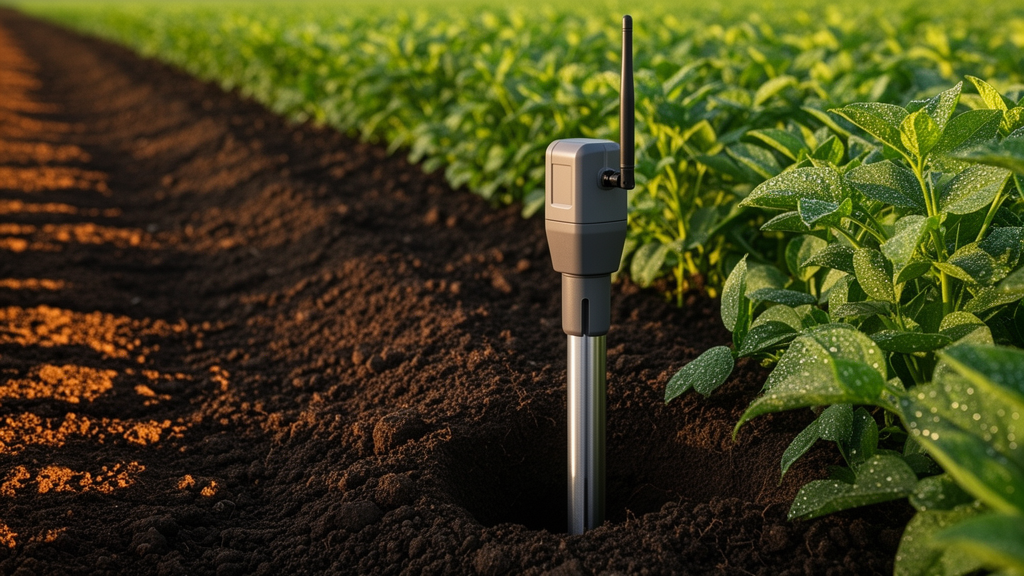
A comprehensive rapid review evaluating the integration of artificial intelligence and the Internet of Things indicates that while smart soil monitoring has demonstrated notable success in controlled settings, decentralized deployments remain constrained. Published in Frontiers in the Internet of Things by researchers Michael O’Grady and Eleni Mangina from University College Dublin, the investigation synthesized recent peer-reviewed literature to assess how the Artificial Intelligence of Things, or AIoT, influences contemporary soil stewardship. The AIoT paradigm alters this dynamic by embedding algorithmic intelligence directly into sensing workflows, enabling continuous environmental tracking and automated decision-making. However, the evidence reveals that despite compelling demonstrations in precision irrigation and microclimate regulation, the transformative potential of localized intelligence deployed directly at the environmental edge remains largely unrealized across commercial agriculture and land management.
The societal urgency surrounding soil technologies stems from severe terrestrial degradation alongside recent regulatory mandates enacted across Europe. Official assessments indicate that up to sixty percent of soils across the European Union exist in an unhealthy state, generating financial degradation costs exceeding fifty billion euros each year, excluding external expenses associated with biodiversity loss, accelerated soil erosion, and chronic public health impacts. In response, the European Union adopted the Soil Monitoring Law in 2025, legally binding member states to monitor soil parameters, curb contamination, and foster regenerative agricultural practices like agroecology through participatory frameworks. In parallel, the European Commission initiated the Mission Soil program, outlining eight target objectives that include reducing desertification, conserving soil organic carbon stocks, halting net soil sealing, preventing erosion, enhancing soil structure for soil biota and crops, and increasing societal soil literacy. This mission centers on establishing one hundred Living Labs and Lighthouses to co-create, test, and demonstrate sustainable soil practices under local operating conditions.
Technological frameworks for tracking soil properties have evolved from traditional Wireless Sensor Networks into distributed computational architectures spanning the Cloud-Edge-IoT continuum. Commercial sensors monitoring temperature, moisture, and electrical conductivity have shifted from specialized scientific tools into accessible consumer hardware marketed to farmers, gardeners, and citizen scientists. However, raw data collection alone faces persistent barriers, including bandwidth constraints, latency bottlenecks, and communication failures. The AIoT paradigm addresses these limitations by shifting analytical computation closer to physical edge devices rather than routing all telemetry through distant centralized cloud servers. Under this continuum model, processing workloads and machine learning inferences are partitioned across microcontrollers, local gateway devices, and cloud data centers according to predetermined orchestration rules. Deploying lightweight intelligence near the sensing interface shortens response latency, optimizes power consumption, and protects sensitive operational data. Additionally, reducing reliance on centralized data centers mitigates computing emissions, as continuous data center expansion constitutes a substantial and acknowledged source of international carbon output.
To evaluate how these technologies are practically utilized, O’Grady and Mangina conducted a structured rapid review adhering to established PRISMA guidelines in June 2026. The researchers targeted three bibliographic repositories—Scopus, Web of Science, and EBSCO—utilizing a search string pairing soil with artificial intelligence of things terminology. This initial query retrieved forty-one candidate publications, which were cataloged using Citavi software for detailed assessment. Screening procedures subsequently eliminated twenty-four papers due to duplicate indexing, lack of focus on AIoT as a core mechanism, or confusion where authors used AIoT to denote agriculture internet of things. To qualify for final inclusion, a study had to document an explicit technical interaction between AIoT infrastructure and soil dynamics within agricultural or non-agricultural contexts. The final corpus comprised seventeen peer-reviewed papers published within the preceding four years. The review noted specific methodological limitations, including omitting unindexed grey literature from Google Scholar or arXiv, restricting linguistic scope to English-language publications, and querying three primary indexing databases.
Analysis of the seventeen included papers revealed that agricultural greenhouses represent the most frequent experimental validation environment for AIoT implementations. Within these controlled settings, researchers utilize connected sensor networks to regulate microclimate dynamics, moisture availability, and nutrient feeds. Bouali and colleagues deployed supervised regression algorithms and Long Short-Term Memory neural networks across an intelligent IoT platform, distributing computational tasks between edge and cloud layers to monitor soil moisture, pH, carbon dioxide, and ultraviolet levels. Chou and associates designed an asparagus greenhouse monitoring architecture that linked physical probes to a Raspberry Pi gateway, recording soil moisture, temperature, and electrical conductivity at thirty-second intervals while running convolutional neural networks for automated pest detection. Addressing operational usability, Nuangpirom and collaborators introduced an accessible greenhouse framework designed for elderly operators, combining multiple regression models with genetic algorithms to schedule automated irrigation based on soil moisture data collected at five-minute intervals.
Research led by Kalyana Sundaram demonstrated an AIoT-Driven Smart Agri Grid framework tested over two growing seasons across a ten-acre field planted with maize and paddy crops. In Indian agricultural contexts, Arienth and colleagues validated a modular cloud-assisted irrigation system using random forest regression and recurrent neural networks across wheat, rice, sugarcane, and cotton plots. Examining sugarcane water optimization, Karn and associates evaluated multiple regression models against open government data and physical field observations, determining that a decision tree regressor delivered the highest predictive accuracy for calculating dynamic water requirements.
Nutrient management and smallholder agricultural applications also constituted substantial focus areas within the corpus, addressing fertilizer overapplication and small farm resource constraints. Hafid Hardyanto and colleagues formulated a Temporal Convolutional Network deployed on edge architecture for rice cultivation, processing multimodal environmental and soil moisture telemetry to deliver site-specific fertilizer guidance in connectivity-limited rural settings. Similarly, Obodai and collaborators developed an intelligent nutrient management prototype evaluating logistic regression, decision trees, and random forest models against offline soil datasets, finding that random forest classification achieved superior accuracy in mapping nitrogen, phosphorus, and potassium requirements. For smallholder farms under two hectares, Bahaa and associates developed an integrated disease detection and monitoring platform using MobileViT vision transformers and LLaMA 3.2 models, transmitting soil moisture and light intensity to cloud backends while providing small-scale farmers with actionable crop care guidance through an interactive conversational chatbot interface.
Beyond conventional open-field cropping, the review documented specialized AIoT implementations designed to navigate extreme environmental conditions and closed-loop circular systems. In Qatar, Sanfilippo and colleagues conducted a techno-economic investigation of hydroponic tomato farming in a 300-square-meter desert greenhouse, processing substrate conductivity, dissolved oxygen, and energy expenditure through genetic algorithms. In urban agriculture, Lu and colleagues deployed rule-based server intelligence at an elderly care facility within the National Taichung University of Science and Technology, combining aquaculture, poultry, and crop irrigation while logging soil conductivity, moisture, temperature, and pH every ten minutes. In vermiculture, Nunez and collaborators implemented bio-inspired optimization algorithms on an offline Raspberry Pi, successfully predicting humus generation and managing worm habitats without internet connectivity.
Although agricultural settings accounted for the majority of studies, the synthesis identified several adjacent and non-agricultural implementations of soil-focused AIoT systems. Akhouad and colleagues developed a wildfire risk prediction framework in Morocco, combining ground-level soil moisture indicators with normalized difference water index data from the NASA POWER API using extreme gradient boosting algorithms. In structural urban landscaping, Lu and associates monitored a vertical green wall over a year-long rooftop experiment in Taichung City, demonstrating that automated AIoT nutrient and irrigation feedback loops significantly outperformed manual maintenance regimes. In ecological and operational logistics, Krishnani and colleagues evaluated invasive water hyacinth biomass as a soil amendment within circular life cycle assessments using multiple machine learning classifiers, while Li and team designed an edge intelligence framework that accelerated inference scheduling by over three times compared to standard deep learning libraries, facilitating synchronized communication among autonomous agricultural vehicles operating across variable soil terrains.
Despite widespread experimental accomplishments, O’Grady and Mangina emphasize that significant technological, economic, and infrastructural hurdles impede the widespread adoption of AIoT in soil stewardship. A fundamental disconnect persists regarding system architecture: while AIoT conceptually prioritizes edge-native computation, most documented deployments remain heavily reliant on centralized cloud servers for model execution and data warehousing. This structural reliance excludes remote farming regions, particularly in the Global South, where telecommunications infrastructure is scarce. Moreover, physical deployments suffer from sensor drift, irregular calibration, and environmental interference, which introduce corrupted data streams that degrade machine learning accuracy. High equipment investment and recurring maintenance costs also restrict accessibility for smallholders. To transition from isolated prototypes to scalable impact, the authors conclude that future research must leverage TinyML microcontrollers, standardize cross-platform interfaces, establish diverse long-term field datasets, and develop comprehensive soil digital twins to evaluate ecological and socio-economic outcomes across diverse global environments.
Subject of Research: Applications and technological limitations of the artificial intelligence of things in soil management
Article Title: Artificial intelligence of things for soil management
Article References: O’Grady, M., & Mangina, E. (2026). Artificial intelligence of things for soil management. Frontiers in The Internet of Things, 5, Article 1943466. https://doi.org/10.3389/friot.2026.1943466
Image Credits: AI Generated
DOI: 10.3389/friot.2026.1943466
Keywords: Artificial Intelligence of Things, AIoT, Soil Management, Precision Agriculture, Edge Computing, Smart Irrigation, Soil Moisture Sensing, Greenhouse Automation, TinyML, Living Labs, Mission Soil, EU Soil Monitoring Law, Sensor Drift, Soil Degradation, Cloud-Edge-IoT Continuum, Nutrient Management, Soil Digital Twins
News Source: Denise Maddox. (November 23, 2026). Rapid Review Finds Smart Soil Systems Remain Constrained by Cloud Dependence. Scienmag.