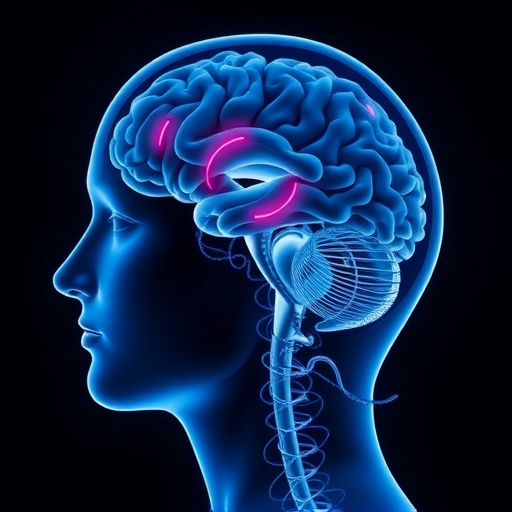
In a groundbreaking new study published in Nature Neuroscience, researchers have unveiled critical insights into the cerebellum’s capacity for rapid motor skill adjustment, a discovery poised to reshape our understanding of motor learning and neural adaptation. The cerebellum, a brain region long known for its role in coordinating movement and balance, relies heavily on intricate error signaling to fine-tune motor output. At the heart of this process lie climbing fibers originating from the inferior olive—an ancient brainstem nucleus—that deliver error signals to Purkinje cells within the cerebellar cortex. Until now, the exact manner in which these neural signals convey detailed error information during rapid motor adaptation remained elusive.
Central to theories of cerebellar learning has been the idea that climbing fibers communicate error signals through complex spikes—brief, binary events in Purkinje cells that herald motor errors to initiate synaptic plasticity. However, this binary nature posed a conceptual challenge: complex spikes alone seemingly lack the granularity required to encode both the direction and magnitude of errors. This posed a conceptual paradox, especially given the cerebellum’s remarkable ability to support fast, precise motor corrections. How does the cerebellum reconcile this supposed informational simplicity with the observed speed and sophistication of motor adaptation?
To tackle this question, the authors of the new study employed an innovative behavioral paradigm in mice, a model organism amenable to precise neurological investigations. Utilizing a joystick-pulling task that the mice learned to perform smoothly, the researchers intermittently introduced sensorimotor perturbations—deliberate mismatches between the expected sensory feedback and the actual movement outcome. This setup mimicked naturalistic motor errors and allowed the team to probe the real-time neural response patterns associated with adaptation.
The researchers combined this behavioral framework with advanced neural imaging techniques to record complex spike activity across populations of Purkinje cells arranged in parasagittal bands within the cerebellar cortex. Remarkably, they observed that when the perturbation was absent, complex spiking was relatively quiescent, showing little modulation. However, the introduction of sensorimotor error induced a striking, reciprocal pattern of complex spike activity distributed across alternating parasagittal zones.
These parasagittal bands, which form a fundamental anatomical and functional organization of the cerebellar cortex, displayed alternating patterns of excitation and inhibition upon encountering the perturbation. Bands responding with increased complex spike firing were juxtaposed against adjacent bands where activity was suppressed, revealing a sophisticated spatial encoding scheme. This reciprocal modulation effectively transformed a seemingly binary error signal into a rich, population-level code that represented both the sign—indicating the direction—and the magnitude of experienced motor errors.
Such findings challenge the traditional view that complex spikes constitute simple “all-or-none” error reporters, instead suggesting that the cerebellum leverages population dynamics across multiple Purkinje cell groups to encode detailed error information rapidly. This population-level coding strategy equips the cerebellum to swiftly recalibrate motor commands, adjusting the animal’s behavior with a speed and precision necessary to navigate a complex, changing environment.
Importantly, the study establishes a direct link between this neural coding phenomenon and behavioral adaptation. As the patterns of complex spike modulation emerged following perturbation onset, the mice’s joystick pulling behavior adapted within remarkably few trials. This rapid learning underscores the efficiency of the cerebellar supervision system, which translates nuanced error signals into synaptic plasticity and then refined, targeted motor correction.
Moreover, the discovery of sign- and magnitude-specific error encoding within Purkinje cell populations opens new avenues for understanding cerebellar dysfunction. Disorders such as ataxia and dystonia, characterized by impaired motor coordination, could derive in part from disrupted population-level error signals, limiting the ability of the cerebellum to execute rapid adaptive motor learning. By elucidating the fundamental principles of cerebellar error representation, this research offers promising targets for therapeutic intervention.
The findings also have broader implications for the design of brain-machine interfaces and adaptive robotics. Incorporating similar population coding schemes into artificial systems could enhance their agility and precision in real-world, dynamic environments. The cerebellum’s elegant strategy of distributing error information across spatially organized neural bands may inspire novel algorithms for rapid sensorimotor correction in engineered devices.
Beyond the immediate translational impacts, this work addresses a longstanding theoretical question in neuroscience: how binary neural events can encode continuous error dimensions necessary for supervised learning. By demonstrating that the cerebellum exploits the spatial arrangement of Purkinje cells and their collective modulation, the research reconciles theory with biological observation, adding a critical piece to the puzzle of motor control.
Technically, these insights were made possible through the integration of behavioral perturbations, large-scale calcium imaging, and computational analysis of neural population activity. This multimodal approach exemplifies the power of modern neuroscience techniques to uncover subtle neural computations that elude traditional single-cell paradigms.
In addition, the experimental design’s elegance—using controlled joystick perturbations coupled with high-resolution neural recording—set a new standard for probing cerebellar function in awake, behaving animals. This methodological advance will likely spur further investigations into how other sensorimotor circuits encode and adapt to errors.
In sum, the study by Nguyen, Gros, and Stell presents a paradigm shift in our understanding of cerebellar learning. Their identification of population-level, parasagittal modulation of complex spike activity as a key mechanism for rapid motor skill adjustment enriches prevailing models of cerebellar supervised learning. It underscores the cerebellum’s capability to encode high-dimensional error information with remarkable efficiency—a neural alchemy that enables the organism to continually refine its movements in an unpredictable world.
Future directions inspired by this work include exploring how these error signals interact with downstream motor pathways, how plasticity rules vary across the activated and inhibited bands, and how modulatory systems influence this finely tuned neural process. This research thus opens a fertile avenue for unraveling the cerebellar code not just for error detection but for the orchestration of adaptive motor control.
As scientists further dissect the neural choreography behind motor learning, the insights from this study reaffirm the cerebellum’s role as a sophisticated computational hub—a biological supercomputer adept at error correction and precision tuning that keeps the dance of movement both fluid and flexible.
Subject of Research: Neural mechanisms of rapid motor skill adjustment in the cerebellum
Article Title: Rapid motor skill adjustment is associated with population-level modulation of cerebellar error signals
Article References:
Nguyen, V., Gros, C. & Stell, B.M. Rapid motor skill adjustment is associated with population-level modulation of cerebellar error signals. Nat Neurosci (2025). https://doi.org/10.1038/s41593-025-02126-7
Image Credits: AI Generated
DOI: https://doi.org/10.1038/s41593-025-02126-7
Tags: brainstem nucleus role in motor controlcerebellar cortex functioncerebellar motor adaptationclimbing fibers and Purkinje cellscomplex spikes in cerebellumerror signaling in the brainmotor learning theoriesneural adaptation mechanismsprecision in motor correctionsrapid motor skill learningsynaptic plasticity in motor skillsunderstanding motor error communication