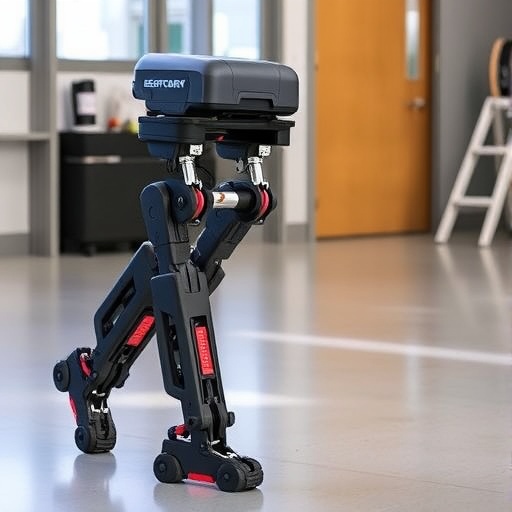
In recent years, the integration of wearable robotics into human mobility enhancement has taken remarkable strides. Among these innovations, exoskeletons have emerged as transformative devices with the potential to revolutionize rehabilitation, assistive technologies, and even augment healthy individuals’ physical capabilities. A new pioneering study by Chen, Yin, Ding, and colleagues published in Communications Engineering in 2025 unveils an interaction-based rapid heuristic optimization framework, designed specifically to refine exoskeleton assistance during walking. This breakthrough represents a landmark convergence of robotics, biomechanics, and computational intelligence, promising to vastly improve device responsiveness and personalized adaptation.
Traditional exoskeleton control systems have long grappled with the challenge of tailoring assistance patterns dynamically to each user’s unique gait and physiological responses. Achieving optimal assistance requires navigating highly complex, nonlinear interactions between human musculoskeletal systems and robotic actuators. Most existing methods rely on pre-set parameters or slow, iterative calibration processes that are ill-suited for real-time adaptation during natural walking. Chen et al.’s study disrupts this paradigm by introducing a rapid heuristic optimization approach that operates based on direct interaction feedback, allowing for swift and precise tuning of exoskeleton torque profiles.
At the heart of this method lies the use of heuristic algorithms informed by instantaneous biomechanical data streams, including joint angles, muscle activation patterns, and ground reaction forces. The system continuously analyzes this multidimensional data to iteratively update assistance parameters, minimizing metabolic cost while maximizing user comfort and stability. Unlike conventional model-based optimizations, this heuristic technique efficiently handles the intrinsic variability in human gait, adjusting assistance on the fly without requiring extensive computational resources or prior biomechanical models.
The research team implemented this framework on a state-of-the-art lower-limb exoskeleton prototype equipped with multi-axis sensors and high-fidelity actuators. Testing involved a diverse group of participants performing natural walking tasks on various surfaces and speeds. Results demonstrated impressive reductions in metabolic expenditure — a critical metric indicating energy savings for the wearer — with the optimized assistance profile emerging within mere minutes of use. This rapid convergence marks a significant improvement over previous approaches that often necessitated hours of parameter tuning.
Such optimization speed is particularly crucial for real-world applications where an individual’s gait can fluctuate due to fatigue, changes in terrain, or variations in speed. Chen and colleagues’ interaction-based system adapts seamlessly to these shifts, maintaining optimal assistance without interrupting walking flow. This capability opens thrilling prospects for deploying exoskeletons beyond clinical or laboratory settings into bustling urban environments, industrial workplaces, and everyday life scenarios.
Beyond metabolic efficiency, the study carefully examined biomechanical outcomes including joint kinematics and muscle recruitment patterns. The optimized assistance scheme not only reduced energy demands but also promoted more natural gait dynamics, evidenced by improved symmetry and reduced compensatory movements. This suggests that the heuristic optimizer preserves or enhances ergonomic factors critical for long-term user health and device acceptance, a frequent limitation of rigidly programmed exoskeleton systems.
Another striking aspect of their framework is its user-centric design philosophy. By leveraging real-time interaction data, the system personalizes assistance to each subject’s intrinsic walking style and preferences. This stands in contrast to one-size-fits-all exoskeleton designs that often fail to accommodate inter-individual variability. The adaptability ensures that users experience immediate benefits without extensive customization sessions, fostering higher satisfaction and usability.
The core heuristic algorithm draws inspiration from bioinspired computing paradigms and reinforcement learning principles, balancing exploratory parameter search with exploitation of beneficial assistance patterns. This synergy enables the optimizer to quickly identify and settle upon torque profiles that harmonize with natural musculoskeletal rhythms. Additionally, the framework flexibly incorporates multiple objective criteria — for example, optimizing for energy cost, comfort, and joint loading simultaneously — reflecting the multifaceted demands of real-world walking.
A notable innovation in the system architecture is its decoupling of sensing and actuation subsystems, connected via a low-latency communication protocol. This modular arrangement permits scalable upgrades including integration of advanced machine learning modules or physiological sensors like electromyography. Furthermore, the team employed robust noise filtering and adaptive signal processing techniques to ensure reliable biomechanical feedback despite real-world disturbances such as sensor shifts or external vibrations.
Significantly, the authors emphasize the extensibility of their heuristic optimization beyond walking assistance. Potential extensions include running, stair ascent and descent, and even upper-limb exoskeleton applications. The generalizable nature of their interaction-based approach lays a foundational platform for accelerating the development of diverse, context-aware wearable robots capable of dynamically tailoring assistance across a variety of motor tasks.
Looking forward, the study opens exciting avenues for further research and commercialization. Future efforts might focus on embedding the optimization algorithm within fully autonomous exoskeleton systems equipped with onboard computational resources. Such advancements could usher in truly hands-free personalized assistance systems that learn and adapt continuously during daily activities. Collaborative integration with neural interfaces or digital twins representing the user’s biomechanics could further amplify responsiveness and predictive control.
In addition to optimizing assistance, the heuristic framework could serve diagnostic and therapeutic roles. By analyzing real-time gait adaptations and metabolic signatures, clinicians might more precisely assess neuromuscular pathologies or track rehabilitation progress. This dual functionality underscores the transformative potential of combining human-robot interaction data streams with rapid, adaptive computational optimization.
The implications of Chen et al.’s rapid heuristic optimization extend well beyond technical novelty. They represent a paradigm shift towards a future where wearable exoskeletons become seamless extensions of the human body—intelligent systems that intuitively augment strength and endurance, empower mobility-impaired individuals, and enhance occupational safety. The convergence of real-time biomechanics sensing, adaptive algorithms, and advanced actuation is poised to redefine how humans and machines collaborate during locomotion.
As the global burden of mobility impairments rises alongside aging populations, innovations such as these gain critical societal relevance. By dramatically reducing metabolic cost and improving comfort and usability, interaction-based exoskeleton assistance can broaden access and adoption, making robotic mobility enhancement a viable option for a wider demographic. This democratization of technology aligns with broader trends in personalized medicine and human augmentation.
The study also raises important questions and opportunities regarding ethical, ergonomic, and safety considerations. Ensuring that adaptive exoskeletons operate reliably across diverse users and environmental conditions is paramount. Future regulations and standards will need to adapt to the complexities introduced by real-time heuristic optimization frameworks. The multidisciplinary collaboration highlighted by this work—from robotics engineers to biomechanists and clinicians—will be essential in navigating these challenges.
In summary, Chen, Yin, Ding, and their colleagues have crafted a revolutionary interaction-based rapid heuristic optimization method that redefines how exoskeletons assist walking. Their approach leverages dynamic biomechanical feedback to deliver personalized, efficient, and adaptive support, overcoming longstanding barriers in wearable robotics. This advancement invites a future where human locomotion is enhanced by responsive, intelligent exoskeletons capable of learning with and from their users—to the profound benefit of health, mobility, and quality of life worldwide.
Subject of Research: Rapid heuristic optimization methods applied to exoskeleton assistance systems for walking, focusing on human-robot interaction and biomechanical adaptation.
Article Title: Interaction-based rapid heuristic optimization of exoskeleton assistance during walking.
Article References:
Chen, J., Yin, W., Ding, J. et al. Interaction-based rapid heuristic optimization of exoskeleton assistance during walking.
Communications Engineering (2025). https://doi.org/10.1038/s44172-025-00574-4
Image Credits: AI Generated
Tags: assistive technology innovationsbiomechanics and robotics integrationcomputational intelligence in mobility devicesdynamic gait adjustment for exoskeletonsenhancing physical capabilities with roboticsexoskeleton technology advancementsinteraction-based control systemspersonalized assistance in walking aidsrapid heuristic optimization in rehabilitationreal-time adaptation in exoskeletonstorque profile tuning for exoskeletonswearable robotics