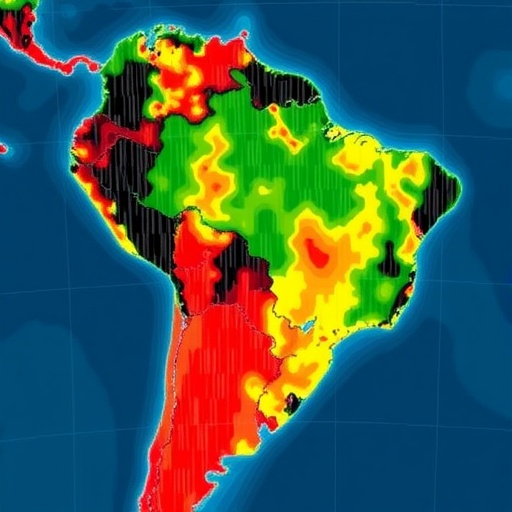
As the relentless march of climate change advances, one of its most palpable manifestations is the intensification of extreme rainfall events. This intensification is poised to wreak havoc across various facets of daily life, not least of which concerns public health. While floods and heavy precipitation events have been widely studied for their long-term environmental and infrastructural impacts, their short-term health consequences remain enigmatic, especially in nations characterized by vast geographic and socio-economic diversity such as Brazil. The recent study by Requia, Kill, and Deo (2026) sheds much-needed light on this understudied interface, providing a comprehensive national-scale analysis of how rainfall events correlate with mortality across Brazil’s varied landscapes.
Brazil’s unique constellation of climatic zones—from the humid equatorial Amazon basin to the semi-arid northeastern regions—offers an unparalleled natural laboratory for investigating rainfall’s acute effects on population health. Prior studies have primarily focused on isolated incidents or specific localities, limiting the ability to generalize findings or to identify nationwide patterns. The current research surmounts these limitations by employing high-resolution meteorological data linked to mortality records over an extended period, enabling a granular exploration of the temporal and spatial dynamics that underpin this relationship.
Intriguingly, the health consequences of extreme rainfall are not unidirectional. On one hand, flooding can lead to immediate physical dangers such as drowning, injuries, and the exacerbation of chronic conditions due to disrupted healthcare access. On the other, certain short-term effects may paradoxically confer some protective benefits. For instance, intense downpours can temporarily reduce air pollution concentrations by washing particulate matter from the atmosphere, which might temporarily reduce respiratory stress in vulnerable groups. The dual nature of these effects complicates the assessment of rainfall-related health burdens, necessitating sophisticated analytical frameworks that can disentangle protective and harmful influences.
The study leveraged a robust dataset encompassing multiple years of daily meteorological measurements combined with mortality registries standardized across Brazilian states. Through advanced statistical modeling, including time-series analyses and distributed lag non-linear models, researchers captured the nuanced influence of rainfall intensity on mortality rates. These models account for lag effects, recognizing that the health impacts of precipitation are not instantaneous but may unfold over several days, reflecting delayed physical or systemic responses.
Results from the study revealed marked regional heterogeneity in the health impacts of extreme rainfall. In northern and northeastern Brazil, where infrastructure often struggles to cope with heavy rains and flooding is more frequent, spikes in all-cause and cause-specific mortality coincided with intense precipitation events. These deaths were predominantly attributed to infectious diseases, exacerbated by water contamination and displacement of populations. In contrast, wealthier southern regions demonstrated a more complex pattern; here, extreme rainfall occasionally coincided with marginal decreases in mortality, possibly linked to pollution washout and the tempering of extreme heat episodes.
Moreover, the investigation underscored the critical role of socio-economic factors mediating the rainfall-mortality nexus. In underserved urban areas, poorly maintained drainage systems and crowded living conditions magnified the health risks posed by heavy rains. Accessibility to healthcare during and following rainfall events emerged as a pivotal determinant of survival, with delayed or disrupted emergency responses correlating with higher fatality rates. These findings spotlight the uneven burden of climate-related health risks within a single nation and hint at policy levers that could mitigate future harms.
Beyond immediate mortality, indirect health effects associated with extreme rainfall demand attention. The proliferation of waterborne pathogens in the wake of flooding, for example, can precipitate public health emergencies that strain local health systems. Furthermore, psychological distress and mental health sequelae linked to disaster displacement and property loss could contribute to longer-term morbidity patterns, though these were beyond the scope of the current analysis. Incorporating these dimensions into future studies would enrich understanding of the total health impact of extreme precipitation under a warming climate.
Another salient point emerging from the study is the temporality of rainfall effects on mortality. The authors highlighted significant lag periods—sometimes up to two weeks—during which mortality rates fluctuated after a rainfall event. This temporal delay is crucial for public health preparedness and response strategies, as it suggests a window of opportunity for interventions, such as disease surveillance, targeted medical outreach, and infrastructure repair, to mitigate adverse outcomes.
Technically, the study’s methodology represents a significant advancement in environmental epidemiology. By harnessing distributed lag models, researchers avoid oversimplified assumptions of immediate causal effects, capturing instead the protracted and multifaceted pathways through which rainfall impacts health. The integration of nationwide datasets further strengthens the generalizability of the results. However, the study also faces limitations inherent in ecological designs, including potential confounding factors like concurrent temperature variations, air pollution levels, and socio-political events that may influence mortality independently of rainfall.
The authors advocate for the integration of their findings into climate adaptation and public health policies. Given that extreme rainfall events are projected to intensify in frequency and magnitude due to climate change, developing resilient infrastructure, enhancing emergency healthcare systems, and improving urban sanitation are critical measures. These strategies would not only reduce direct mortality but also curtail the secondary health risks associated with flooding, contamination, and disrupted services.
In conclusion, the study by Requia, Kill, and Deo offers a seminal contribution to our understanding of how extreme rainfall events translate into real-world health outcomes at a national scale in Brazil. It elucidates the complex, sometimes paradoxical nature of rainfall’s influence, shaped by intersecting environmental, socio-economic, and infrastructural variables. As climate change continues to reshape the planet’s hydrological cycles, research of this caliber will be indispensable for crafting evidence-based interventions that safeguard human health in a wetter, more volatile future.
This research also exemplifies the urgent necessity for interdisciplinary collaboration—melding climatology, epidemiology, urban planning, and health policy—to build holistic strategies that can anticipate and withstand the health challenges posed by climate extremes. For Brazil, a country emblematic of both vast opportunity and stark inequality, such integrative approaches could chart a path toward climate-resilient health systems that protect the most vulnerable while advancing national sustainability goals.
Looking ahead, expanding this analytical framework to incorporate finer-grained exposure assessments, diverse health outcomes, and broader climatic variables will be essential. Furthermore, translating these findings into accessible knowledge for policymakers, health practitioners, and communities alike is imperative to drive timely action. The complexities revealed by this study underscore that confronting climate change’s health impacts demands nuanced, data-driven approaches—efforts that can no longer be relegated to the periphery of environmental or public health discourse.
In all, the insights afforded by this landmark study serve as both a somber warning and a beacon of hope. While extreme rainfall poses undeniable risks, understanding its patterns and consequences equips humanity with the tools needed to adapt and thrive amidst mounting climate uncertainties. Brazil’s experience stands as a compelling microcosm of the global challenge, and a clarion call for robust, equitable, and forward-looking climate-health policies worldwide.
Subject of Research: The relationship between extreme rainfall events and short-term mortality in Brazil.
Article Title: Rainfall events and mortality in Brazil.
Article References:
Requia, W.J., Kill, E.F. & Deo, S.V. Rainfall events and mortality in Brazil. J Expo Sci Environ Epidemiol (2026). https://doi.org/10.1038/s41370-026-00890-7
Image Credits: AI Generated
DOI: 08 April 2026
Tags: Amazon basin rainfall health studyclimate change impact on public healthextreme rainfall events health effectshigh-resolution meteorological data analysisnationwide rainfall mortality correlationrainfall patterns and mortality in Brazilregional rainfall variability Brazilsemi-arid northeastern Brazil climate risksshort-term health impacts of floodingsocio-economic factors and rainfall mortalityspatial analysis of rainfall mortalitytemporal dynamics of rainfall and death rates