• HOME
  • NEWS
  • EXPLORE
    • CAREER
      • Companies
      • Jobs
    • EVENTS
    • iGEM
      • News
      • Team
    • PHOTOS
    • VIDEO
    • WIKI
  • BLOG
  • COMMUNITY
    • FACEBOOK
    • INSTAGRAM
    • TWITTER
Wednesday, April 1, 2026
BIOENGINEER.ORG
No Result
View All Result
  • Login
  • HOME
  • NEWS
  • EXPLORE
    • CAREER
      • Companies
      • Jobs
        • Lecturer
        • PhD Studentship
        • Postdoc
        • Research Assistant
    • EVENTS
    • iGEM
      • News
      • Team
    • PHOTOS
    • VIDEO
    • WIKI
  • BLOG
  • COMMUNITY
    • FACEBOOK
    • INSTAGRAM
    • TWITTER
  • HOME
  • NEWS
  • EXPLORE
    • CAREER
      • Companies
      • Jobs
        • Lecturer
        • PhD Studentship
        • Postdoc
        • Research Assistant
    • EVENTS
    • iGEM
      • News
      • Team
    • PHOTOS
    • VIDEO
    • WIKI
  • BLOG
  • COMMUNITY
    • FACEBOOK
    • INSTAGRAM
    • TWITTER
No Result
View All Result
Bioengineer.org
No Result
View All Result
Home NEWS Science News Health

Radiation therapy vital to treating brain tumors, but it exacts a toll

Bioengineer by Bioengineer
June 9, 2017
in Health
Reading Time: 2 mins read
0
Share on FacebookShare on TwitterShare on LinkedinShare on RedditShare on Telegram

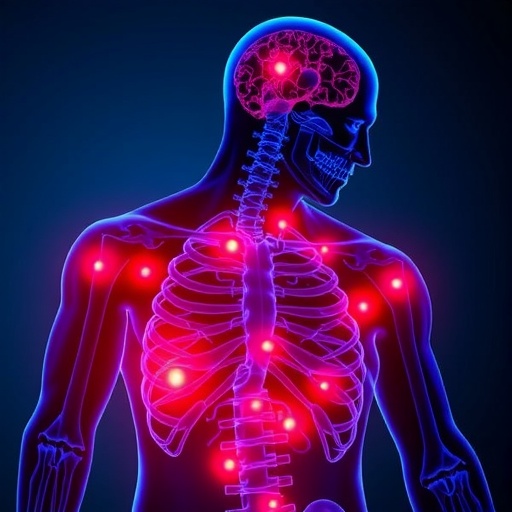
Radiation therapy (RT) using high-energy particles, like x-rays or electron beams, is a common and critical component in successfully treating patients with brain tumors, but it is also associated with significant adverse effects, such as neuronal loss in adjacent healthy tissues.

In a new study, published in the June issue of Brain Connectivity, researchers at the University of California San Diego School of Medicine report that irradiation can cause broader adverse effects, altering the structural network properties in impacted brains and perhaps contributing to delayed cognitive impairments observed in many patients following brain RT.

"RT is a mainstay of brain tumor treatment," said Naeim Bahrami, PhD, a postdoctoral fellow in the Center for Multimodal Imaging and Genetics at UC San Diego School of Medicine and first author of the study. "Unfortunately, a side effect can be incidental irradiation of normal brain tissue and radiation-induced injury, which have been linked to impairment of brain function. As patient outcomes improve, a major concern is managing long-term complications, including cognitive decline and disability."

Previous research has shown that RT can affect discrete brain regions by causing cortical atrophy. In the new study, Bahrami and colleagues used complex mathematical models, such as graph theory, to look more broadly by estimating the thickness of the brain cortex in 54 patients with brain tumors before and after RT, using magnetic resonance imaging.

They found that RT produced both local and global changes in the structural network topology of the brain, thinning the cortex at a rate faster than that associated with Alzheimer's disease, and increasing segregation between regions of the brain that typically work together to perform functions such as memory-making and recall.

Apart from adding new urgency to efforts to further refine RT and minimize adverse side effects, Bahrami said more research is needed to determine whether their topology-based technique might be useful in predicting or monitoring neurocognitive decline in patients following RT or other cancer-related therapies.

"Finding a non-invasive imaging biomarker to better assess cognitive function in the moment and in the future would be very helpful to clinicians," Bahrami said.

###

Co-authors of the study include: Tyler M. Seibert and AnithaPriya Krishan, Multimodal Imaging Laboratory; Roshan Karunamuni and Jona A. Hattangadi-Gluth, Department of Radiation Medicine; Hauke Bartsch and Nikokht Farid, Multimodal Imaging Laboratory and Department of Radiology; and senior author Carrie R. McDonald, Center for Multimodal Imaging and Genetics, departments of Psychiatry and Radiation Medicine and Multimodal Imaging Laboratory, all at UC San Diego.

Media Contact

Scott LaFee
[email protected]
858-249-0456
@UCSanDiego

http://www.ucsd.edu

http://dx.doi.org/10.1059/brain.2017.0494

############

Story Source: Materials provided by Scienmag
Share12Tweet8Share2ShareShareShare2

Related Posts

Loss of Luminal Lineage Fuels Resistance to ERα Antagonists

April 1, 2026

Adults with Unknown Autoinflammation Mimic Still’s Disease

April 1, 2026

Excess Pancreatic Fat in Obese Youth Associated with Increased Cardiometabolic Health Risks

April 1, 2026

Questions Raised About the Efficacy of Popular ‘KT-Tape’ in Relieving Joint and Muscle Pain and Enhancing Mobility

April 1, 2026
Please login to join discussion

POPULAR NEWS

  • blank

    Revolutionary AI Model Enhances Precision in Detecting Food Contamination

    96 shares
    Share 38 Tweet 24
  • Imagine a Social Media Feed That Challenges Your Views Instead of Reinforcing Them

    1006 shares
    Share 398 Tweet 249
  • Promising Outcomes from First Clinical Trials of Gene Regulation in Epilepsy

    51 shares
    Share 20 Tweet 13
  • Popular Anti-Aging Compound Linked to Damage in Corpus Callosum, Study Finds

    43 shares
    Share 17 Tweet 11

About

We bring you the latest biotechnology news from best research centers and universities around the world. Check our website.

Follow us

Recent News

Creating Desktop Particle Accelerators to Open New Frontiers in Scientific Research

Do Your Genes Influence How Lifestyle Choices Affect Aging?

Urban Systems and Traffic: Unequal Two-Way Links

Subscribe to Blog via Email

Enter your email address to subscribe to this blog and receive notifications of new posts by email.

Join 78 other subscribers
  • Contact Us

Bioengineer.org © Copyright 2023 All Rights Reserved.

Welcome Back!

Login to your account below

Forgotten Password?

Retrieve your password

Please enter your username or email address to reset your password.

Log In
No Result
View All Result
  • Homepages
    • Home Page 1
    • Home Page 2
  • News
  • National
  • Business
  • Health
  • Lifestyle
  • Science

Bioengineer.org © Copyright 2023 All Rights Reserved.