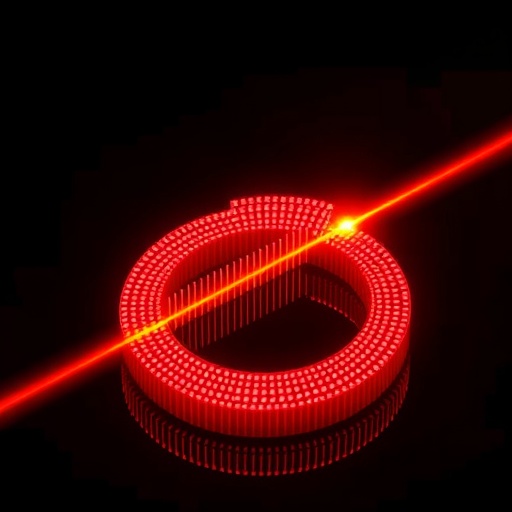
A groundbreaking advancement in photonic technology has emerged from a collaborative research venture between Harvard University and the Technical University of Vienna, promising to revolutionize mid-infrared spectroscopy through unprecedented miniaturization and stability. At the core of this innovation lies a racetrack-shaped quantum cascade laser (QCL), a compact on-chip device that generates bright, stable frequency combs—precisely spaced, multi-frequency laser emissions essential for delicate optical measurements. This development opens the door to integrated spectrometry systems with the power and precision traditionally confined to sprawling laboratory environments.
Quantum cascade lasers stand as a unique class of semiconductor lasers notable for their emission in the mid-infrared range, a spectral window rich with absorption features for a variety of gases, including greenhouse gases like methane and carbon dioxide. Detecting these molecules with high sensitivity and resolution is paramount for environmental monitoring and industrial process control. Conventional frequency combs, which produce a set of equidistant spectral lines resembling the teeth of a comb, have been instrumental in cutting-edge optical measurement. However, achieving such combs in the mid-infrared band has posed persistent challenges related to device size, stability, and susceptibility to external perturbations.
The team’s innovation pivots on transforming the laser architecture from the traditional linear bar emitter to a unidirectional ring resonator intricately shaped as a racetrack. Within this closed-loop pathway, light circulates bi-directionally but principally in one direction, at an astonishing repetition rate of approximately 15 gigahertz. The racecourse-like shape of the resonator is engineered to optimize optical confinement and mode stability, substantially mitigating the deleterious influence of back-reflected light, a common convulsion inducing instability in conventional comb-generating lasers.
Engineers have introduced a synergistic electrical driving mechanism via metallic probes, stimulating the racetrack laser with a radio-frequency (RF) signal precisely matched to the optical round-trip frequency. This radio-frequency injection enforces phase locking between the electronic modulation and the optical oscillation, effectively switching the laser emission on and off at ultra-high speeds. This form of active modulation coerces the laser’s emission spectrum into the highly ordered frequency comb structure, augmenting the comb’s coherence and amplitude stability. By essentially toggling the laser’s output synchronously with the RF drive, the researchers have crafted a broadband, spectrally rich comb without resorting to bulky external stabilization apparatuses.
A pivotal advantage of the racetrack design is its inherent immunity to optical feedback, a notorious plague in traditional frequency comb lasers. When stray reflections enter the optical cavity of linear lasers, they can induce chaotic interference patterns that dismantle the comb’s coherence. In contrast, the racetrack laser’s unidirectional propagation ensures that reflected light moving against the main circulation direction experiences an immediate gain suppression, swiftly extinguishing any feedback-induced oscillations. Experiments verified this robustness by intentionally reflecting high levels of light back into the laser, noting negligible distortion in the frequency comb structure — a testament to the architecture’s feedback resilience.
This breakthrough holds transformative implications for dual-comb spectroscopy, a technique wherein two frequency combs with slightly distinct repetition rates interact to produce radio-frequency signals encoding molecular absorption spectra. Although powerful, current dual-comb systems are cumbersome, requiring meter-scale optical benches and intricate stabilization. The integration potential offered by multiple racetrack lasers fabricated on a single semiconductor chip, each driven independently by distinct RF signals, heralds a paradigm shift toward highly compact, chip-scale dual-comb spectrometers. Such devices could catalyze new eras in environmental sensing, industrial diagnostics, and medical breath analysis, heralding accessibility and portability previously unimaginable.
Historically, the generation of frequency combs required large free-space optical setups or delicate fiber laser systems, prone to mechanical drift and environmental interference. The quantum cascade laser platform, combined with RF injection locking, propels frequency comb technology into a solid-state, robust domain, completely compatible with standard semiconductor processing. This compatibility paves the way for mass production, cost reduction, and widespread deployment outside research laboratories, democratizing data acquisition in critical sectors such as climate science and precision medicine.
The racetrack QCL also taps into nonlinear optical phenomena within the laser cavity to maintain comb stability, further enhanced by the precision fabrication afforded by cleanroom semiconductor manufacturing. The precise layering and doping of semiconductor materials craft the quantum wells responsible for electron transitions and photon emission, with engineering controls that balance optical gain and dispersion management. These material engineering feats ensure that the mid-infrared frequency combs generated are not only broad in spectral coverage but also exhibit exceptional phase coherence.
Beyond spectrometry, the technology fundamentally advances our understanding of light-matter interaction at the nanoscale, harnessing intracavity dynamics to foster novel regimes of quantum optics. This may inspire future research into ultrafast pulse generation and integrated photonic circuits for quantum information processing. The ability to electrically control and stabilize complex optical states within a microscopic footprint redefines the boundaries of integrated photonic device engineering.
The research team, led by Federico Capasso—an acclaimed figure in applied physics—alongside first co-authors Ted Letsou and Johannes Fuchsberger, underscores the interdisciplinarity and international collaboration inherent in this effort. The work appears in the journal Optica, highlighting not only applied optics but also core principles of nonlinear optics, photonics, and quantum mechanics. Supported by the National Science Foundation, this research continues the legacy of pioneering efforts to harness light in compact, high-performance formats.
Looking forward, integration of racetrack QCLs with on-chip detectors, waveguides, and electronic control circuitry promises fully autonomous sensing modules. Such platforms could continuously monitor atmospheric gases with unparalleled sensitivity, benefitting climate change research and industrial emission control. Moreover, the compactness and stability of the comb source could enable handheld devices for medical diagnostics, providing non-invasive breath analysis capabilities for early disease detection with real-time results.
This research epitomizes the confluence of advanced materials science, electrical engineering, and photonics, achieving what once was a monumental laboratory feat on a microchip scale. By mastering control over frequency modulated ring laser combs, the scientific community edges closer to ubiquitous, precise, and flexible optical tools that will permeate numerous facets of modern life.
Subject of Research: Not applicable
Article Title: High-power ring laser frequency-modulated combs
News Publication Date: 18-Mar-2026
Web References:
https://opg.optica.org/optica/fulltext.cfm?uri=optica-13-3-533
https://seas.harvard.edu/person/federico-capasso
https://www.nobelprize.org/prizes/physics/2005/9807-the-nobel-prize-in-physics-2005-2005-6/
https://seas.harvard.edu/news/compact-mid-infrared-pulse-generator
References:
Capasso, F., Letsou, T., Fuchsberger, J., Schwarz, B., et al. “High-power ring laser frequency-modulated combs.” Optica (2026).
Image Credits: Joshua Mornhinweg
Keywords
Applied optics, Optics, Light sources, Optical devices, Photonics, Nanophotonics, Nonlinear optics, Laser physics, Light, Light beams, Light polarization, Light propagation, Optical wavelengths, Quantum mechanics, Quantum optics
Tags: compact frequency comb technologyenvironmental gas detection lasershigh-precision laser emissionsintegrated spectrometry systemsmethane and carbon dioxide sensingmid-infrared frequency combsmid-infrared optical measurementson-chip photonic devicesquantum cascade laser miniaturizationracetrack-shaped quantum cascade laserssemiconductor lasers for spectroscopystable frequency comb generation