An increasing number of emerging quantum applications operate using optical technologies. Essentially, photons carry information at the speed of light and over long distances, making them good candidates for fast and secure communications and quantum computing. Many of these applications require photons that are identical (indistinguishable). When the photons are not identical, it can lead to errors in the data and quantum technologies become less reliable.
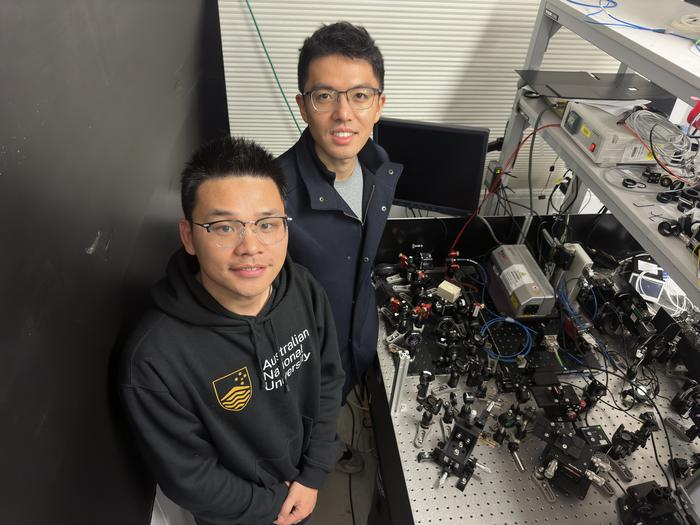
Credit: TMOS
An increasing number of emerging quantum applications operate using optical technologies. Essentially, photons carry information at the speed of light and over long distances, making them good candidates for fast and secure communications and quantum computing. Many of these applications require photons that are identical (indistinguishable). When the photons are not identical, it can lead to errors in the data and quantum technologies become less reliable.
Currently, quantum photon sources are regularly taken offline to be tested and adjusted using an interferometer. This requires comparing photons multiple times using different configurations, a process that is time consuming and requires relatively bulky equipment that can accommodate the various physical arrangements.
Real-time analysis of photon indistinguishability that can be conducted within a device while it operates could improve the precision of quantum technologies.
Researchers at TMOS, the ARC Centre of Excellence for Transformative Meta-Optical Systems, have designed and demonstrated a new device that uses an ultra-thin metasurface to do all the necessary measurements in a single pass. The work was reported today in Optica.
Co-lead author Jihua Zhang says, “This metasurface-enabled multiport interferometer can determine if a photon pair’s properties are identical in a single shot. It doesn’t need multiple measurements using phase or time delays because the multiport structure allows the device to run measurements concurrently. This enables realtime and accurate characterization.”
One essential advantage is that this multiport interfrerometer is single-element, which not only reduces the size but also make it ultrastable when compared with previous multiport interferometers in the free-space optical setup. The use of meta-optics further decreases the size, weight and power of the device, as well as the cost of production. Flat optics, as meta-optics has become known, is key to miniaturising optical systems, which will in turn lead to the miniaturisation of devices we use day to day. It
Co-lead author Jinyong Ma says, “We created a static, dielectric metasurface grating without any reconfigurable elements. The grating was designed using multi-factor topology optimization, which is essentially adjusting the surface pattern so that it interacts with light in a specific way. After successful simulations, fabrication and a one-off calibration, we were able to successfully characterise the similarity of the photons’ spatial mode, polarization and spectra.”
Chief Investigator Andrey Sukhorukov, who leads the research from the Australian National University, says, “The success of our experimental trials suggests that the work could be further developed to also measure the indistinguishability of other photon properties, such as orbital angular momentum. It could underpin ultracompact and power-efficient optical elements that would be especially suited for portable and satellite-based free space quantum photonic technologies.”
For more information about this research, contact [email protected]
Journal
Optica
DOI
10.1364/OPTICA.516064
Method of Research
Experimental study
Subject of Research
Not applicable
Article Title
Single-shot characterization of photon indistinguishability with dielectric metasurfaces
Article Publication Date
23-May-2024