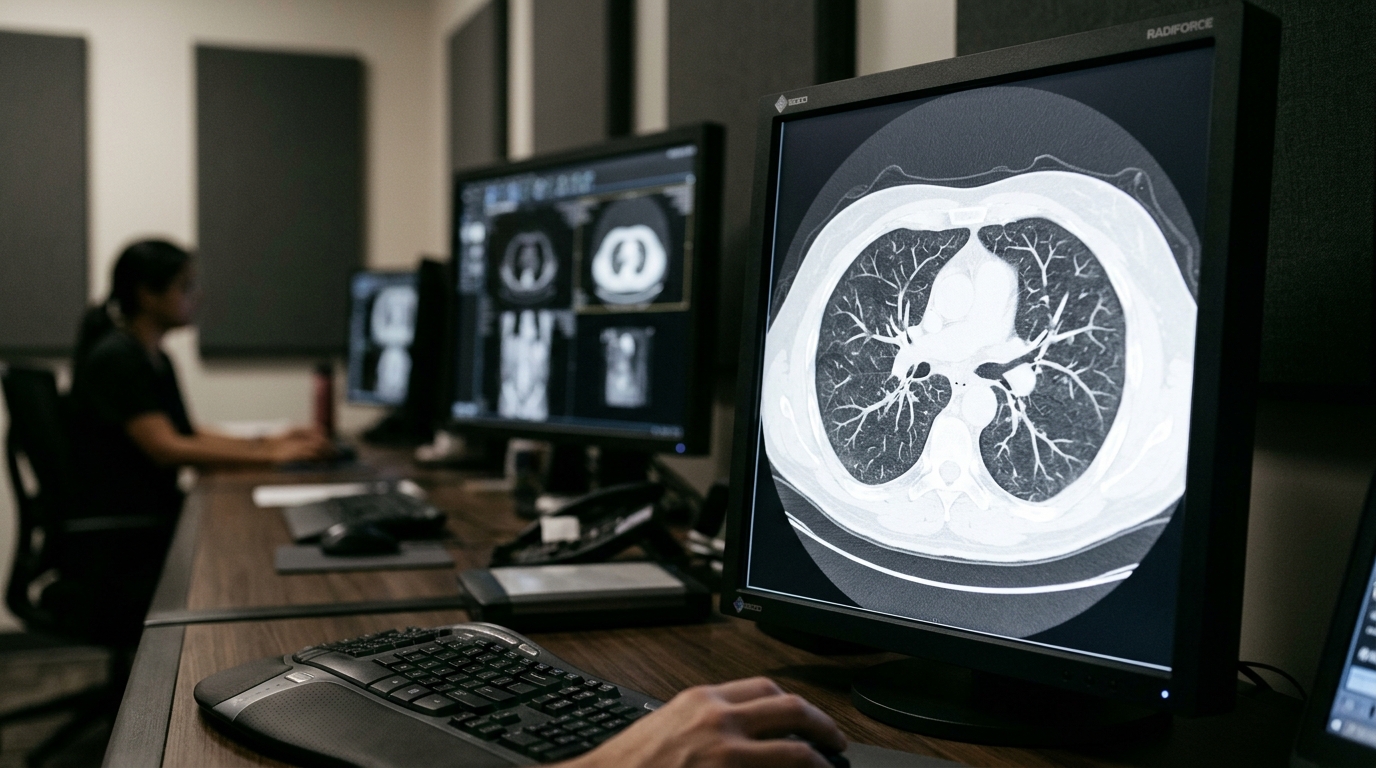
Researchers evaluating quantum computing algorithms for medical diagnostics have demonstrated that Quantum Support Vector Machines achieve an average eight percent increase in recall over classical models when classifying lung cancer across balanced patient datasets. In a study published in BMC Artificial Intelligence, investigators analyzed how encoding classical clinical records into high-dimensional quantum states alters diagnostic sensitivity. The investigation focused on Support Vector Classification architectures, directly comparing conventional kernel methods against a quantum framework employing a specialized feature map and simulator backend. While classical machine learning algorithms achieved superior overall accuracy, precision, specificity, and area under the receiver operating characteristic curve, the quantum classifier exhibited consistent advantages in identifying true positive cancer cases. This primary outcome indicates that quantum-enhanced feature spaces can address critical healthcare scenarios where the diagnostic priority of detecting malignant cases outweighs the burden of resolving false positives, offering an alternative computational strategy for cancer screening pipelines.
Lung cancer remains among the most prevalent and deadly malignancies worldwide, making early and accurate clinical identification crucial for improving patient survival rates and long-term treatment outcomes. Traditional clinical diagnostic modalities, including radiographic imaging and tissue biopsies, frequently encounter operational limitations tied to diagnostic expense, procedural accessibility, and variable accuracy. As a result, medical research has increasingly embraced supervised machine learning algorithms to evaluate expansive patient cohorts and uncover complex pathological signatures that elude conventional screening methods. Classical computational models such as decision trees, random forests, and deep neural networks have shown significant diagnostic capability, yet they regularly confront difficulties when navigating high-dimensional spaces, non-linear relationships, and intricate feature correlations. Quantum Machine Learning has therefore attracted growing interest as a methodology that exploits quantum principles to transform classical inputs into expanded feature representations, theoretically facilitating the resolution of complicated diagnostic boundaries that classical computational algorithms struggle to untangle.
The mathematical foundation of classical Support Vector Classification centers on constructing an optimal separating hyperplane that maximizes the geometric margin between distinct diagnostic categories. When data distributions are not perfectly separable, the algorithm incorporates slack variables into its optimization formulation to permit controlled misclassifications along the decision boundary. The governing optimization objective minimizes half the squared Euclidean norm of the weight vector plus the sum of slack variables multiplied by a penalty parameter, denoted as C. This penalty parameter dictates the delicate equilibrium between margin width and classification tolerance. Selecting an elevated C parameter penalizes misclassifications strictly, producing narrower geometric margins that elevate the danger of statistical overfitting to training data. Conversely, configuring a low C parameter accepts more classification errors in exchange for wider separation margins, fostering superior generalization on unseen observations. In experimental machine learning workflows, this regularization parameter is systematically tuned using exhaustive grid search cross-validation or probabilistic Bayesian optimization methods.
To accommodate non-linear data distributions, the Support Vector Machine framework transitions from its primal form into a Lagrangian dual formulation governed by Lagrange multipliers. Under these dual constraints, the optimization problem depends entirely on computing inner products between sample vectors rather than calculating explicit point coordinates. The kernel trick leverages this property by substituting vector inner products with mathematical kernel functions, effectively projecting input data into higher-dimensional spaces where linear boundaries can separate complex classes. Standard mathematical formulations include the polynomial kernel, defined by an offset constant and degree exponent, and the Radial Basis Function kernel, which utilizes an adjustable gamma parameter to calibrate the width of Gaussian curves. While these established mathematical kernels allow classical algorithms to construct intricate decision boundaries without directly evaluating high-dimensional transformations, they can encounter severe performance bottlenecks when mapping complex, correlated biomedical attributes that exhibit subtle interactions across patient profiles.
Quantum Support Vector Classification expands classical kernel methodology by mapping numerical patient features into quantum states within a multi-dimensional Hilbert space via unitary transformations. In this study, the quantum pipeline implemented a ZZ-Feature Map, which encodes data by applying single-qubit Hadamard gates and Z-axis rotations to initialized ground-state qubits, followed by entangling phase gates that capture pairwise feature interactions. The resulting quantum kernel operates through the FidelityQuantumKernel algorithm, computing inner products directly from the squared overlap fidelity between encoded quantum states.
The empirical investigation utilized the publicly accessible Lung Cancer Risk in 25 Countries dataset from Kaggle, containing 220,632 records and 24 clinical, demographic, and binary attributes. The baseline data exhibits severe natural class imbalance, comprising 8,961 positive lung cancer diagnoses alongside 211,671 negative diagnoses. To construct a balanced diagnostic testbed and prevent algorithmic learning biases, the researchers extracted five mutually exclusive subsets without replacement, with each subset consisting of 1,000 unique records split evenly into 500 positive and 500 negative cases. Prior to model training, twelve features were excised to prevent data leakage and eliminate irrelevant information: patient identifiers, survival duration, country, population size, adenocarcinoma histological subcategory, early detection markers, treatment classification, country development status, regional prevalence, tumor stage, annual deaths, and broader mortality rates. This feature filtering ensured that both algorithms were assessed exclusively on genuine risk factors rather than retrospective outcomes or demographic confounders.
The remaining categorical and binary variables underwent label encoding to convert textual attributes into integer values suitable for algorithmic processing. Continuous numerical attributes—specifically patient age, years of smoking, and daily cigarette consumption—were standardized through subset-specific z-score normalization, subtracting the mean and dividing by the standard deviation. Each subset was handled independently during data preparation and model evaluation to replicate realistic clinical settings where predictive tools are deployed across isolated patient cohorts. To avoid the arbitrary selection biases associated with single train-test splits, the researchers applied stratified five-fold cross-validation within each of the five subsets. This cross-validation design guaranteed that the fifty-fifty ratio between positive and negative cases was maintained across every fold, while continuous variables were scaled using parameters derived strictly from training folds. In total, this experimental protocol yielded twenty-five distinct evaluation checkpoints per classifier, establishing a rigorous basis for comparing algorithmic stability.
The performance evaluation tracked six standard classification metrics derived from confusion matrix parameters: accuracy, precision, recall, specificity, F1-score, and area under the receiver operating characteristic curve. Across all cross-validation folds, the classical Support Vector Machine secured superior general metrics, achieving an average accuracy of 0.65, specificity of 0.65, precision of 0.65, and a receiver operating characteristic score of 0.66. Conversely, the Quantum Support Vector Machine achieved an average recall improvement of approximately eight percent, reaching higher sensitivity than the classical model across balanced testing subsets. However, this sensitivity came with distinct performance trade-offs: the quantum model recorded a lower average precision of 0.55, a specificity of 0.41, and an area under the curve of 0.58. Because the quantum model’s heightened sensitivity compensated for its lower precision, both systems delivered comparable overall F1-scores, averaging 0.65 for the classical model and 0.63 for the quantum algorithm in balanced testing environments.
A detailed fold-wise analysis across all twenty-five evaluation checkpoints confirmed that the observed trade-offs remained remarkably consistent. Classical support vector models maintained stable operational ranges, with accuracy fluctuating moderately between 0.59 and 0.70 and recall spanning from 0.56 to 0.72. By contrast, the quantum classifier exhibited wider variance in accuracy, ranging from 0.50 to 0.63, while demonstrating higher sensitivity values spanning from 0.62 to 0.83. This superior recall materialized across all five subsets, with the quantum model exceeding classical sensitivity in nearly every individual evaluation fold. The standard deviation for quantum recall was slightly wider at plus or minus 0.06 compared to 0.05 for the classical model, indicating greater dispersion alongside increased positive responsiveness. Confusion matrices demonstrated that the quantum model systematically prioritized positive labeling, substantially reducing dangerous false negatives while generating more false positives, a pattern reflected in ROC curves where steeper quantum slopes indicated elevated false positive rates at lower decision thresholds.
When the researchers recalculated model precision under an assumed epidemiological prevalence ratio of one positive cancer diagnosis per one hundred negative screenings, both models experienced a severe decline in predictive value. Classical support vector precision dropped from sixty-five percent to 1.82 percent, while quantum classifier precision fell from fifty-five percent to 1.23 percent. This steep reduction underscores that while quantum feature mapping consistently boosts sensitivity, its vulnerability to false positive accumulation becomes pronounced under severe class imbalance. Furthermore, the authors noted critical methodological constraints: the study evaluated relatively small, artificially balanced cohorts of 1,000 tabular patient records rather than large, diverse clinical datasets, and execution was limited to classical simulators rather than physical quantum hardware. Consequently, the researchers concluded that while quantum support vector classifiers show promising sensitivity gains for oncology diagnostics, practical clinical implementation requires extensive future validation on heterogeneous real-world cohorts, exploration of alternative quantum kernels, and testing on actual fault-tolerant quantum hardware.
Subject of Research: Quantum Support Vector Machine performance and sensitivity in lung cancer diagnostic classification
Article Title: Overcoming SVM limitations in lung cancer classification with a quantum feature map
Article References: Toufah, A., Kadim, M. A., & El Hafidi, M. Y. (2025). Overcoming SVM limitations in lung cancer classification with a quantum feature map. BMC Artificial Intelligence, 1(1), Article 15. https://doi.org/10.1186/s44398-025-00016-3
Image Credits: AI Generated
DOI: 10.1186/s44398-025-00016-3
Keywords: Quantum Machine Learning, Support Vector Machines, Lung Cancer Classification, Quantum Kernel, ZZFeatureMap, Medical Diagnostics, Diagnostic Sensitivity, Class Imbalance, Overcoming, limitations, lung, cancer
News Source: Nathaniel Bowman. (November 7, 2026). Quantum Feature Maps Boost Recall in Simulated Lung Cancer Classification. Scienmag.