• HOME
  • NEWS
  • EXPLORE
    • CAREER
      • Companies
      • Jobs
    • EVENTS
    • iGEM
      • News
      • Team
    • PHOTOS
    • VIDEO
    • WIKI
  • BLOG
  • COMMUNITY
    • FACEBOOK
    • INSTAGRAM
    • TWITTER
Wednesday, July 8, 2026
BIOENGINEER.ORG
No Result
View All Result
  • Login
  • HOME
  • NEWS
  • EXPLORE
    • CAREER
      • Companies
      • Jobs
        • Lecturer
        • PhD Studentship
        • Postdoc
        • Research Assistant
    • EVENTS
    • iGEM
      • News
      • Team
    • PHOTOS
    • VIDEO
    • WIKI
  • BLOG
  • COMMUNITY
    • FACEBOOK
    • INSTAGRAM
    • TWITTER
  • HOME
  • NEWS
  • EXPLORE
    • CAREER
      • Companies
      • Jobs
        • Lecturer
        • PhD Studentship
        • Postdoc
        • Research Assistant
    • EVENTS
    • iGEM
      • News
      • Team
    • PHOTOS
    • VIDEO
    • WIKI
  • BLOG
  • COMMUNITY
    • FACEBOOK
    • INSTAGRAM
    • TWITTER
No Result
View All Result
Bioengineer.org
No Result
View All Result
Home NEWS Science News Chemistry

Quantum computing: Benchmarking performance by random data

Bioengineer by Bioengineer
August 29, 2023
in Chemistry
Reading Time: 2 mins read
0
Quantum computing: benchmarking performance by random data
Share on FacebookShare on TwitterShare on LinkedinShare on RedditShare on Telegram

With increasing size and complexity, quantum computers become a sort of black box. Using methods from mathematical physics, a team has now succeeded in deriving concrete numbers from random, data sequences that can serve as a benchmark for the performance of a quantum computer system. Experts from Helmholtz-Zentrum Berlin, Freie Universität Berlin, Qusoft Research Centre Amsterdam, the University of Copenhagen and the Technology Innovation Institute Abu Dhabi were involved in the work, which has now been published in Nature Communications.
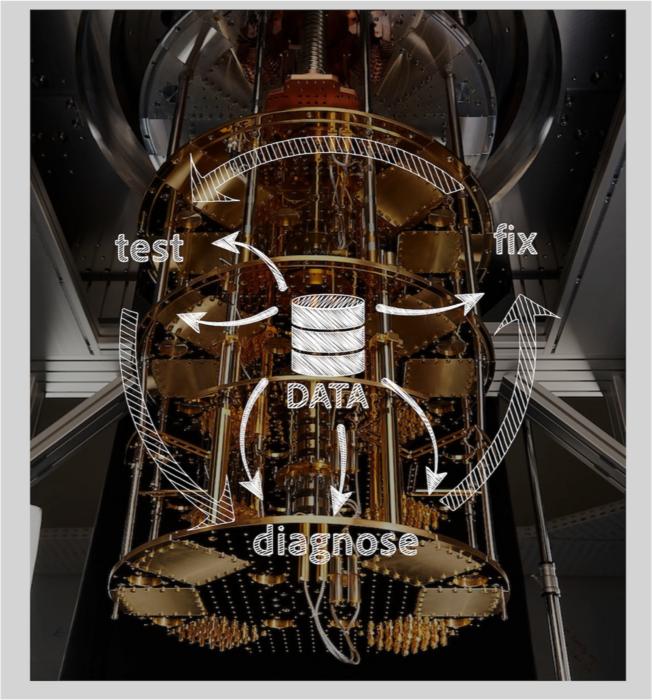
Quantum computing: benchmarking performance by random data

Credit: I. Roth/Quantum research center, TII

With increasing size and complexity, quantum computers become a sort of black box. Using methods from mathematical physics, a team has now succeeded in deriving concrete numbers from random, data sequences that can serve as a benchmark for the performance of a quantum computer system. Experts from Helmholtz-Zentrum Berlin, Freie Universität Berlin, Qusoft Research Centre Amsterdam, the University of Copenhagen and the Technology Innovation Institute Abu Dhabi were involved in the work, which has now been published in Nature Communications.

Quantum computers can be used to calculate quantum systems much more efficiently and solve problems in materials research, for example. However, the larger and more complex quantum computers become, the less transparent the processes that lead to the result. Suitable tools are therefore needed to characterise such quantum operations and to fairly compare the capabilities of quantum computers with classical computing power for the same tasks. Such a tool with surprising talents has now been developed by a team led by Prof. Jens Eisert and Ingo Roth.

Roth, who is currently setting up a group at the Technology Innovation Institute in Abu Dhabi, explains: “From the results of random test sequences, we can now extract different numbers that show how close the operations are on statistical average to the desired operations. This allows us to learn much more from the same data than before. And what is crucial: the amount of data needed does not grow linearly but only logarithmically.” This means: to learn a hundred times as much, only twice as much data is needed. An enormous improvement. The team was able to prove this by using methods from mathematical physics.

“This is about benchmarking quantum computers,” says Eisert, who heads a joint research group on theoretical physics at Helmholtz-Zentrum Berlin and Freie Universität Berlin. “We have shown how randomised data can be used to calibrate such systems. This work is important for the development of quantum computers.”


Journal

Nature Communications

DOI

10.1038/s41467-023-39382-9

Method of Research

Computational simulation/modeling

Subject of Research

Not applicable

Article Title

Shadow estimation of gate-set properties from random sequences

Article Publication Date

19-Aug-2023

COI Statement

none

Share12Tweet8Share2ShareShareShare2

Related Posts

Salt adaptation linked to higher disease risk, Mizzou study finds

Salt adaptation linked to higher disease risk, Mizzou study finds

July 6, 2026
Intelligent Microgrid Management Promises Lower Household Energy Bills and Reduced Diesel Emissions — Chemistry

Intelligent Microgrid Management Promises Lower Household Energy Bills and Reduced Diesel Emissions

July 4, 2026

Graz University of Technology Deciphers the Structural Secrets of MOF Thin Films

July 2, 2026

Breaking Thermodynamic Limits: Wavelength-Driven Catalysis Advances Ammonia Synthesis

July 2, 2026

POPULAR NEWS

  • Detection of EDCs in Breast Milk and Infant Urine Up to Six Months Highlights Early Exposure Risks

    77 shares
    Share 31 Tweet 19
  • New Drug Candidate Developed at McMaster Shows Potential for Treating Brain Cancer

    58 shares
    Share 23 Tweet 15
  • Saying Goodbye to PGY-6: Pediatric Fellowship Realities

    103 shares
    Share 41 Tweet 26
  • KTU Researchers Explore Ultrasound’s Role in Enhancing Blood Flow Beyond Diagnostics

    53 shares
    Share 21 Tweet 13

About

We bring you the latest biotechnology news from best research centers and universities around the world. Check our website.

Follow us

Recent News

Flame retardant BDE-209 targets molecularly linked to ulcerative colitis

Ultra-high frequency particle impacts mimic rockbursts to shatter hard rock

Kidney transplant outcomes in older adults studied by German researchers

Subscribe to Blog via Email

Success! An email was just sent to confirm your subscription. Please find the email now and click 'Confirm' to start subscribing.

Join 83 other subscribers
  • Contact Us

Bioengineer.org © Copyright 2023 All Rights Reserved.

Welcome Back!

Login to your account below

Forgotten Password?

Retrieve your password

Please enter your username or email address to reset your password.

Log In
No Result
View All Result
  • Homepages
    • Home Page 1
    • Home Page 2
  • News
  • National
  • Business
  • Health
  • Lifestyle
  • Science

Bioengineer.org © Copyright 2023 All Rights Reserved.