As wildfires continue to ravage landscapes worldwide, researchers are turning to cutting-edge technologies to craft smarter, more effective strategies for wildfire management. A groundbreaking study by Dent, Stoddard, Smith, and colleagues, soon to be published in Communications Engineering, reveals an innovative approach that harnesses the power of network separation modeling combined with quantum computing to design wildfire fuelbreaks — the critical barriers that starve fires of fuel and help control their spread.
Wildfire fuelbreaks have long served as a frontline defense in firefighting, carved strategically into forests and grasslands to slow advancing flames. Yet, determining the optimal placement and design for these breaks remains complex due to the unpredictable nature of fire behavior, complex terrain, and vast spatial scales involved. Traditional approaches often rely heavily on empirical methods and classical computational models, which struggle to fully capture the dynamic and interconnected variables influencing wildfire propagation. This latest research marks a paradigm shift by deploying network theory and quantum information science as novel tools to dissect and manipulate the fire spread network at unprecedented granularity.
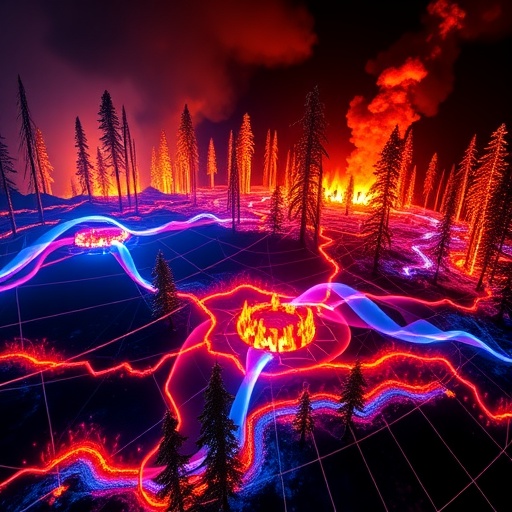
At its core, the methodology conceptualizes a wildfire landscape as a vast, multifaceted network where nodes symbolize patches of combustible terrain, and edges represent potential pathways for fire transmission. Network separation modeling, a mathematical framework designed to identify the minimal interventions that maximally sever the connectivity within a network, becomes a centerpiece of analysis. By applying this framework, researchers can pinpoint critical choke points within the landscape—those precise locations where establishing fuelbreaks would most effectively disrupt fire spread and protect vulnerable ecosystems and human habitations.
However, the ambition to analyze and manipulate such intricate networks encounters steep computational hurdles. Wildfire landscapes constitute enormously complex graphs with millions of nodes and interconnections, generating combinatorial challenges that rapidly overwhelm classical supercomputers. This is where the team’s ingenious application of quantum computing enters the picture. Leveraging the properties of quantum bits, or qubits, quantum algorithms execute network separation computations in parallel across vast solution spaces, dramatically accelerating optimization processes that would otherwise take years or decades on conventional hardware.
The researchers utilized a state-of-the-art quantum annealer device, capable of solving specific forms of complex optimization problems by encoding them into quantum states and guiding the system to settle into the lowest-energy configuration—a solution representing the ideal pattern of fuelbreak placement. Through rigorous simulations on real-world datasets spanning fire-prone regions in California and Australia, the quantum-enhanced framework was able to generate fuelbreak designs that balanced efficacy, environmental impact, and economic feasibility better than any classical benchmark.
What makes this research especially compelling is the detailed incorporation of diverse ecological and topographical variables into the network model. The scholars integrated data layers such as vegetation types, moisture content, wind patterns, slope gradients, and human infrastructure into their nodal and edge attributes. As a result, the network separation solutions are highly tailored, reflecting the nuanced interplay between environmental conditions and fire dynamics rather than relying on oversimplified assumptions.
Furthermore, the approach demonstrates a powerful capability for adaptive management. By rerunning the quantum optimization with updated environmental inputs—such as seasonal changes or short-term weather forecasts—managers can continuously refine and reconfigure fuelbreak plans in near real-time. This dynamic responsiveness could revolutionize wildfire prevention strategies, allowing rapid adjustments to emerging threats and minimizing losses.
Beyond practical applications, the study advances fundamental scientific understanding of wildfire behavior through the lens of complex systems theory. The network perspective underscores fire as a collective phenomenon shaped by local interactions propagating across scales, revealing hidden vulnerabilities and resilience mechanisms within ecosystems. By uncovering these systemic patterns, the work opens pathways for interdisciplinary collaborations linking ecology, physics, computer science, and environmental engineering.
Critically, the integration of quantum computing signals a broader trend in leveraging emerging technologies to tackle urgent environmental crises. While quantum hardware remains in early stages and faces engineering challenges, this study exemplifies how progress in quantum algorithms and problem encoding can yield tangible benefits even now. It anticipates a future where powerful quantum systems become routine tools in environmental modeling and disaster mitigation.
The researchers also emphasize the societal implications of their work. Fuelbreak optimization informed by rigorous network science can protect valuable natural resources, safeguard lives, and reduce economic damages caused by wildfires. Particularly for vulnerable communities in fire-prone zones, such precise intervention strategies hold promise for enhancing resilience and strengthening disaster preparedness frameworks.
Looking ahead, the team envisions extensions of their model to encompass interactions between multiple hazards, such as simultaneous fire and drought impacts, or coupling with climate change projections to forecast long-term landscape shifts. Additionally, they aim to integrate ground-based sensor data and remote satellite observations to fine-tune real-time network models and improve predictive accuracy.
The publication of this pioneering research in Communications Engineering underscores the transformative potential of merging abstract mathematical theories with state-of-the-art computational platforms to solve concrete environmental problems. Dent, Stoddard, Smith, and their colleagues have illuminated a path toward smarter, more adaptive wildfire management that is both scientifically rigorous and technologically visionary.
As climate change continues to fuel more frequent and severe fires globally, innovations like network separation modeling and quantum-powered optimization could become indispensable cornerstones in humanity’s extensive toolkit for coexistence with nature’s fiery forces. This cutting-edge study not only pushes the frontier of wildfire science but also offers hope for more effective stewardship of vulnerable ecosystems in an increasingly uncertain world.
Subject of Research: Wildfire fuelbreak strategy development using network separation modeling and quantum computing.
Article Title: Network separation modeling and quantum computing for developing wildfire fuelbreak strategy.
Article References:
Dent, S., Stoddard, K., Smith, M. et al. Network separation modeling and quantum computing for developing wildfire fuelbreak strategy. Commun Eng (2026). https://doi.org/10.1038/s44172-026-00585-9
Image Credits: AI Generated
Tags: complex terrain fire behaviorcomputational models for wildfire predictioncutting-edge wildfire researchdynamic fire propagation analysisempirical methods in firefightinginnovative wildfire control techniquesinterdisciplinary approaches to wildfire controlnetwork models for fire spreadnetwork theory in environmental sciencequantum computing for wildfire managementwildfire fuelbreak design strategieswildfire management technologies