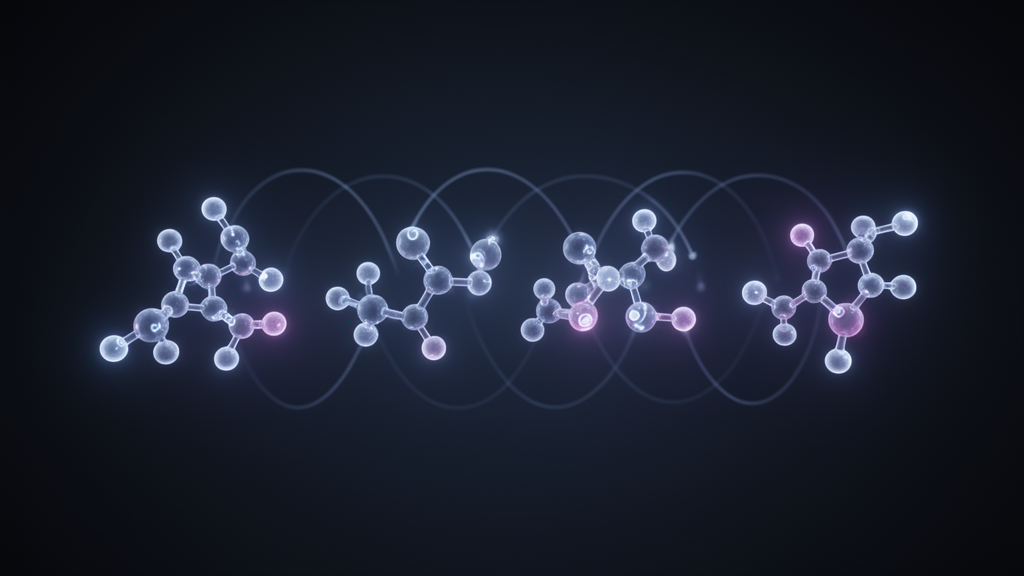
A comprehensive quantum chemical investigation has mapped the intrinsic gas-phase reaction pathways, thermodynamic profiles, and spectroscopic properties governing the formation of allylimine isomers under the extreme physical conditions of the interstellar medium. The study focused on four distinct structural conformers of the molecule—trans-anti, trans-syn, cis-anti, and cis-syn allylimine—following the recent tentative astronomical detection of the species toward the Galactic Center molecular cloud G+0.693−0.027. By evaluating barrierless radical-radical association mechanisms driven by fundamental precursor radicals, the researchers determined how these prebiotic nitrogen-bearing species assemble in space. However, because isolated two-body collisions in cold, low-density interstellar gas generate nascent intermediate complexes with significant excess internal energy that cannot easily dissipate through collisions, the findings demonstrate that these reactions require third-body solid-state grain surfaces to prevent rapid fragmentation into smaller molecular fragments.
To rigorously investigate the underlying energetics and molecular geometries, the researchers utilized high-level density functional theory combined with coupled-cluster electronic structure refinements. Geometry optimizations and analytical harmonic vibrational frequency calculations for all stationary points were performed using the double-hybrid omegaB97XD functional paired with the large aug-cc-pVQZ basis set. Analytical frequency analyses confirmed that every optimized stationary point corresponded to a true local minimum on the potential energy surface by yielding zero imaginary frequencies. For refined energetics, single-point energy calculations were carried out on the optimized geometries at the coupled-cluster singles and doubles with perturbative triples, or CCSD(T), level using the aug-cc-pVTZ basis set. Single-point electronic energies were augmented with zero-point vibrational energy corrections scaled by a universal factor of 0.9862 to ensure consistency with empirical vibrational benchmarks.
The electronic structure calculations firmly establish the relative stability hierarchy among the four allylimine isomers, identifying the trans-anti conformer as the global thermodynamic minimum. At the CCSD(T)/aug-cc-pVTZ level of theory, the trans-syn conformer resides only 0.8 kilocalories per mole above the trans-anti global minimum, whereas the cis-anti and cis-syn conformers are located significantly higher in energy, at 2.8 and 3.3 kilocalories per mole above the ground state, respectively. Relative energy calculations computed at the omegaB97XD level expressed in wavenumbers relative to the trans-anti isomer show values of 438.9 reciprocal centimeters for trans-syn, 1097.4 reciprocal centimeters for cis-anti, and 1536.3 reciprocal centimeters for cis-syn, corresponding to equivalent thermal temperatures of 631.2 Kelvin, 1578.2 Kelvin, and 1894.8 Kelvin. The energetic proximity between the two cis conformers, separated by only 0.5 kilocalories per mole, reflects substantial conformational strain compared to the planar trans structures.
The assembly of the allylimine isomeric family proceeds from three fundamental radical building blocks that are abundant in the interstellar medium: methylidyne, methylene, and imidogen radicals. Across all mapped pathways, the initial chemical step involves the barrierless, highly exothermic recombination of methylene and methylidyne to synthesize the vinyl radical. Relaxed potential energy surface scans confirmed that this entrance channel proceeds without an activation barrier, releasing a reaction enthalpy at zero Kelvin of negative 174.9 kilocalories per mole. The substantial energetic stability of the resulting vinyl intermediate is largely attributable to the delocalization of its unpaired electron across the allylic pi-electron network. From this shared reactive intermediate, the chemical pathways bifurcate along distinct mechanistic routes to construct either the trans-anti and cis-anti isomers or the trans-syn and cis-syn isomers.
For the trans-anti and cis-anti conformers, the synthesis progresses through a sequential three-step addition mechanism designated as Reaction 1. In this sequence, the newly generated vinyl radical encounters a second methylidyne radical in another barrierless association step. Addition of methylidyne to the terminal carbon forms the trans-CH2CHCH intermediate radical with a reaction enthalpy at zero Kelvin of negative 81.1 kilocalories per mole, or alternatively yields the cis-CH2CHCH radical with an enthalpy release of negative 105.1 kilocalories per mole. In the terminal step, an imidogen radical attacks the radical carbon center of the conjugated chain. For the trans intermediate, addition of imidogen releases negative 196.7 kilocalories per mole to produce the trans-anti allylimine isomer, while addition to the cis intermediate releases negative 170.0 kilocalories per mole to form the cis-anti isomer.
A distinct mechanistic sequence, termed Reaction 2, accounts for the formation of the trans-syn and cis-syn isomers of allylimine by altering the pairing order of the radical precursors. In this second reaction network, the methylidyne radical first couples directly with the imidogen radical to generate a resonance-stabilized CHNH intermediate radical. This initial bimolecular coupling is exceptionally exothermic, releasing approximately negative 212.1 kilocalories per mole relative to the separated reactants, with additional stability derived from conjugation between the nitrogen lone pair and the adjacent carbon-carbon bond. Subsequently, the vinyl radical recombines with this CHNH radical in a barrierless association. Depending on the spatial orientation of the radical precursors during mutual approach, this recombination yields trans-syn allylimine with a reaction enthalpy of negative 98.5 kilocalories per mole, or cis-syn allylimine with an enthalpy release of negative 95.9 kilocalories per mole.
Standard statistical thermodynamic evaluations carried out at 298.15 Kelvin and one atmosphere pressure provide comprehensive thermodynamic parameters that further illustrate the spontaneous, exergonic nature of these synthetic routes. The calculated changes in Gibbs free energy relative to the initial precursor radicals demonstrate that trans-anti allylimine is the most thermodynamically favored product, with a delta G of negative 187.0 kilocalories per mole. The cis-anti isomer follows with a delta G of negative 161.2 kilocalories per mole, while trans-syn and cis-syn exhibit free energy changes of negative 86.7 and negative 84.2 kilocalories per mole, respectively. Enthalpy changes at standard temperature show a parallel energetic distribution, evaluated at negative 198.3 kilocalories per mole for trans-anti, negative 170.9 kilocalories per mole for cis-anti, negative 99.7 kilocalories per mole for trans-syn, and negative 97.4 kilocalories per mole for cis-syn.
Despite the steep thermodynamic driving forces and barrierless reaction profiles, the researchers emphasized that these gas-phase associations face severe physical obstacles in low-density interstellar space. The immense kinetic energy and vibrational exothermicity imparted into the nascent intermediate complexes exceed the dissociation thresholds of weaker chemical bonds. In unassisted gas-phase collisions, the intermediate complexes cannot undergo rapid collisional stabilization and instead suffer exit-channel fragmentation, generating small dissociated products such as hydrogen cyanide or hydrogen isocyanide along with atomic hydrogen. Consequently, the authors conclude that these associative mechanisms physically require icy dust grain mantles to serve as third-body heat sinks. The amorphous solid water matrix of interstellar ice absorbs the extreme reaction heat through intermolecular coupling to the low-frequency phonon modes of the hydrogen-bonded lattice, thermalizing the complexes before fragmentation can take place.
The study also evaluated how non-thermal interstellar processes overcome severe kinetic bottlenecks that typically inhibit radical chemistry in quiescent interstellar environments. In cold molecular clouds at temperatures near ten Kelvin, heavy radicals are essentially immobile on dust grain surfaces, and abundant atomic hydrogen statistically drives competitive hydrogenation toward saturated species like propene. However, the unique astrophysical conditions of the Galactic Center molecular cloud G+0.693−0.027 resolve these limitations through widespread low-velocity shocks and intense cosmic-ray bombardment. Transient shock heating temporarily elevates grain mantle temperatures to enhance radical surface diffusion, while cosmic-ray penetration directly produces radical pairs in close proximity within bulk ice matrices. These energetic non-equilibrium phenomena enable the barrierless radical additions to successfully outcompete destructive hydrogenation and populate stabilized allylimine reservoirs.
To support future astronomical searches via rotational and radio spectroscopy, the researchers calculated the dipole moments and polarizabilities across the isomeric family. The trans-syn isomer exhibited the largest total dipole moment at 2.69 Debye, indicating substantial asymmetric charge separation that makes it highly polar and especially detectable in rotational transitions. The trans-anti isomer showed a calculated dipole moment of 2.18 Debye, closely matching available experimental measurements. Conversely, the cis-anti isomer yielded the smallest dipole moment at 1.73 Debye, meaning it interacts more weakly with electromagnetic fields and exhibits reduced gas-phase detectability. Ta ANH displayed the highest isotropic polarizability at 50.0 cubic angstroms, followed by Ts ANH at 49.0 cubic angstroms, while Ca ANH and Cs ANH showed lower values, reaching 46.4 cubic angstroms for the cis-syn isomer.
Detailed infrared spectral calculations between 500 and 4000 reciprocal centimeters, generated with a full width at half maximum of 40 reciprocal centimeters, provide vital diagnostic fingerprints for identifying allylimine conformers in laboratory ice analogs and space. In the high-frequency stretching regime between 2800 and 3600 reciprocal centimeters, the spectra feature a dense carbon-hydrogen stretching envelope between 3002.0 and 3226.0 reciprocal centimeters alongside distinct imine nitrogen-hydrogen stretching bands. Crucially, the nitrogen-hydrogen stretching frequency exhibits a clear conformational split: anti conformers absorb at higher frequencies of 3465.5 reciprocal centimeters for trans-anti and 3478.1 reciprocal centimeters for cis-anti, whereas syn conformers undergo a pronounced red-shift of 45 to 59 reciprocal centimeters, appearing at 3420.9 reciprocal centimeters for trans-syn and 3418.8 reciprocal centimeters for cis-syn.
Finally, the authors analyzed the kinetic stability of the allylimine isomers once formed, concluding that their observational interstellar abundances are strictly dictated by formation branching ratios rather than thermal interconversion. Established physical chemistry benchmarks indicate that structural isomerization via carbon-carbon double-bond rotation requires activation energies exceeding 60 kilocalories per mole, while imine nitrogen inversion requires over 20 to 30 kilocalories per mole. Under the low temperatures characteristic of interstellar molecular clouds, the available thermal energy is completely insufficient to cross these enormous activation barriers. Consequently, once allylimine conformers form and thermalize on icy grain surfaces, they remain kinetically trapped in their respective potential wells, ensuring that pristine chemical signatures of their radical synthesis are preserved across cosmic time.
Subject of Research: Quantum chemical modeling of interstellar allylimine formation pathways and spectroscopic properties
Article Title: Gas phase radical association pathways and spectroscopic properties of allylimine isomers
Article References: Mishra, P., Pandey, P., Ahamad, A., Singh, R., Shivani, Yadav, M., Misra, A., Shukla, A., & Tandon, P. (2026). Gas phase radical association pathways and spectroscopic properties of allylimine isomers. Discover Chemistry, 3(1), Article 640. https://doi.org/10.1007/s44371-026-01096-4
Image Credits: AI Generated
DOI: 10.1007/s44371-026-01096-4
Keywords: allylimine, astrochemistry, radical-radical association, interstellar medium, G+0.693-0.027, quantum chemical calculations, density functional theory, coupled-cluster theory, reaction enthalpy, infrared spectroscopy, dipole moment, polarizability, isomerization barriers, icy grain mantles, vibrational spectroscopy, Galactic Center
News Source: Katie Riggs. (November 21, 2026). Quantum Calculations Map Barrierless Interstellar Pathways Forming Four Allylimine Isomers. Scienmag.