Credit: Berkeley Seismological Laboratory
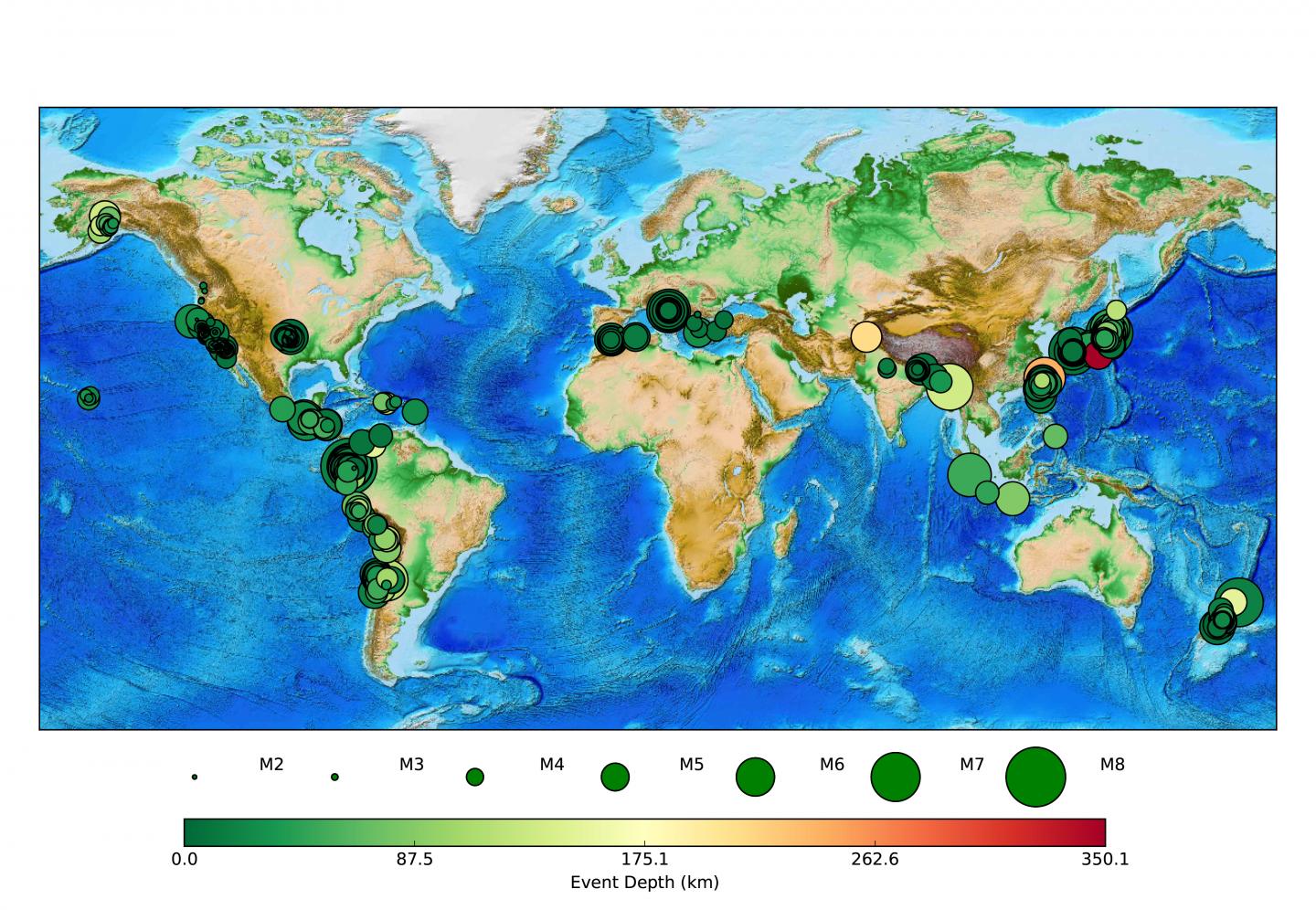
The University of California, Berkeley's worldwide network of smartphone earthquake detectors has recorded nearly 400 earthquakes since the MyShake app was made available for download in February, with one of the most active areas of the world the fracking fields of Oklahoma.
The Android app harnesses a smartphone's motion detectors to measure earthquake ground motion, then sends that data back to the Berkeley Seismological Laboratory for analysis. The eventual goal is to send early-warning alerts to users a bit farther from ground zero, giving them seconds to a minute of warning that the ground will start shaking. That's enough time to take cover or switch off equipment that might be damaged in a quake.
To date, nearly 220,000 people have downloaded the app, and at any one time, between 8,000 and 10,000 phones are active — turned on, lying on a horizontal surface and connected to a wi-fi network – and thus primed to respond.
An updated version of the MyShake app will be available for download Dec. 14 from the Google Play Store, providing an option for push notifications of recent quakes within a distance determined by the user, and the option of turning the app off until the phone is plugged in, which could extend the life of a single charge in older phones.
"The notifications will not be fast initially – not fast enough for early warning – but it puts into place the technology to deliver the alerts and we can then work toward making them faster and faster as we improve our real-time detection system within MyShake," said project leader Richard Allen, a UC Berkeley professor of earth and planetary sciences and director of the seismology lab.
In a presentation on Wednesday, Dec. 14, during this week's annual meeting of the American Geophysical Union in San Francisco, UC Berkeley developer and graduate student Qingkai Kong will summarize the app's performance. Ten months of operation clearly shows that the sensitivity of the smartphone accelerometers and the density of phones in many places are sufficient to provide data quickly enough for early warning. The phones readily detect the first seismic waves to arrive – the less destructive P waves – and send the information to Berkeley in time to issue an alert that the stronger S wave will soon arrive.
"We already have the algorithm to detect the earthquakes running on our server, but we have to make sure it is accurate and stable before we can start issuing warnings, which we hope to do in the near future," Kong said.
The app can detect quakes as small as magnitude 2.5, with the best sensitivity in areas with a greater density of phones. The largest number of phones to record a quake was 103, after the 5.2 magnitude quake that occurred on the San Jacinto fault near Borrego Springs in San Diego County on June 10. Phones 200 kilometers from the epicenter detected that temblor. The largest quake detected occurred on April 16 in Ecuador: a 7.8 magnitude quake that triggered two phones, 170 and 200 kilometers from the epicenter.
Allen, Kong and their colleagues at Deutsche Telekom's Silicon Valley Innovation Center believe the app's performance shows it can complement traditional seismic networks, such as that operated nationally by the U.S. Geological Survey, but can also serve as a stand-alone system in places with few seismic stations, helping to reduce injuries and damage from earthquakes.
While the app has detected quakes in seismically active areas such as Chile, Mexico, New Zealand, Taiwan, Japan and the West Coast of the U.S., one surprising hot spot has been the traditionally quiet state of Oklahoma. The practice of injecting oil well wastewater deep underground has activated faults in the area to the extent that the state is rattled hundreds of times a year.
"Oklahoma is now clearly No. 1 in terms of the number of earthquakes in the lower 48 states," Kong said.
Most of Oklahoma's earthquakes are small, but MyShake users in the state, which number only about 200, easily detected the Sept. 3 magnitude 5.8 quake, the strongest ever to hit the state. During that event, 14 phones in the state triggered, but even this relatively small number of phones allowed the seismology lab to peg the magnitude within 1 percent of estimates from ground seismic stations, and located the epicenter to within 4 kilometers (2.5 miles).
"These initial studies suggest that the data will be useful for a variety of scientific studies of induced seismicity phenomena in Oklahoma, as well as having the potential to provide earthquake early warning in the future," Kong said.
He will summarize the Oklahoma data during a poster session on Friday, Dec. 16.
The MyShake app and the computer algorithm behind it were developed by Allen, Kong and a team of programmers at the Silicon Valley Innovation Center in Mountain View, California, which is part of the Telekom Innovation Laboratories (T-Labs) operated by Deutsche Telekom, owner of T-Mobile. Louis Schreier, the leader of that team, co-wrote a paper with Allen and Kong on the first six months of MyShake's observations, published Sept. 29 in the journal Geophysical Research Letters.
###
Media Contact
Robert Sanders
[email protected]
510-643-6998
@UCBerkeleyNews
############
Story Source: Materials provided by Scienmag