In an experimental biomechanical investigation evaluating structural options for anterior cruciate ligament reconstruction, quadrupled semitendinosus tendon constructs achieved significantly higher ultimate load-to-failure and greater dynamic stiffness than all-soft-tissue quadriceps tendon constructs prepared with integrated suture tape augmentation. The research, conducted on fresh-frozen human cadaveric knee specimens, revealed that the quadrupled hamstring construct withstood an average ultimate tensile load of 806.1 newtons before mechanical failure, whereas the tape-augmented quadriceps tendon construct failed at an average load of 577.9 newtons. Furthermore, mechanical assessments established that every quadriceps specimen failed via longitudinal suture tape cut-through, commonly designated as cheese wiring, localized strictly at the proximal fixation interface rather than through mid-substance tendon rupture. By contrast, the quadrupled semitendinosus constructs failed primarily through suture material rupture under load. These experimental measurements offer direct mechanical insights into construct-specific limitations, demonstrating that the structural holding capacity of the tendon-implant interface represents the primary constraint when high-tensile braided tape is integrated directly into laminated donor tissue.
Anterior cruciate ligament ruptures represent one of the most widespread ligamentous injuries in clinical orthopedics, occurring with an estimated global incidence of approximately 70 cases per 100,000 individuals annually. Restoring knee joint stability routinely necessitates surgical reconstruction using autologous tendon grafts, with arthroscopic intervention remaining the established clinical benchmark. Historically, surgeons have relied extensively on bone-patellar tendon-bone preparations or multi-strand hamstring configurations, such as doubled semitendinosus-gracilis or quadrupled semitendinosus assemblies. While these conventional donor grafts yield dependable clinical outcomes, each presents distinct operational limitations, including donor site morbidity, anterior knee pain, and variable graft harvest diameters. Consequently, the all-soft-tissue quadriceps tendon autograft has attracted expanding interest as an alternative graft source. Harvesting the quadriceps tendon offers substantial graft tissue volume, customizable dimensional thickness, reduced donor site morbidity, and less postoperative pain than bone-tendon-bone harvests, making it an appealing option for primary procedures, adolescent patients, and complex revision reconstructions.
Selecting an appropriate replacement graft hinges upon closely replicating the structural behavior of the uninjured human ligament. In young, healthy individuals, the native anterior cruciate ligament demonstrates an ultimate tensile strength approaching 2,160 newtons, with maximum values documented up to 2,300 newtons in laboratory studies. However, native ligament strength declines progressively across the lifespan, falling to approximately 658 newtons in donors older than 60 years. Published baseline data indicate that isolated quadriceps tendon autografts exhibit ultimate tensile failure loads between 249 and 2,186 newtons, whereas isolated hamstring tendons span from 225 to 4,590 newtons. Nevertheless, isolated tissue tensile values do not adequately capture the clinical performance of a surgically prepared construct. Structural stability inside the joint depends critically upon graft preparation methodology, suspensory hardware fixation, and overall construct stiffness, particularly when accelerated rehabilitation regimens require patients to initiate early weight-bearing activities without jeopardizing graft fixation integrity.
To augment construct robustness, contemporary surgical approaches have introduced braided suture tape enhancements into soft tissue graft preparation. Suture tape integration generally follows two biomechanically distinct philosophies: independent secondary augmentation and integrated load sharing. When configured as an independent restraint, often described as a seat-belt mechanism, the tape remains mechanically passive during regular motion, engaging only after the tendon undergoes elongation past a specified physiological limit. Conversely, integrated load-sharing configurations incorporate braided tape directly through the biological tissue substance using specialized stitching, connecting the tape directly to adjustable cortical loop suspensory fixation buttons. In this load-sharing arrangement, tension distributes simultaneously through both the synthetic braided tape and the tendon substance from the moment initial tension is applied. While intended to reinforce the surgical assembly, this intimate structural composite introduces a complex mechanical junction where the rigid tape interacts directly with natural collagen bundles.
The study protocol evaluated these distinct configurations using an established all-inside reconstruction model approved by the Ethics Committee of the Medical University of Vienna. Biomechanical testing examined 20 tendon specimens retrieved from fresh-frozen cadaveric knees, comprising nine all-soft-tissue quadriceps tendons and 11 quadrupled semitendinosus tendons obtained from body donors with an overall mean age of 80.2 years. Donors within the quadriceps cohort averaged 79.9 years of age and included four female and five male donors, whereas donors in the semitendinosus cohort averaged 80.5 years across seven female and four male donors. Two additional harvested quadriceps specimens were excluded prior to biomechanical testing due to macroscopic evidence of severe tissue degeneration that failed structural inclusion standards, whereas all harvested semitendinosus specimens satisfied tissue quality requirements. Harvested quadriceps grafts were shaped to a length of 70 millimeters using a 9-millimeter double-blade harvesting instrument, yielding an average prepared length of 6.89 centimeters and a mean graft diameter of 10.3 millimeters. Prepared semitendinosus grafts achieved an average length of 6.20 centimeters and a mean diameter of 8.77 millimeters.
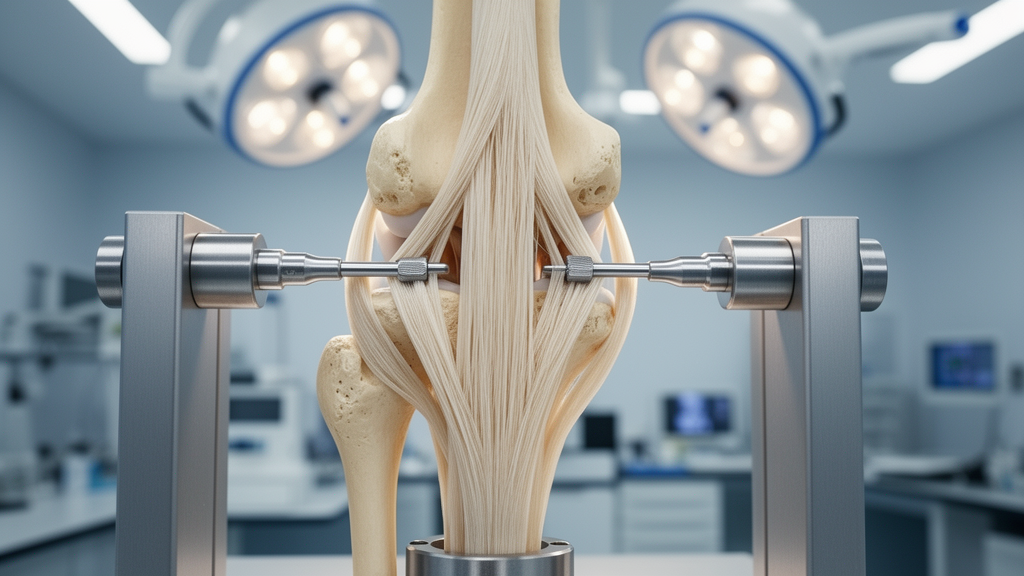
Graft construct preparation strictly followed established modern surgical techniques. Quadriceps tendon grafts were assembled using the QuadLink system with FiberTag TightRope implants, wherein a high-strength braided suture tape is structurally integrated into an adjustable loop suspensory fixation device. Using the SpeedWhip rip-stop suturing technique, surgeons placed six circumferential stitches through both the tendon substance and the integrated FiberTag tape at each graft end, creating an integrated load-sharing composite. For the semitendinosus group, tendons were quadrupled, mounted onto two adjustable loop cortical suspensory devices, and secured with the buried-knot suturing technique described by Lubowitz. All grafts underwent five minutes of static mechanical pretensioning at 50 newtons on a dedicated graft preparation board. Specimens were mounted onto a calibrated universal material testing machine equipped with force sensors, affixing suspensory cortical buttons against metal plates simulating cortical bone bridges.
The mechanical loading protocol simulated in vivo knee joint loading forces experienced during postoperative rehabilitation. Specimens completed 10 preconditioning cycles loading up to 50 newtons at 200 millimeters per minute, followed by 1,000 force-controlled cyclic repetitions between 50 and 250 newtons at a cyclic frequency of 0.75 hertz, mimicking the weight-bearing forces exerted during routine ambulation. Following cyclic conditioning, constructs were pulled to failure at a constant displacement rate of 50 millimeters per minute to measure ultimate load, dynamic stiffness, and terminal failure stiffness. Testing recorded an initial dynamic stiffness of 120.7 newtons per millimeter for semitendinosus constructs compared with 93.3 newtons per millimeter for quadriceps constructs, a statistically significant divergence. At the conclusion of cyclic testing, final dynamic stiffness reached 153.9 newtons per millimeter in the semitendinosus cohort versus 117.1 newtons per millimeter in the quadriceps cohort. During pull-to-failure testing, ultimate failure stiffness measured 173.8 newtons per millimeter for semitendinosus constructs and 120.1 newtons per millimeter for quadriceps constructs.
Ultimate tensile force measurements confirmed substantial performance differences between the two surgical configurations. The quadrupled semitendinosus constructs sustained a mean ultimate failure load of 806.1 newtons with a standard deviation of 127.0 newtons, significantly surpassing the 577.9 newtons, with a standard deviation of 100.6 newtons, recorded in the quadriceps group. Despite exhibiting lower ultimate force than the hamstring assemblies, both graft constructs exceeded the classic 450-newton threshold established by Noyes as the minimum fixation strength required to maintain knee joint stability during daily functional demands. Reported physiological anterior cruciate ligament forces span approximately 150 newtons during level walking, 303 newtons during single-leg stance, 445 newtons during stair descent, and 450 newtons during jogging. While both assemblies satisfy baseline biological loading criteria, their structural modes of failure diverged completely: all nine quadriceps specimens failed via suture tape cutting longitudinally through tendon tissue at the proximal fixation site, whereas semitendinosus constructs failed via suture breakage in 10 cases and cortical button breakage in one case.
The universal occurrence of cheese-wiring failure at the proximal quadriceps interface underscores how microstructural collagen architecture dictates mechanical behavior under localized stress. The human quadriceps tendon is an anatomically laminated structure composed of parallel sheets of collagen stacked along the transverse axis. This structural arrangement makes the tissue susceptible to interlaminar cleavage, particularly in elderly tissue where age-related degenerative changes and fatty infiltration weaken lateral cohesion. When high-tensile braided suture tape is stitched directly into this laminated substance under load-sharing tension, mechanical stress concentrates acutely at the suture-tendon contact margin. Under escalating tensile strain, the relatively narrow braided tape slices through adjacent collagen layers prior to reaching the tensile limit of the tape itself. By contrast, the semitendinosus tendon consists of a compact tubular architecture containing circumferentially organized collagen bundles that naturally resist transverse cut-through, allowing the construct to withstand higher loads until the suture material ruptures.
These experimental findings must be evaluated within the context of specific methodological boundaries, most notably donor demographics and static time-zero conditions. The cadaveric donors examined possessed a mean age of approximately 80 years, whereas clinical anterior cruciate ligament reconstructions predominantly occur in active patients between 15 and 40 years of age. Advanced donor age disproportionately compromises laminated quadriceps tendon morphology through structural degeneration, magnifying susceptibility to cheese-wiring compared with younger, healthier collagen matrices. Furthermore, this time-zero biomechanical simulation reflects immediate post-implantation strength, excluding dynamic biological healing, graft incorporation, and cellular remodeling that occur in living patients. The asymmetric use of suture tape augmentation exclusively within the quadriceps cohort also means the results reflect composite construct mechanics rather than the intrinsic tensile potential of pure quadriceps tendon tissue. Consequently, these findings highlight essential construct-specific vulnerabilities when using load-sharing tape in compromised tissue without diminishing the established utility of quadriceps autografts in younger clinical populations.
Subject of Research: Biomechanical comparison of all-soft-tissue quadriceps tendon and quadrupled semitendinosus autograft constructs in anterior cruciate ligament reconstruction
Article Title: Biomechanical properties of an all-soft tissue quadriceps tendon autograft compared with a quadrupled semitendinosus autograft: a cadaveric study
Article References: Sator, T., Pichler, L., Kiss, G., Binder, N., Payr, S., Hofbauer, M., Koch, T., Kandathil, S. A., Hirtler, L., & Tiefenboeck, T. M. (2026). Biomechanical properties of an all-soft tissue quadriceps tendon autograft compared with a quadrupled semitendinosus autograft: a cadaveric study. Knee Surgery & Related Research, 38(1), Article 39. https://doi.org/10.1186/s43019-026-00337-1
Image Credits: AI Generated
DOI: 10.1186/s43019-026-00337-1
Keywords: Anterior Cruciate Ligament, ACL Reconstruction, Quadriceps Tendon Autograft, Semitendinosus Autograft, Biomechanical Testing, Cadaveric Study, Load to Failure, Construct Stiffness, Suture Tape Augmentation, FiberTag TightRope, Cheese Wiring, Adjustable Loop Device, All-Inside ACLR, Cyclic Loading, Failure Modes, Knee Surgery, Orthopedic Biomechanics
News Source: Ophelia Keating. (November 18, 2026). Quadrupled Hamstring Constructs Outperform Tape-Augmented Quadriceps Tendons in Cadaveric Knee Reconstructions. Scienmag.