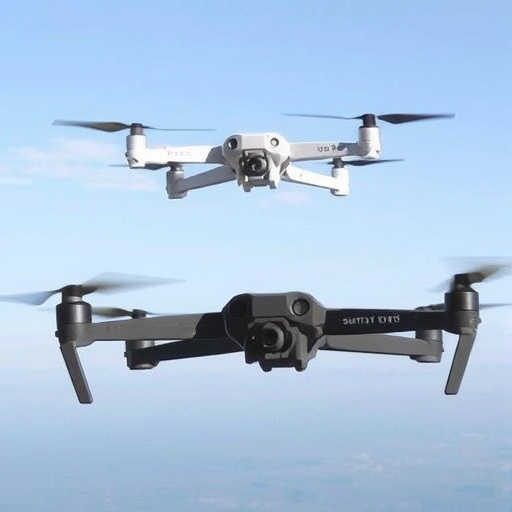
In the realm of autonomous vehicles and robotics, a groundbreaking framework known as COVER has emerged, capturing the attention of researchers and engineers alike. This innovative approach, which stands for Cross-Vehicle Transition Framework, facilitates seamless control of quadrotors in coordination with ground vehicles. Conducted by a team of scientists led by Q. Ren, alongside M. Xu and M. Zhang, the research aims to redefine how autonomous systems interact during complex operations on both land and air. The implications of this work could potentially revolutionize the field of robotics, marking a significant step towards more integrated and versatile autonomous platforms.
The heart of the COVER framework lies in its ability to manage the transition between aerial and ground control in quadrotors. Traditionally, controlling a quadrotor in conjunction with ground vehicles has presented numerous challenges, particularly in mixed operational environments. This study proposes a novel method of fostering communication and operational synchronization between various vehicle types, leading to more efficient mission execution. By creating a cohesive system that interlinks vehicles in a multi-domain scenario, researchers are setting the stage for enhanced collaboration among robots, ultimately pushing the boundaries of what’s possible in autonomous operations.
One of the standout features of the COVER framework is its focus on dynamic vehicle coordination. The researchers understand the complexities that arise when transitioning a quadrotor from aerial maneuvers to ground operations. Thus, they have developed sophisticated algorithms that allow for real-time adjustments in control strategies based on the current environment. This capability is critical, as it enables quadrotors to make swift decisions that align with the movements and actions of ground vehicles, thus promoting safety and efficiency.
In addition to control algorithms, the researchers have integrated advanced sensory modalities that contribute to the framework’s robust performance. Incorporating various sensors into both the quadrotors and the ground vehicles empowers the system to gather comprehensive data about its surroundings. This bank of information is invaluable, as it aids in obstacle detection, navigation, and real-time decision-making. With the ability to quickly analyze environmental factors, the quadrotors become more adept at executing their missions while coordinating closely with their counterpart ground vehicles.
The potential applications of the COVER framework are wide-ranging. From disaster response scenarios—where drones and ground vehicles collaboratively search for survivors or deliver medical supplies—to agricultural tasks like crop surveillance and monitoring, this technology could significantly enhance operational effectiveness. The idea is not merely to have vehicles operate independently, but rather to merge their capabilities in a way that leverages the strengths of each vehicle type. Such integrated operations could lead to faster response times and improved outcomes in various fields.
Moreover, the research team has conducted extensive simulations to validate the efficacy of the COVER framework. The results indicate significant improvements in mission performance when applying this cross-vehicle coordination technique. These simulations provide a critical bridge between theoretical development and practical application, showcasing how well the framework operates under varying conditions and scenarios. Such empirical evidence is essential for gaining acceptance within the broader field of robotics and ensuring that these innovations are not only theoretically sound but also practically viable.
The implications of the COVER framework extend beyond mere vehicle coordination; it also opens doors to new avenues of research. By demonstrating the effectiveness of cross-vehicle transitions, this work encourages further exploration into multi-robot systems. Researchers now have a robust platform from which to investigate additional complexities, such as cooperation under adverse weather conditions, enhanced communication protocols, and the fusion of AI technologies to improve decision-making processes across multiple autonomous systems.
This research has garnered significant attention within the academic community, particularly due to its potential for transforming current approaches to robotic cooperation. Publication in the esteemed journal “Autonomous Robots” highlights the groundbreaking nature of the findings and provides a valuable scholarly contribution to the ongoing dialogue on autonomous vehicle collaboration. The article serves not only as documentation of the research conducted but also as an inspiration for future innovations in the field.
As we move toward an era where autonomous vehicles become more prevalent, frameworks like COVER will be essential. They provide a blueprint for how teams of robots can work together effectively. This collaboration is poised to improve efficiencies, safety, and overall performance in a multitude of applications. The strategic insights and technological advancements derived from this study will inspire engineers and researchers to pursue further innovations that enhance coordination and communication in autonomous systems.
The COVER framework embodies a significant leap forward in the engineering of autonomous vehicles, particularly in how they cooperate with one another. By addressing the challenges associated with mixed-environment operations, this research paves the way for a future where aerial and ground vehicles operate in harmony. Such advancements not only signal the increase in sophistication among autonomous systems but also highlight the collaborative potential that comes with advanced robotics.
As the world embraces digital transformation and the rise of smart technologies, research like that presented by Ren, Xu, and Zhang becomes incredibly relevant. Their focus on cross-vehicle transitions will likely inspire a wave of development efforts designed to implement similar frameworks in other areas of robotics and automation, reinforcing the importance of hybrid systems in advancing the field toward the next frontier of robotics.
The horizon appears bright for the integration of the COVER framework into various sectors that rely on both aerial and ground transportation methods. By fostering a new era of cooperation between quadrotors and ground vehicles, the research team is not only addressing immediate engineering challenges but is also setting the groundwork for robust future applications. The ability to manage complex interactions between autonomous systems will be critical as the demand for sophisticated, cooperative technologies increases across industries.
To summarize, the introduction of the COVER framework represents an essential advancement in quadrotor control and air-ground synergy. This ongoing research journey will affect how we envision robot capabilities and their deployment in various fields, prompting a shift in how multi-robot systems are developed and utilized. As we look to the future, it is clear that the work of Ren, Xu, Zhang, and their colleagues will play a pivotal role in shaping the next generation of autonomous vehicle technologies.
Subject of Research: Cross-Vehicle Transition Framework for Quadrotor Control in Air-Ground Cooperation
Article Title: COVER: cross-vehicle transition framework for quadrotor control in air-ground cooperation
Article References:
Ren, Q., Xu, M., Zhang, M. et al. COVER: cross-vehicle transition framework for quadrotor control in air-ground cooperation.
Auton Robot 49, 23 (2025). https://doi.org/10.1007/s10514-025-10209-4
Image Credits: AI Generated
DOI: 10.1007/s10514-025-10209-4
Keywords: autonomous vehicles, quadrotors, cross-vehicle transition, multi-robot systems, robotic cooperation, air-ground cooperation, control frameworks.