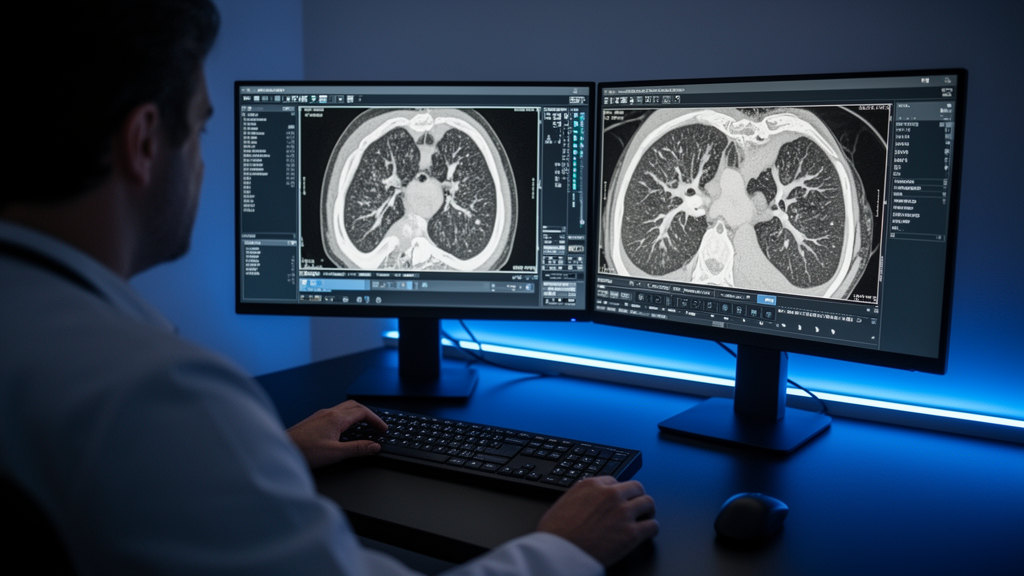
Researchers have introduced ProtoSurv, an artificial intelligence framework that adapts large-scale pretrained chest computed tomography models to predict prognosis in lung cancer patients when labeled survival data are scarce. In precision oncology, accurate prognostic risk assessment is critical for personalizing treatment plans and improving patient outcomes, particularly for individuals undergoing targeted therapies or chemoradiotherapy. While three-dimensional chest computed tomography scans are routinely collected in clinical practice and capture rich details of tumor morphology and spatial heterogeneity, training supervised deep learning models directly on clinical survival outcomes faces a persistent obstacle. Establishing clinical survival endpoints such as progression-free survival and overall survival requires extended post-treatment observation, leaving medical centers with limited cohorts of fully annotated follow-up data and exposing conventional supervised models to significant risks of overfitting.
Although self-supervised and multimodal pretraining approaches have emerged as effective strategies to extract generalized image representations from large pools of unannotated medical data, standard models frequently fail to capture survival-specific patterns. Vision-language models trained using contrastive objectives on paired radiological images and routine reports, such as contrastive language-image pretraining, primarily learn features that correspond to overt radiological findings explicitly described in text. However, critical biological determinants of patient survival, subtle intratumoral variations, and long-term treatment responses are rarely documented in standardized diagnostic radiology text. Consequently, general-purpose vision-language encoders often lack the prognostic specificity required to stratify patient risk accurately, presenting an urgent need for adaptation mechanisms capable of distilling survival-relevant representations from vast unannotated imaging archives.
To overcome this bottleneck, the investigators designed ProtoSurv around a multi-stage adaptation architecture that bridges generalized multimodal representations and specialized clinical survival modeling. The framework begins with large-scale vision-language pretraining, in which a three-dimensional visual encoder and a textual encoder are jointly trained on clinical chest computed tomography scans paired with descriptive radiology reports. Rather than directly transferring this generalized encoder or attempting full supervised fine-tuning on a small labeled prognostic cohort, ProtoSurv establishes a prognosis-oriented anchor classifier using the limited available survival data. This anchor classifier provides an initial task-aware decision boundary within the high-dimensional feature space, which then serves as the foundation for constructing class-specific prototypes and guiding the selection, filtering, and refinement of unlabeled computed tomography examinations.
The pretraining foundation of the system was developed using an extensive retrospective imaging cohort collected from 104,783 patients at the First Hospital of Jilin University between May 2023 and October 2023. This dataset comprised 409,261 three-dimensional chest computed tomography volumetric sequences alongside their corresponding institutional radiology reports. To focus feature learning on relevant anatomical structures and suppress non-informative background noise, lung regions were segmented automatically using a U-Net architecture from the lungmask library prior to model ingestion. The visual encoder utilized a three-dimensional Swin Transformer backbone initialized on Kinetics-400 video data to capture spatial contextual dependencies across volumetric scans, while a pretrained Bidirectional Encoder Representations from Transformers model mapped the paired clinical reports into shared semantic embeddings optimized via a symmetric InfoNCE contrastive loss.
Once multimodal pretraining aligned the visual encoder with institutional radiological semantics, the textual encoder was set aside, and the visual encoder was frozen to preserve its generalizable representations while preventing parameter degradation during downstream tasks. The adaptation process then leveraged labeled training sets to define binary prognostic status based on whether disease progression or patient death occurred before the median event time of the respective dataset. Using feature vectors extracted by the frozen encoder from these labeled samples, the team computed class prototypes defined as the mathematical centroids of each prognostic class. These centroids summarized global semantic centers of survival patterns, enabling the system to evaluate how closely unlabeled patient examinations from the broader imaging archive aligned with distinct clinical trajectories through cosine similarity calculations.
To systematically harvest useful supervisory signals from massive unlabeled datasets without introducing excessive noise, ProtoSurv implements a hierarchical pseudolabel assignment strategy governed by empirical similarity thresholds. By analyzing the similarity distributions of labeled cases relative to their class prototypes, the researchers defined high-confidence and low-confidence boundaries based on the third and first quartiles of those distributions. Unlabeled scans demonstrating high similarity to a single prototype and low similarity to the opposing class received deterministic pseudolabels. Conversely, samples with intermediate similarity falling between the lower and upper quartile thresholds were designated as weak-consistency cases assigned to the closest class, while ambiguous scans that simultaneously crossed both high thresholds or failed to meet either low threshold were rejected entirely to avoid introducing harmful label noise.
Because raw geometric similarity in feature space cannot completely eliminate false assignments caused by feature overlap and institutional domain shifts, candidate unlabeled scans were subjected to secondary confidence filtering using the anchor classifier. The anchor classifier, trained on the labeled survival cohort with binary cross-entropy loss, evaluated candidate scans and discarded any pseudolabeled instance failing to meet predefined class-specific probability thresholds. Furthermore, recognizing that weakly matched scans lying near classification margins could destabilize downstream learning if utilized in their raw form, the team implemented an adaptive feature calibration mechanism. This formulation dynamically shifted the feature representation of each weak-consistency sample toward its assigned prototype centroid via an adaptive interpolation weight, pulling ambiguous samples inward and improving intraclass compactness before model ingestion.
The resulting refined pseudolabeled examinations were merged with the original labeled training cohort to construct an augmented hybrid dataset used to train a dedicated downstream prognostic classifier. Built upon a one-dimensional residual architecture, this classification head incorporates multiple bottleneck-style residual blocks for nonlinear transformations alongside squeeze-and-excitation attention modules designed to adaptively recalibrate channel-wise feature dependencies and accentuate survival-relevant signals. During downstream optimization with binary cross-entropy loss, the visual encoder remained completely frozen, ensuring that feature extraction retained general anatomical representations while the residual classification head learned to map calibrated features into individualized continuous risk scores reflecting progression or mortality probabilities.
The clinical utility of ProtoSurv was systematically validated on two distinct clinical cohorts: the HUAXI dataset, consisting of 507 patients from West China Hospital receiving targeted epidermal growth-factor receptor tyrosine kinase inhibitor therapy evaluated for progression-free survival, and the public LUNG1 cohort comprising 420 patients receiving radiotherapy or chemoradiotherapy evaluated for overall survival. In the HUAXI testing cohort, ProtoSurv achieved an area under the receiver operating characteristic curve of 0.765 with a ninety-five percent confidence interval of 0.673 to 0.856, alongside a concordance index of 0.684 with a confidence interval of 0.622 to 0.755. These results markedly outperformed traditional clinical models, which attained an area under the curve of 0.590 and a concordance index of 0.576, as well as DenseNet and M3D deep learning baselines which posted areas under the curve of 0.594 and 0.636, respectively.
Similar performance advantages emerged on the LUNG1 overall survival dataset, where ProtoSurv delivered an area under the curve of 0.822 with a confidence interval of 0.737 to 0.903 and a concordance index of 0.727 with a confidence interval of 0.665 to 0.798. In comparison, the clinical reference model achieved an area under the curve of only 0.525 and a concordance index of 0.538, while DenseNet reached 0.641 and M3D achieved 0.643. Furthermore, Kaplan-Meier survival curves demonstrated that patients stratified into high-risk and low-risk categories by ProtoSurv exhibited statistically significant divergence in actual survival times, recording a log-rank p-value of 0.0296 in the HUAXI cohort where clinical models failed to achieve meaningful separation. In additional Cox proportional hazards modeling, the continuous risk score maintained significant associations with survival outcomes, achieving hazard ratios of 1.61 for progression-free survival and 2.20 for overall survival.
Ablation experiments confirmed that both data augmentation through pseudolabeling and prototype-guided feature calibration were vital to these performance gains. When the framework operated with data augmentation alone, without prototype-guided pulling, the concordance index and area under the curve dropped noticeably across both cohorts, accompanied by partial mixing and overlap in feature space distributions. Quantitative evaluations using uniform manifold approximation and projection and principal component analysis demonstrated that the complete pipeline increased the separation-to-compactness ratio from 0.7890 to 3.0869 in HUAXI and from 0.6691 to 1.6497 in LUNG1. Gradient-weighted class activation mapping further revealed that the model focused attention on dominant pulmonary lesions and adjacent parenchymal tissue, demonstrating biologically plausible decision patterns.
Despite these promising outcomes, the authors emphasized several key limitations inherent to the current study design. The analysis was conducted retrospectively across specific clinical cohorts, indicating that broad multicenter prospective trials are required to confirm robustness across varied hospital scanner settings and diverse imaging protocols. Additionally, formulating the survival task around a median event time cutoff transforms continuous time-to-event trajectories into a binary classification structure, which does not fully capture fine-grained temporal patterns. Future investigations plan to integrate prototype adaptation directly with survival-specific loss functions, evaluate biological correlates of learned representations, and conduct controlled comparisons between multimodal report-guided pretraining and purely visual self-supervised foundation models.
Subject of Research: Artificial intelligence framework adapting chest CT foundation models for lung cancer prognosis prediction
Article Title: ProtoSurv: prototype-guided adaptation of computed tomography foundation model for lung-cancer prognosis prediction
Article References: Liu, C., Li, S., Sang, H., Huang, X., Wang, C., Shu, Y., Wu, Y., Tian, J., Zhang, H., Zhang, L., & Wang, S. (2026). ProtoSurv: prototype-guided adaptation of computed tomography foundation model for lung-cancer prognosis prediction. Visual Computing for Industry, Biomedicine, and Art, 9(1), Article 21. https://doi.org/10.1186/s42492-026-00233-1
Image Credits: AI Generated
DOI: 10.1186/s42492-026-00233-1
Keywords: ProtoSurv, lung cancer, computed tomography, prognosis prediction, foundation model, vision-language pretraining, contrastive learning, progression-free survival, overall survival, prototype adaptation, pseudolabel assignment, feature calibration, survival analysis, deep learning, medical imaging, Swin Transformer, oncology
News Source: Nathaniel Bowman. (November 24, 2026). Prototype-Guided Framework Adapts Chest CT Foundation Models for Lung Cancer Prognosis Prediction. Scienmag.