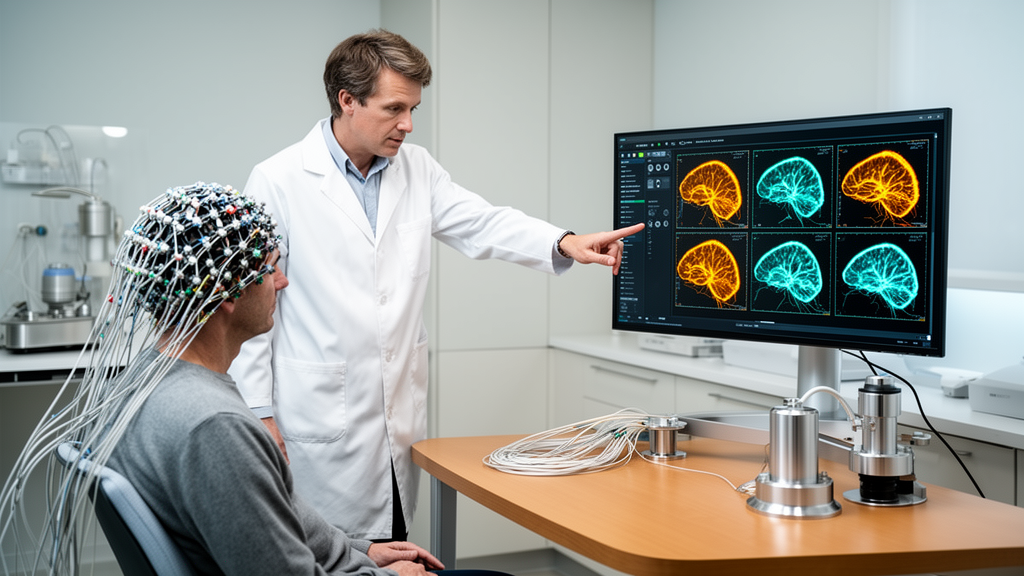
A newly published systematic review protocol outlines a comprehensive methodology designed to link group-level regional brain activation patterns from functional magnetic resonance imaging with prospective neural targets in restorative online brain–computer interfaces for adults experiencing post-stroke aphasia. Developed by clinical investigators across institutions in China, including Zhejiang Chinese Medical University and Jiaxing University, the methodological framework addresses how functional imaging during language tasks and closed-loop neural training can be synthesized systematically. Post-stroke aphasia frequently restricts everyday spoken communication, auditory comprehension, social participation, and functional access to rehabilitation. While conventional speech and language therapy serves as the standard clinical foundation of stroke care, recovery trajectories and individual treatment responses vary substantially across clinical cohorts. By specifying a dual-stream design combining quantitative voxel-based meta-analysis with a structured narrative synthesis, the protocol aims to provide an anatomical and functional context for emerging neurotechnologies without overstating early clinical efficacy.
The methodological framework establishes three predefined core objectives that guide the identification, extraction, and synthesis of research evidence across both neuroimaging and device-based interventions. First, the investigation seeks to determine the spatial convergence characterizing positive task-versus-baseline blood-oxygen-level-dependent responses during language production and comprehension in adults recovering from stroke. Second, the synthesis intends to catalogue the specific neural features trained during restorative brain–computer interface interventions and assess whether documented neural modifications correlate statistically with unassisted language or functional-communication gains. Third, where published spatial coordinates and anatomical documentation permit, the review protocol plans to assess whether reported cortical brain–computer interface targets anatomically align with spatial convergence peaks identified in the corrected task-fMRI meta-analysis for corresponding language functions. Throughout the framework, the term restorative explicitly denotes a prespecified rehabilitation purpose directed toward language recovery rather than proven therapeutic efficacy, maintaining a necessary scientific boundary between interventional intent and verified clinical outcome.
To capture relevant literature comprehensively, the protocol defines formal electronic search strategies across multiple international bibliographic databases from their inception dates to the final execution date. The search architecture spans PubMed, Embase via Embase.com, Web of Science Core Collection, and APA PsycINFO via Ovid for both investigative streams, while adding the IEEE Xplore digital library specifically for the neurotechnology component. Search syntax combines controlled vocabulary and free-text terms covering aphasic disorders, dysphasia, anomia, acquired alexia, and agraphia with stroke-related pathology and neuroimaging modalities including functional magnetic resonance imaging, blood-oxygen-level-dependent contrasts, neurofeedback, closed-loop systems, real-time fMRI, event-related potentials such as P300 signals, and functional near-infrared spectroscopy. Electronic database queries operate without language or publication-type restrictions during initial retrieval, while formal eligibility screening strictly selects full, peer-reviewed English-language journal articles. Handsearches of reference lists from key prior reviews and included papers will supplement retrieval, alongside focused forward citation tracking in Web of Science conducted exclusively at the final search update.
Study selection will follow rigorous eligibility criteria applied independently by two calibrated reviewers to preserve methodological transparency and minimize bias. For the functional neuroimaging stream, eligible designs comprise cross-sectional or longitudinal investigations capturing blood-oxygen-level-dependent responses during language production or comprehension in non-interventional studies or pre-intervention assessments involving at least five adult participants with clinically verified post-stroke aphasia. Eligible imaging reports must conduct whole-brain inferential analyses, demonstrate a recoverable effect direction, and provide complete signed standard-space coordinates, a complete unthresholded statistical map, or an explicit confirmed whole-brain report confirming no suprathreshold peaks in either direction. Studies restricted exclusively to regions of interest, small-volume corrections, connectivity metrics, lateralization indices, hemisphere-flipped datasets lacking unflipped equivalents, or partial fields of view are formally excluded to avoid biasing spatial reconstruction models.
For the brain–computer interface evidence stream, eligible investigations must evaluate adults with post-stroke aphasia across at least two distinct training sessions in which a participant-derived real-time neural signal dynamically determines sensory feedback or training progression. The intervention must maintain an unambiguous, prespecified restorative aim targeted at aphasia impairment, reading capability, or functional language recovery declared prior to results inspection in the report abstract, introduction, protocol, or methods. Studies must demonstrate at least one of two defined evaluative pathways: a longitudinal neural outcome pathway documenting trained-feature acquisition, transfer without feedback, delayed retention, or independent neural change, or an independent outcome pathway assessing standardized language instruments, verified behavioral tasks, or everyday functional communication without online device assistance. Investigations evaluating purely assistive communication devices, single-session proof-of-concept experiments, post hoc restorative claims, offline classification algorithms, or healthy participant validation are excluded from synthesis.
The quantitative neuroimaging synthesis relies on seed-based d mapping with permutation of subject images, using software version 6.23 to pool compatible three-dimensional whole-brain statistical maps and reported peak coordinate sets. Spatial convergence of positive activation contrasts will be modeled separately for language production and language comprehension, with each domain requiring a prespecified feasibility threshold of at least ten independent cohort inputs before spatial pooling is permitted. Production isolates experimental subtractions retaining spoken, written, lexical, or orthographic output post-subtraction, whereas comprehension isolates auditory or visual linguistic understanding while excluding expressive motor demands. The protocol establishes a random-effects model using 50 imputations, 10,000 permutations, and one-sided threshold-free cluster enhancement family-wise error correction set at p less than 0.025 per model. Dividing the conventional family-wise alpha level of 0.05 equally across the two distinct domain models preserves statistical protection against type I errors without post hoc reallocation.
Methodological quality appraisal will be conducted systematically by two independent reviewers utilizing validated domain-based assessment frameworks tailored to each study design. Task-fMRI studies will be evaluated across four qualitative non-scoring domains encompassing patient selection, task and baseline paradigms, motion control and lesion normalization, and whole-brain inferential completeness alongside cohort independence. Individually randomized controlled trials of brain–computer interface interventions will be evaluated using the Cochrane risk-of-bias tool for randomized trials, version 2, while non-randomized quasi-experimental designs, cohort studies, case series, and case reports will be appraised using the appropriate Joanna Briggs Institute critical appraisal instruments. In addition, the Consensus on the Reporting and Experimental Design of Clinical and Cognitive-Behavioral Neurofeedback Studies checklist will guide structured descriptive evaluations of feedback parameters, control conditions, and feature learning without functioning as a formal risk-of-bias scoring metric.
To avoid unit-of-analysis distortions and inflated sample estimates, the authors specify detailed procedures for tracking cohort independence across multi-site datasets, participant recruitment dates, demographic profiles, and author publication histories. When multiple publications stem from shared or nested patient samples, they will be combined into a single study family contributing at most one contrast per language domain, selected according to a strict hierarchical decision rule prior to inspecting spatial results. Contrast selection prioritizes the primary contrast identified by the source authors, followed by the contrast that most cleanly isolates language processing after baseline subtraction, and finally the largest eligible participant sample. The review framework records contributing baseline categories classified as minimal or passive, active linguistic, or active non-linguistic to assist narrative contextualization and critical appraisal without introducing ad hoc statistical subgroup parsing.
The narrative synthesis of restorative brain–computer interface studies will systematically categorize training characteristics, including signal acquisition modalities such as electroencephalography, real-time functional magnetic resonance imaging, and functional near-infrared spectroscopy, alongside feedback modalities and cumulative intervention dosing. Reviewers will maintain strict analytical separation between interface performance metrics, such as information-transfer rates, spelling speed, or classification accuracy, and genuine clinical rehabilitation outcomes. When studies report both neural outcomes and clinical language assessments, the synthesis will document whether the original authors statistically tested their association rather than merely observing parallel improvements across separate domains. Where studies report behavioral progress in the absence of documented trained-feature acquisition, changes will be classified as behavioral observations occurring over the training timeline rather than confirmed neurofeedback-induced learning.
A critical translational component of the planned review involves a joint synthesis table cross-referencing restorative brain–computer interface cortical targets with the corrected peaks generated from the task-fMRI voxel-based meta-analysis. Cortical targets and spatial peaks will be referenced to the Automated Anatomical Labeling Atlas 3 parcellation within a standardized coordinate space, classifying anatomical relationships into shared parent regions, absence of a shared parent-region peak, or unassessable configurations. An atlas parent region comprises anatomically adjacent subparcels within the same hemisphere sharing a named gyrus, preserving structural specificity while enabling broad group-level cross-study comparisons. The protocol explicitly notes that an absence of a shared parent-region peak does not demonstrate that a neurofeedback training target is therapeutically ineffective, but simply denotes that current literature lacks spatial convergence at that broad anatomical coordinate scale.
The authors explicitly detail substantial methodological challenges and biological limitations inherent in stroke neuroimaging and neurotechnology research that necessitate conservative interpretation. Structural brain lesions present significant barriers to spatial normalization and regional brain coverage, while altered or attenuated perilesional haemodynamic responses can diminish blood-oxygen-level-dependent signal detectability independently of actual underlying neural processing. Furthermore, coordinate-based meta-analytic inputs convey substantially less spatial information than unthresholded statistical maps, and meeting the ten-input feasibility threshold does not guarantee optimal statistical power or estimate stability across heterogeneous cohorts. In the brain–computer interface domain, the frequent absence of concurrent control groups complicates efforts to distinguish closed-loop neural effects from behavioral practice, concurrent therapy, or spontaneous biological recovery, underscoring the critical need for preregistered, rigorous systematic synthesis.
Subject of Research: Systematic review protocol for task-fMRI activation patterns and restorative online brain–computer interfaces in post-stroke aphasia
Article Title: Language-related task-fMRI patterns and restorative online brain–computer interfaces in post-stroke aphasia: a protocol for a systematic review with voxel-based meta-analysis and narrative synthesis
Article References: Shu, B., Fu, J., He, K., Wang, Z., Bai, J., He, S., Chen, X., Ma, L., Zhang, T., & Zeng, M. (2026). Language-related task-fMRI patterns and restorative online brain–computer interfaces in post-stroke aphasia: a protocol for a systematic review with voxel-based meta-analysis and narrative synthesis. Frontiers in Neurology, 17, 1983643. https://doi.org/10.3389/fneur.2026.1983643
Image Credits: AI Generated
DOI: 10.3389/fneur.2026.1983643
Keywords: post-stroke aphasia, systematic review protocol, task-fMRI, brain-computer interfaces, voxel-based meta-analysis, SDM-PSI, neurofeedback, language production, language comprehension, blood-oxygen-level-dependent, Automated Anatomical Labeling Atlas 3, restorative BCI, PROSPERO registration, PRISMA-P, rehabilitation medicine, P300 training, functional near-infrared spectroscopy
News Source: Cassandra Pierce. (November 11, 2026). Protocol Plans Review Linking Language Imaging and Brain Interfaces in Stroke Aphasia. Scienmag.