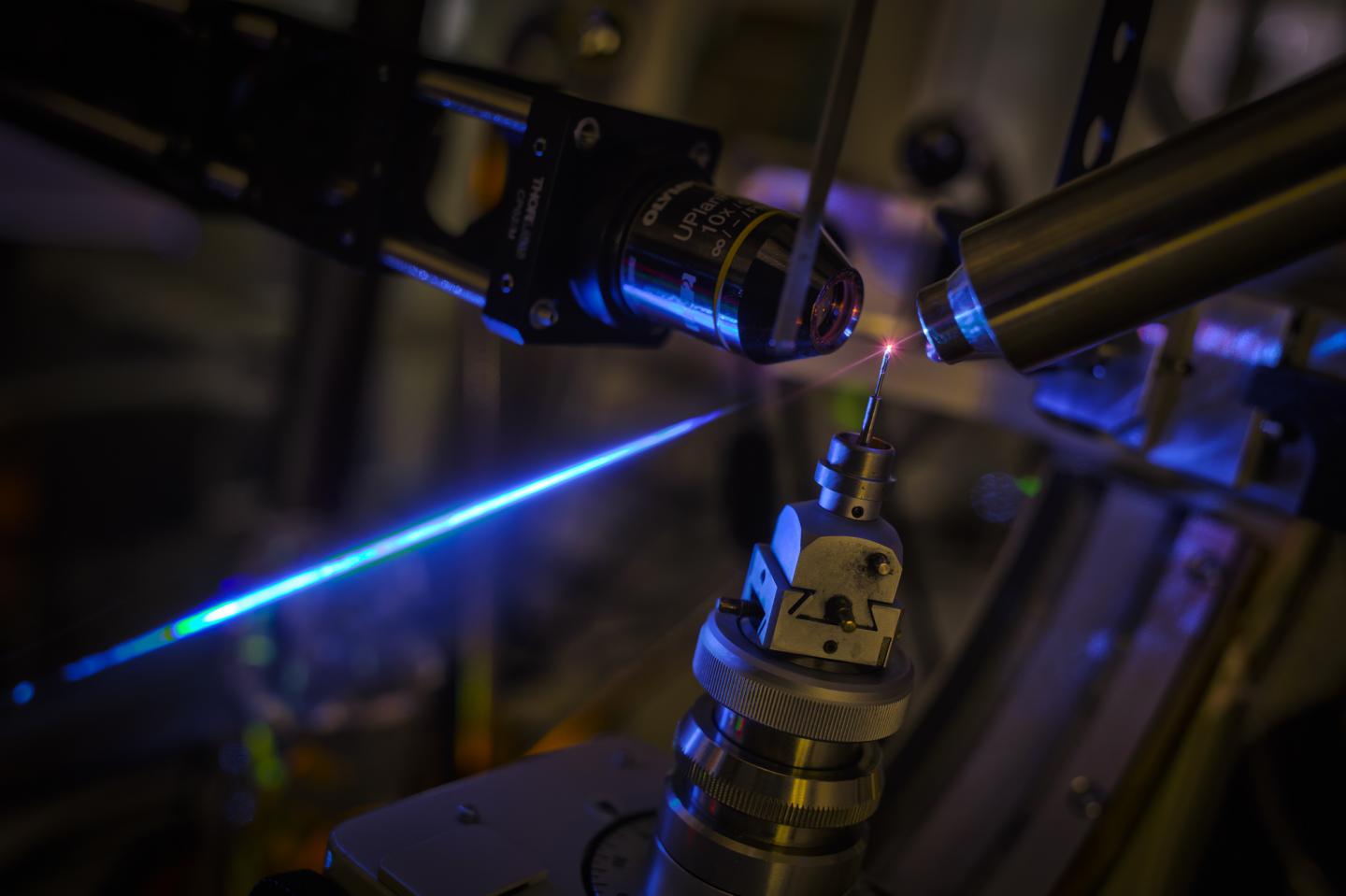
Credit: Credit: Petr Pachl / IOCB Prague
Researchers led by Josef Lazar of the Institute of Organic Chemistry and Biochemistry of the Czech Academy of Sciences (IOCB Prague) have demonstrated that molecules of fluorescent proteins act as antennas with optical properties (i.e. the ability to absorb and emit light) dependent on their spatial orientation. First discovered in jellyfish, fluorescent proteins are nowadays widely used in studies of molecular processes in living cells and organisms. The newly described properties of these molecules will find applications in basic biological research as well as in novel drug discovery. A team of researchers from IOCB Prague, the Institute of Microbiology, and the Institute of Molecular Genetics of the Czech Academy of Sciences has published its findings in the journal Proceedings of the National Academy of Sciences of the United States of America.
To achieve these results, the researchers produced sufficient amounts of fluorescent proteins by using genetically modified bacteria, identified the conditions under which the proteins form crystals, and determined the atomic structure of the crystals. Employing a unique microscope developed within the group, they then measured how these crystals absorb and emit light, and from the data they calculated the directional properties of the individual molecules. This allowed them to verify that the fluorescent protein molecules do not behave as tiny luminescent dots, as they are often mistakenly assumed, but rather as miniature antennas. Much like antennas for radio, WiFi, and television transmission, these molecules only absorb light from certain directions. Likewise, they only emit light in certain directions. The researchers also succeeded in precisely establishing these directions.
The possibility of fluorescent protein molecules behaving as antennas capable of absorbing extraneous light had been assumed, but it long proved difficult to confirm, and that limited its applications. The obstacles have been overcome by Josef Lazar of IOCB Prague and his team, which specializes in the development and use of advanced optical microscopy methods.
“Based on the findings of other laboratories and our own, we suspected that fluorescent protein molecules likely behaved as antennas. Nonetheless, we were surprised to see just how true that analogy is and how accurately we were able to establish the directions from which these molecules absorb light and emit it,” says Josef Lazar.
The fact that fluorescent protein molecules function as miniature antennas is interesting not only as a curiosity of physics – it can also have important practical applications. Attaching a fluorescent protein to some other protein of interest means attaching a miniature antenna to it that can then be used to establish, in detail, changes in the shape of the molecules of the protein of interest, directly in a living cell. Such changes in molecular shape can be induced by a drug, for instance. The present discovery will thus find applications in the study of important physiological processes at the molecular level as well as in novel drug discovery.
“The significance of our finding lies in the fact that even though fluorescent protein molecules are widely used in biological research, their ability to behave like antennas isn’t fully appreciated yet, nor is it really being put to use. Knowledge of the directional properties of fluorescent proteins can lead to new ways of using these useful molecules,” explains Lazar.
In collaboration with other groups at IOCB Prague, Josef Lazar’s team is already attempting to apply the present findings in, for example, the study of the physiological effects of insulin and the development of insulin substitutes for peroral use. Another example of a possible application of the present discovery is the tracing of electrical signals in nerve cells, which could prove beneficial in the study of the brain and neurological diseases.
###
The Institute of Organic Chemistry and Biochemistry of the Czech Academy of Sciences / IOCB Prague (http://www.
You can embed our YouTube video with an animation: https:/
Media Contact
Dusan Brinzanik
[email protected]
Original Source
https:/