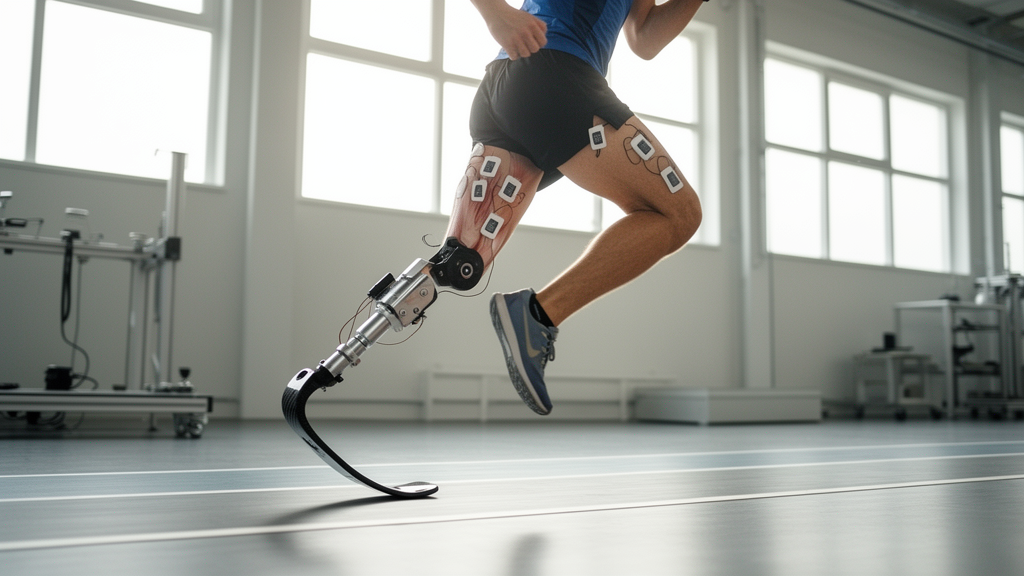
A biomechanical investigation published in the Journal of NeuroEngineering and Rehabilitation reveals that changing prosthetic foot mechanics alters individual muscle activation patterns during load carriage without reorganizing core motor control strategies in individuals with unilateral transtibial amputation. Researchers Satria Ardianuari, Richard R. Neptune, and Glenn K. Klute observed that while powered and stiffer prosthetic feet induced distinct muscular adjustments, the underlying coordination modules responsible for walking remained essentially intact across unloaded and loaded conditions.
Individuals with below-knee amputations frequently use prosthetic feet featuring fixed mechanical properties, an engineering constraint that can restrict distal neuromuscular flexibility during physically demanding activities such as carrying heavy equipment. Although advanced powered devices and designs with increased stiffness are purported to facilitate ambulation under increased physical loads, their specific influence on the central nervous system’s neuromuscular control strategies during loaded walking had previously remained unclear, prompting this systematic evaluation of muscle activity and modular control.
To evaluate these motor responses, the investigators evaluated twelve adults with unilateral transtibial amputation as they walked at their self-selected preferred speeds across multiple load configurations. Participants completed walking trials without any added weight and while supporting a 13.6-kilogram (30-pound) load carried in four distinct positional conditions: on the front of the body, on the back, on the intact-limb side, and on the prosthetic-limb side, providing a comprehensive assessment of directional load carriage demands.
Each participant completed the experimental walking conditions using their clinically prescribed daily prosthetic foot alongside an identical foot model configured to be one category stiffer. In addition, a subset of seven participants was tested while walking with an active, powered ankle-foot prosthesis. The research team recorded surface electromyography signals from eight muscles on the intact limb and five muscles on the residual limb, concentrating their primary motor module calculations on intact-limb coordination while quantifying both muscle activation magnitudes and co-contraction levels.
The mathematical evaluation of motor control utilized non-negative matrix factorization applied to the electromyographic datasets to derive muscle motor modules and evaluate neural complexity. The authors used linear mixed-effects models to identify statistically significant differences between prosthetic foot models in terms of muscle activation amplitude and module complexity. Furthermore, cosine similarity metrics were applied to gauge module structural similarity across conditions, and one-dimensional statistical parametric mapping was executed to evaluate temporal differences in activation timing throughout the gait cycle.
The resulting measurements showed that prosthetic foot designs meaningfully influenced intact-limb muscle activation across diverse loading configurations. In comparison with the standard prescribed foot, using the powered prosthesis increased medial gastrocnemius activation by 26 to 29 percent during unloaded walking and intact-side load carriage, while boosting rectus femoris activation by 46 percent during unloaded walking. In contrast, walking with the stiffer prosthetic foot led to a 37 percent increase in vastus medialis activation specifically when participants carried the load on their intact side.
Despite these noticeable muscle-level adjustments, overall motor module complexity was largely preserved across prosthetic foot types and carried loads. Three motor modules accounted for more than 90 percent of electromyographic variance across most participants, accompanied by only modest reductions of approximately 2 to 3 percent in first-module variance when using the powered prosthesis during back-load and intact-side load carriage. Module composition and activation timing showed high consistency across all tested feet, and an exploratory analysis of residual-limb musculature revealed no significant between-foot differences in module complexity.
These observations indicate that individuals with transtibial amputation primarily accommodate variations in prosthetic foot stiffness, active mechanical power, and external carriage loads by modulating discrete muscle recruitment rather than fundamentally altering their modular motor control architecture. Registered under ClinicalTrials.gov identifier NCT07159490, the study provides quantified empirical evidence showing that peripheral prosthetic mechanics alter local muscular demands without requiring the nervous system to assemble alternative motor control frameworks.
Subject of Research: Transtibial amputee neuromuscular motor control during loaded walking with varied prostheses
Article Title: Amputee motor control during loaded walking with stiffer and powered prostheses
Article References: Ardianuari, S., Neptune, R. R., & Klute, G. K. (2026). Amputee motor control during loaded walking with stiffer and powered prostheses. Journal of NeuroEngineering and Rehabilitation. https://doi.org/10.1186/s12984-026-02185-2
Image Credits: AI Generated
DOI: 10.1186/s12984-026-02185-2
Keywords: transtibial amputation, motor control, prosthetic foot stiffness, powered prostheses, load carriage, electromyography, motor modules, non-negative matrix factorization, intact limb, residual limb, medial gastrocnemius, rectus femoris, vastus medialis, co-contraction, statistical parametric mapping, linear mixed-effects models
News Source: Ophelia Keating. (November 19, 2026). Prosthetic Foot Mechanics Alter Muscle Activation Without Shifting Motor Control Modules. Scienmag.