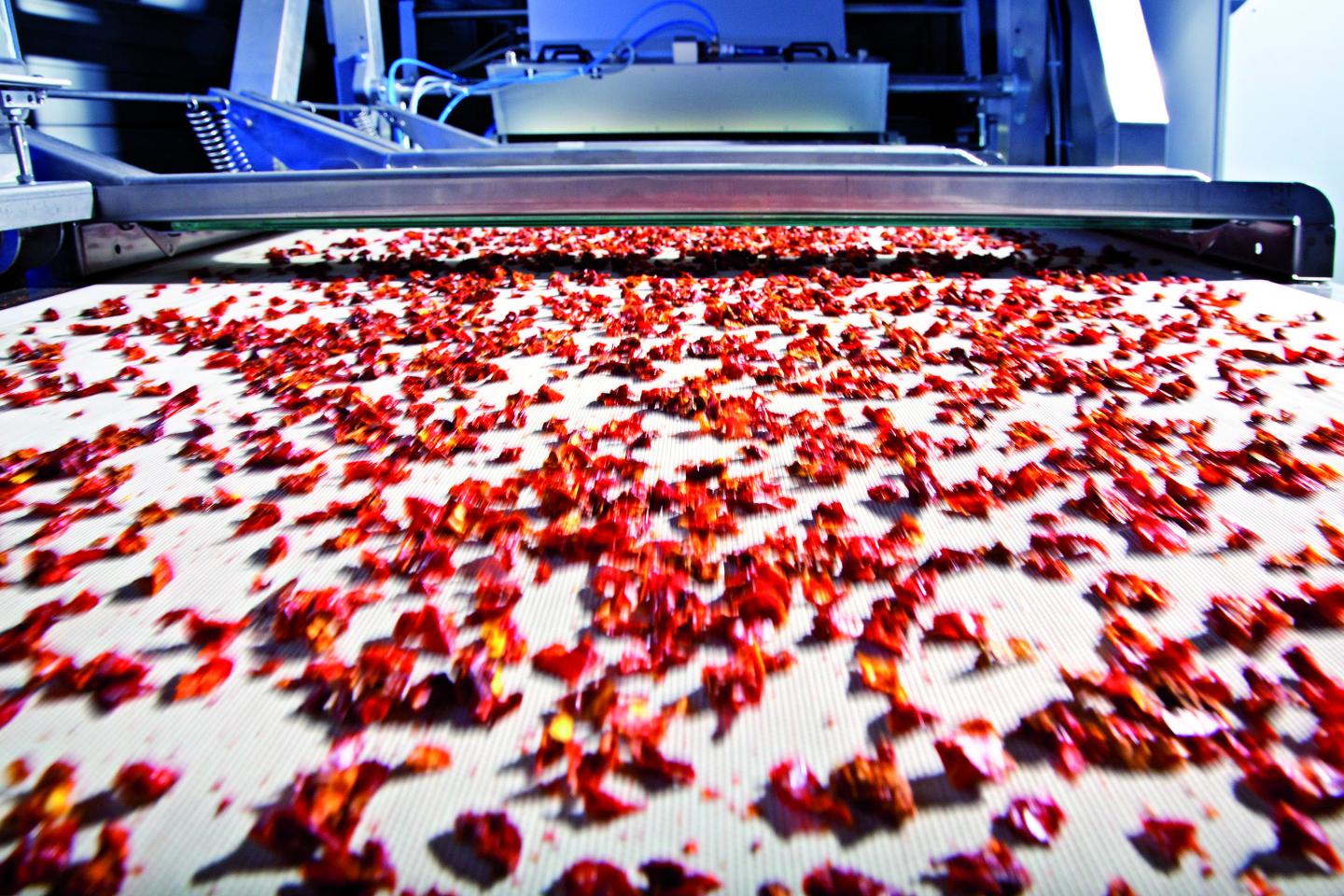
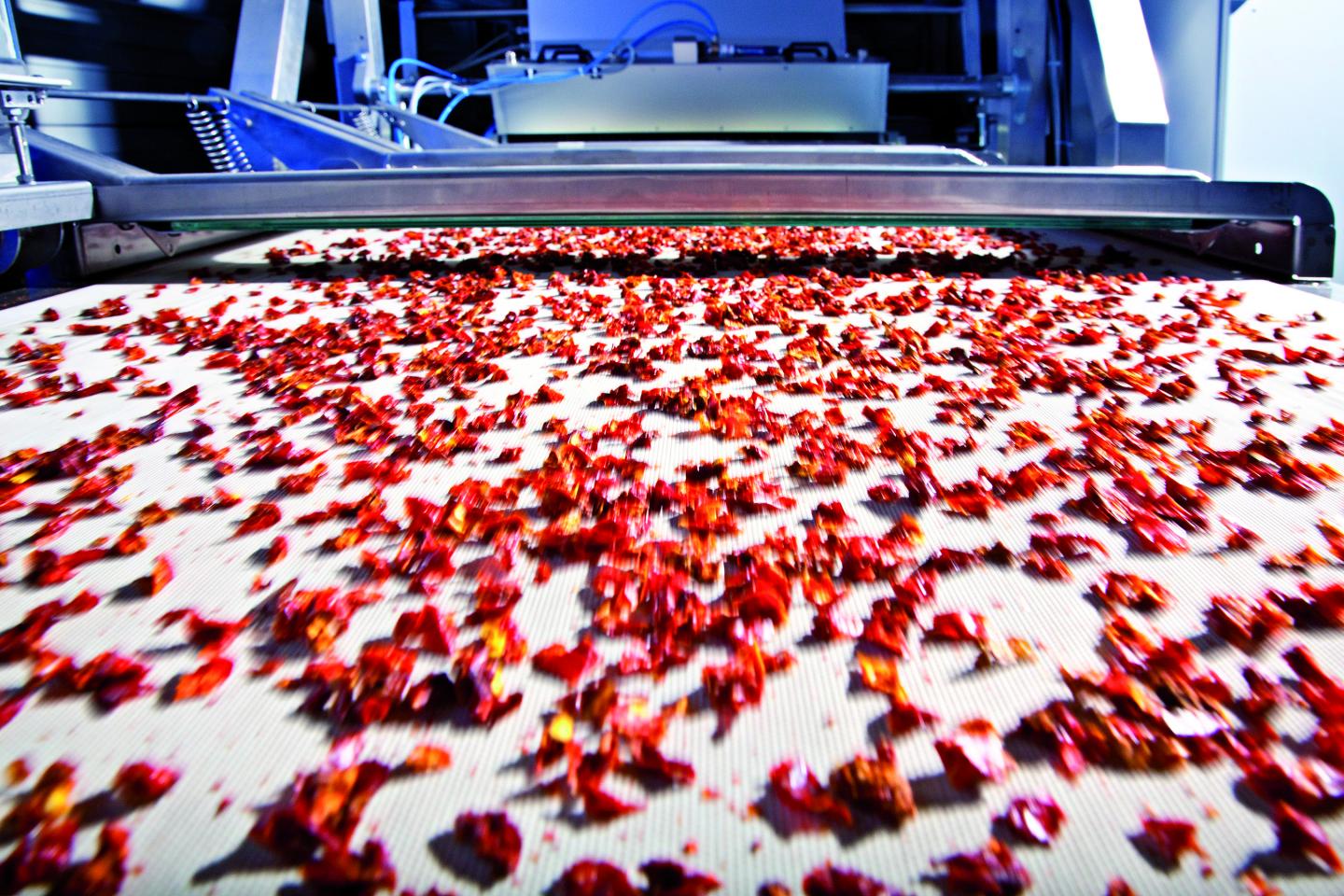
Credit: Photo: Fraunhofer IOSB
Sand, gravel, coal, deicing salt or diamonds, grain, sugar, coffee or grapes and waste – a lot of everyday goods are more or less grainy. To classify this bulk material by quality and size, it must be sorted in a sophisticated process. Tens of thousands of belt-type sorting plants are run in Germany alone. Scientists of the Karlsruhe Institute of Technology (KIT) and the Fraunhofer Institute for Optronics, Systems Technology and Image Evaluation (IOSB) have developed a system which is able to sort much faster, more cheaply and more accurately than previous techniques.
Bulk materials are processed in nearly all industries, be it building construction, logistics, chemistry or agriculture. Given the large number of plants, any improvement of the sorting steps necessary everywhere could save billions. "The economic benefit of this project can hardly be overestimated; enormous resources could be saved," explains Professor Uwe Hanebeck of the Chair of Intelligent Sensor – Actuator Systems (ISAS) at the KIT in describing the new technology. Because of the patterns of movement of objects to be sorted, much more precise classification is possible than in conventional sorting systems. Industry had already shown interest in the new technology, says Professor Thomas Längle, responsible for the project at the Fraunhofer IOSB.
"Classical belt-type sorting systems scan the material to be sorted by means of a camera; parts not to be treated are blown out by means of pressurized-air nozzles," explains Georg Maier of the IOSB. There is a problem: The cameras now in use scan the objects only on a short belt section, which allows only rough classification. As a consequence, several runs are necessary to achieve a satisfactory result.
The team around Längle and Hanebeck developed a sorting system in which cameras operating from different perspectives take a more precise view of the bulk material. In this way, objects of different categories can be distinguished more effectively. In addition, algorithms based on the images predict how objects are going to move on the belt. In this way, it is possible to sort out foreign bodies much more precisely.
The advantages of the new sorting system are explained by Benjamin Noack of the ISAS by the example of spheres and hemispheres: "When seen from the top, they look alike. While hemispheres normally remain on the belt, spheres are restless, thus additionally aggravating the sorting process. However, when seen from the side, spheres and hemispheres can be distinguished." In addition, the system was now able to predict the behavior of these objects and then adjust its operation accordingly and, in this way, also achieve better classification, says Noack.
The scientists also found a way to increase the accuracy of existing sorting systems quickly and at low cost. "This requires but a software update," explains Hanebeck.
Besides the KIT and IOSB, also the Ruhr University of Bochum (RUB) and the Technical University of Berlin (TUB) are involved in the project. Scientists at those institutions in particular work on realistic simulations of bulk material and the numerical design of sorting systems.
###
For further information, please contact: Dr. Felix Mescoli, Press Officer , Phone: +49 721 608-48120, Fax: +49 721 608-43658, Email: [email protected]
The Karlsruhe Institute of Technology (KIT) pools its three core tasks of research, higher education, and innovation in a mission. With about 9,300 employees and 25,000 students, the KIT is one of the big institutions of research and higher education in natural sciences and engineering in Europe.
KIT – The Research University in the Helmholtz Association
Since 2010, the KIT has been certified as a family-friendly university.
This press release is available on the internet at http://www.kit.edu.
Media Contact
Monika Landgraf
[email protected]
49-721-608-47414
@KITKarlsruhe
http://www.kit.edu/index.php
############
Story Source: Materials provided by Scienmag