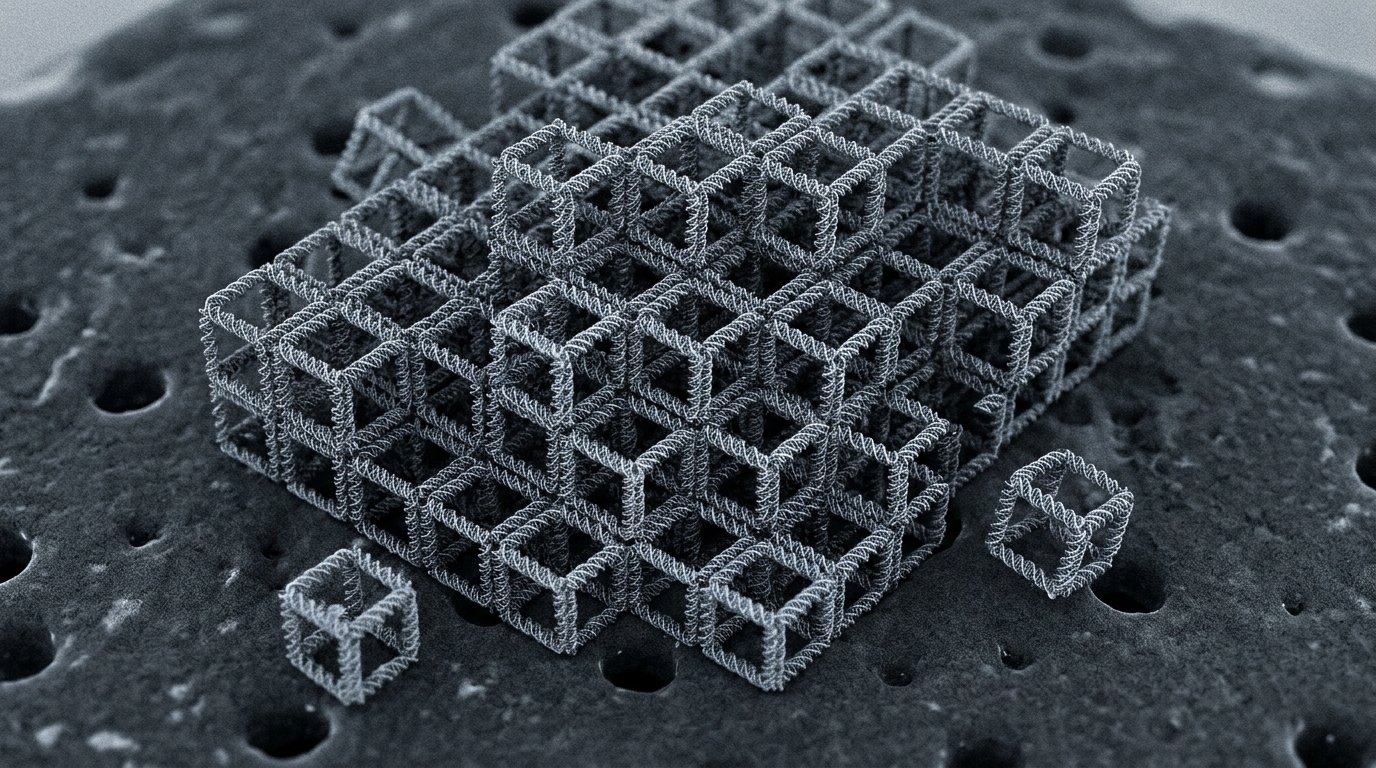
A research team led by Associate Professor Petr Sulc at Arizona State University has developed a programmable DNA-based assembly platform that enables microscopic, cube-shaped building blocks to autonomously organize into intricate three-dimensional architectures. Detailed in an experimental study published in Science Robotics, the framework demonstrates a computational and molecular methodology designed to overcome one of the central hurdles in nanotechnology: constructing sophisticated nanoscale geometries without needing to manipulate and position every single molecular component by hand. By programming synthetic DNA sequences to govern how individual nanoscale cubes recognize, collide with, and bind to one another in liquid solution, the researchers demonstrated the spontaneous formation of complex structures ranging from ordered periodic lattices to sophisticated fractal geometries, establishing a versatile foundation for future developments in reconfigurable nanorobots and multidimensional electronics.
Constructing physical matter at the molecular scale presents physical constraints fundamentally different from macroscopic manufacturing. In macroscopic assembly or modular construction, an engineer can pick up an individual component and mechanically place it into an exact coordinate. At the nanoscale, however, mechanical manipulation of individual building blocks is exceedingly difficult and inefficient. When compatible surfaces collide, complementary molecular strands bind together. However, unguided self-assembly carries substantial risks of erroneous binding; without precise geometric and chemical rules governing every facet, random collisions can cause the blocks to aggregate into disordered, nonfunctional clumps rather than the desired target geometry.
To solve this challenge, the researchers utilized the predictable biochemical pairing properties of deoxyribonucleic acid. Although DNA is primarily recognized as the biological carrier of genetic information in living organisms, its strict base-pairing rules make it an exceptionally dependable and programmable construction material for physical engineering. The Arizona State University team translated these biochemical properties into three-dimensional geometric units, designing nanoscale DNA structures shaped like tiny cubes.
Because designing such intricate molecular assemblies by sheer laboratory trial and error would be virtually impossible, the research team created an advanced computational design pipeline based on what they term a minimal kit design principle. Operating backward from a specified target three-dimensional geometry, constrained optimization algorithms calculate the absolute smallest collection of unique building blocks necessary to successfully assemble the full architecture. At the same time, the computational system systematically optimizes the binding rules across all available surfaces to suppress unintended cross-talk and spurious interactions that could otherwise steer the self-assembly pathway toward kinetic traps, assembly faults, or disorganized structural aggregation.
The computational workflow begins with an idealized mathematical representation of the target shape, testing the proposed building blocks through multiscale simulations to verify whether they will assemble reliably into the intended configuration. If the computer model detects premature precipitation, aberrant clustering, or unwanted structural deviations, the algorithm iteratively refines the component definitions and evaluates them again. Once an abstract structural plan demonstrates high assembly fidelity, researchers translate the theoretical design into physical DNA nucleotide sequences. They subsequently subject these sequences to high-resolution physical simulations to confirm that the physical strands will fold and interact as expected before any chemical synthesis occurs in the laboratory.
The physical scale and structural resolution of these modeling operations placed substantial demands on computational infrastructure. Executing the highest-resolution simulations required modeling more than 3.5 million distinct particles simultaneously, necessitating the use of high-performance computing clusters and advanced graphics processing units hosted at Arizona State University. Sulc noted that this computationally guided methodology represents a fundamental paradigm shift for the field of nanotechnology. Historically, nanomaterials development relied heavily on iterative benchtop experimentation, where scientists synthesized designs, evaluated results under microscopes, diagnosed failures, and repeatedly adjusted recipes. The team compared this transition to the evolution of aviation, which advanced from physical trial flights by the Wright brothers to modern computational engineering and aerodynamic simulations.
Following computational validation, the team synthesized the physical DNA components and experimentally assembled a diverse array of target structures in the laboratory. The experimental demonstrations spanned multiple structural paradigms, including finite discrete objects, expansive repetitive lattice frameworks, and a complex geometric fractal known as a Menger cube. Spanning more than 500 nanometers across and possessing a molecular mass of roughly 2 gigadaltons of DNA strands, this assembly represents what the authors report as the largest three-dimensional noncrystalline structure ever constructed in the field of DNA nanotechnology.
Verifying the successful physical formation and structural integrity of these nanoscale assemblies required addressing significant metrological hurdles. By depositing carefully calibrated, ultrathin coatings of silicate over the assembled DNA lattices, the team stabilized the frameworks. Achieving the precise silicate concentration required rigorous experimentation, as insufficient silicate allowed the assemblies to break, whereas excessive silicate obscured their delicate nanoscale features.
Beyond constructing rigid, static geometries, the researchers sought to verify that their modular DNA construction platform could generate dynamic structures capable of physical transformation. They devised an experimental mechanism termed a cube displacement reaction, in which introducing newly designed DNA cubes into an aqueous solution containing preassembled structures causes the newly added blocks to displace existing components at designated positions. This targeted exchange enables post-assembly geometric reconfiguration without requiring the complete dismantling of the underlying framework. The team demonstrated this principle by assembling a dynamic structural model dubbed a dancing robot, wherein the systematic addition of specific displacement cubes induced reorientations of designated structural appendages, driving the arms, legs, or head into distinct physical configurations.
In another demonstration of functional material integration, the team collaborated with researchers at Emory University to bridge DNA nanotechnology with molecular electronics. Because DNA molecules naturally adhere to the cylindrical walls of carbon nanotubes, allowing nucleotide strands to wrap securely around their external surfaces, the researchers successfully functionalized carbon nanotubes with complementary DNA sequences. By incorporating these hybrid carbon nanotube units into their modular DNA cube framework, the team organized the nanotubes into a precise three-dimensional junction. This spatial arrangement highlights the utility of programmable DNA scaffolding for positioning inorganic nanomaterials in defined multi-axis geometries, offering a viable structural pathway toward overcoming the manufacturing limits of planar integrated circuits.
Current semiconductor microchips rely predominantly on two-dimensional planar manufacturing processes, which face increasing physical challenges as electronic devices require higher component densities and enhanced computational capabilities within constrained footprints. Arranging semiconducting materials vertically in three dimensions offers a compelling strategy to expand circuit functionality, and carbon nanotubes have long been recognized as exceptional candidate materials for future computing architectures. The Arizona State University platform provides a concrete experimental blueprint illustrating how bottom-up programmable DNA scaffolding can accurately coordinate functional electronic elements in three dimensions, establishing an initial foundation for 3D nanofabrication.
The experimental endeavor was driven largely by student researchers within Sulc’s laboratory, with the first nine authors of the publication being students in his research group, led by co-first authors Thong Diep and Hao Liu. The experimental synthesis demanded intensive manual laboratory work, as building the largest multi-component assemblies required pipetting and combining thousands of individual DNA strands by hand. To support broader adoption and collaborative advancement across the scientific community, Sulc launched NANOBASE.org, an open digital platform where researchers worldwide can share structural models and download modular design kits. Supported by the Department of Energy Basic Energy Sciences Biomolecular Materials program under grant DE-SC0025265, this open-access framework aims to help researchers assemble increasingly complex functional nanomaterials without having to design underlying assembly codes from scratch.
Subject of Research: Programmable self-assembly of three-dimensional DNA nanostructures using computational design
Article Title: ASU scientists create a new way to assemble complex structures at the nanoscale
Article References: ASU scientists create a new way to assemble complex structures at the nanoscale. Original publication (Bibliographic details unavailable.)
Image Credits: AI Generated
DOI: Not provided
Keywords: DNA nanotechnology, self-assembly, nanostructures, computational modeling, Science Robotics, Petr Sulc, Arizona State University, minimal kit design, nanorobotics, three-dimensional electronics, carbon nanotubes, Menger cube, cryogenic electron microscopy, scanning electron microscopy, cube displacement reaction, silicate coating, NANOBASE.org, molecular engineering
News Source: Denise Maddox. (November 27, 2026). Programmable DNA Cubes Assemble Complex Three-Dimensional Nanostructures Through Predictive Computer Simulations. Scienmag.