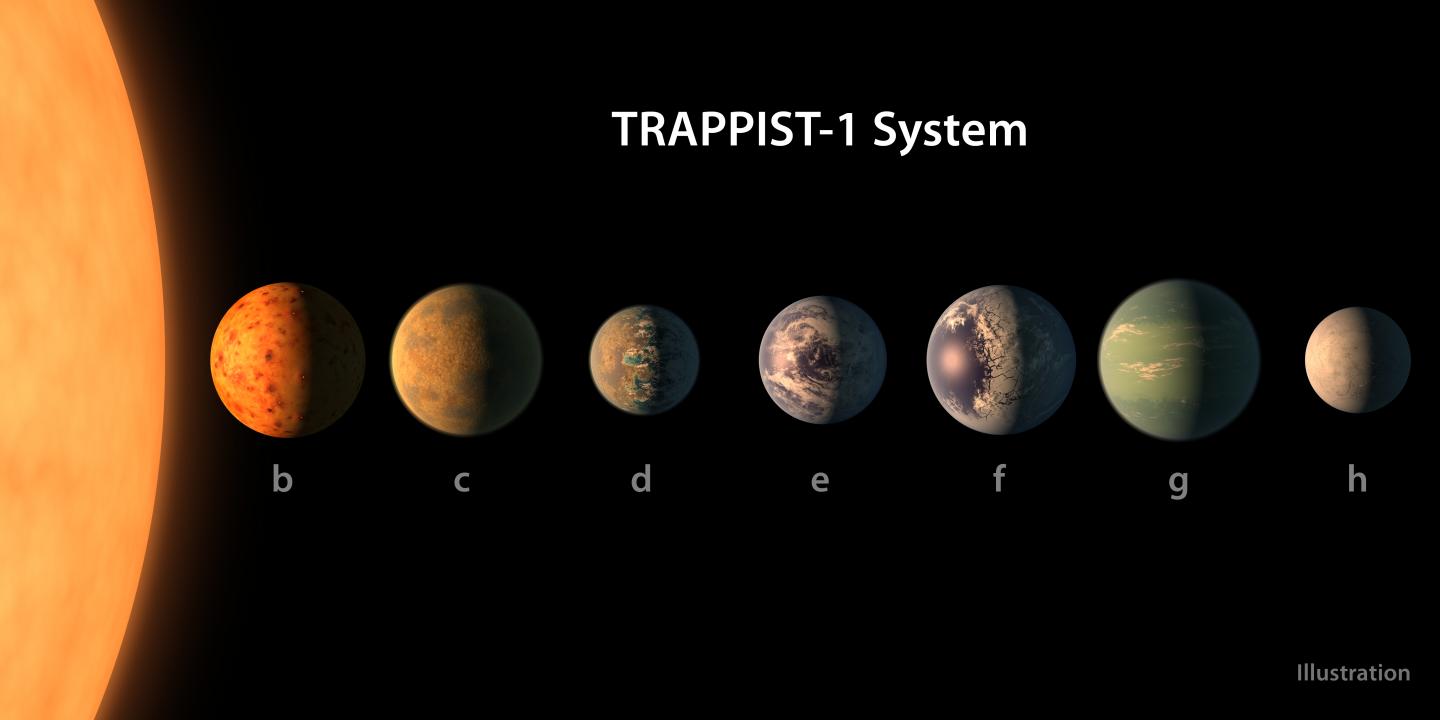
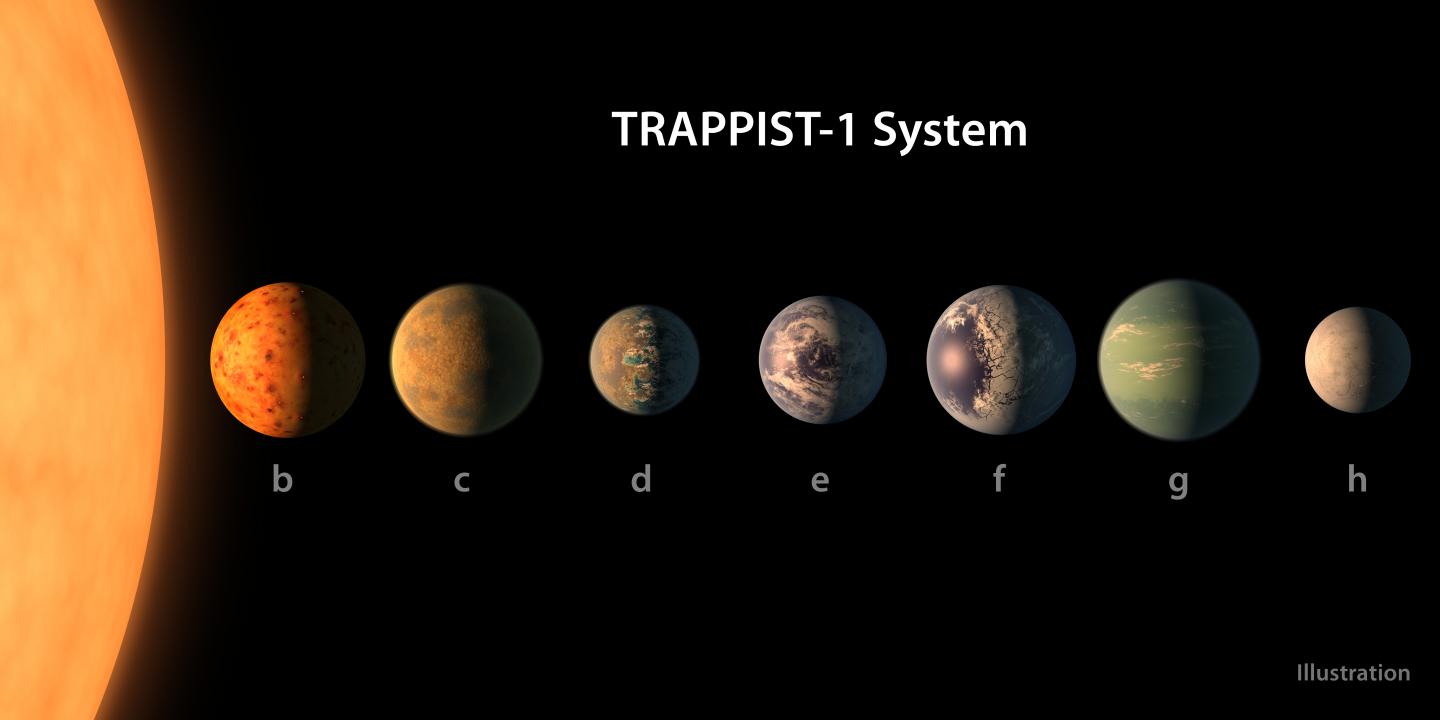
Credit: Credits: NASA/JPL-Caltech
With the discovery of seven earth-sized planets around the TRAPPIST-1 star 40 light years away, astronomers are looking to the upcoming James Webb Space Telescope to help us find out if any of these planets could possibly support life.
"If these planets have atmospheres, the James Webb Space Telescope will be the key to unlocking their secrets," said Doug Hudgins, Exoplanet Program Scientist at NASA Headquarters in Washington. "In the meantime, NASA's missions like Spitzer, Hubble, and Kepler are following up on these planets."
"These are the best Earth-sized planets for the James Webb Space Telescope to characterize, perhaps for its whole lifetime," said Hannah Wakeford, postdoctoral fellow at NASA's Goddard Space Flight Center in Greenbelt, Maryland. At Goddard, engineers and scientists are currently testing the Webb telescope which will be able to view these planets in the infrared, beyond the capabilities we currently have. "The Webb telescope will increase the information we have about these planets immensely. With the extended wavelength coverage we will be able to see if their atmospheres have water, methane, carbon monoxide/dioxide and/or oxygen."
When hunting for a potentially life-supporting planet, you need to know more than just the planet's size or distance from its star. Detecting the relative proportions of these molecules in a planet's atmosphere could tell researchers whether a planet could support life.
"For thousands of years, people have wondered, are there other planets like Earth out there? Do any support life?" said Sara Seager, astrophysicst and planetary scientist at MIT. "Now we have a bunch of planets that are accessible for further study to try to start to answer these ancient questions."
Launching in 2018, one of Webb's main goals is to use spectroscopy, a method of analyzing light by separating it into distinct wavelengths which allows one to identify its chemical components (by their unique wavelength signatures) to determine the atmospheric components of alien worlds. Webb will especially seek chemical biomarkers, like ozone and methane, that can be created from biological processes. Ozone, which protects us from harmful ultraviolet radiation here on Earth, forms when oxygen produced by photosynthetic organisms (like trees and phytoplankton) synthesizes in light. Because ozone is largely dependent on the existence of organisms to form, Webb will look for it in alien atmospheres as a possible indicator of life. It will also be able to look for methane which will help determine a biological source of the oxygen that leads to ozone accumulation.
The discovery of the planets in the TRAPPIST-1 system means that Webb will be able to use its immense capabilities on a relatively nearby system. Researchers recently identified three promising planets in the TRAPPIST-1 system – e, f and g – which orbit in the habitable zone and would make good candidates for Webb to study. Depending upon their atmospheric composition, all three of these Earth-like exoplanets could have the appropriate conditions for supporting liquid water. Because the planets orbit a star that is small, the signal from those planets will be relatively large, and just strong enough for Webb to detect atmospheric features. Shawn Domagal-Goldman, an astrobiologist at NASA's Goddard Space Flight Center said, "Two weeks ago, I would have told you that Webb can do this in theory, but in practice it would have required a nearly perfect target. Well, we were just handed three nearly perfect targets."
The number of planets in the system will also enable new research in the field of comparative planetology, which uncovers fundamental planetary processes by comparing different worlds. "This is the first and only system to have seven earth-sized planets, where three are in the habitable zone of the star," said Wakeford. "It is also the first system bright enough, and small enough, to make it possible for us to look at each of these planets' atmospheres. The more we can learn about exoplanets, the more we can understand how our own solar system came to be the way it is. With all seven planets Earth-sized, we can look at the different characterisitics that make each of them unique and determine critical connections between a planet's conditions and origins."
NASA is exploring the solar system and beyond to better understand the universe and our place in it. We're looking to answer age-old questions, like how did our universe begin and evolve; how did galaxies, stars, and planets come to be; and are we alone.
The James Webb Space Telescope is the scientific successor to NASA's Hubble Space Telescope. It will be the most powerful space telescope ever built. Webb is an international project led by NASA with its partners, ESA (European Space Agency) and the Canadian Space Agency.
For more information about the Webb telescope visit: http://www.jwst.nasa.gov or http://www.nasa.gov/webb
###
Media Contact
Rob Gutro
[email protected]
@NASAGoddard
http://www.nasa.gov/goddard
############
Story Source: Materials provided by Scienmag