

• HOME
  • NEWS
  • EXPLORE
    • CAREER
      • Companies
      • Jobs
    • EVENTS
    • iGEM
      • News
      • Team
    • PHOTOS
    • VIDEO
    • WIKI
  • BLOG
  • COMMUNITY
    • FACEBOOK
    • INSTAGRAM
    • TWITTER
Wednesday, October 28, 2026
BIOENGINEER.ORG
No Result
View All Result
  • Login
  • HOME
  • NEWS
  • EXPLORE
    • CAREER
      • Companies
      • Jobs
        • Lecturer
        • PhD Studentship
        • Postdoc
        • Research Assistant
    • EVENTS
    • iGEM
      • News
      • Team
    • PHOTOS
    • VIDEO
    • WIKI
  • BLOG
  • COMMUNITY
    • FACEBOOK
    • INSTAGRAM
    • TWITTER
No Result
View All Result
Bioengineer.org
No Result
View All Result
Home NEWS Science News Agriculture

Prickly pear pomace powder darkens biscuits and boosts their antioxidants

by
October 28, 2026
in Agriculture
Reading Time: 2 mins read
0
Prickly pear pomace powder darkens biscuits and boosts their antioxidants

Prickly pear pomace powder darkens biscuits and boosts their antioxidants

Share on FacebookShare on TwitterShare on LinkedinShare on RedditShare on Telegram

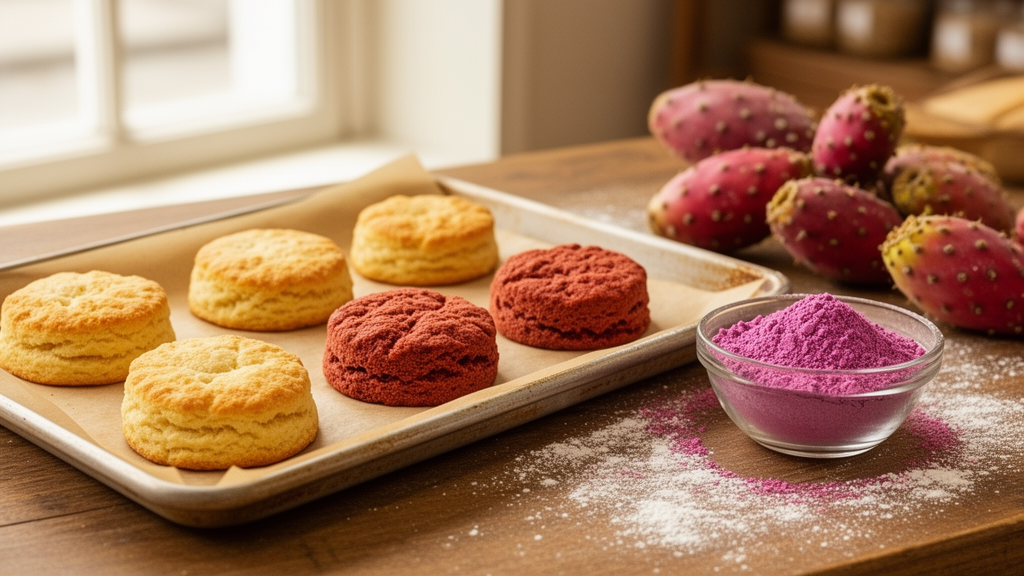
Biscuits made with powdered prickly pear fruit pomace, a by-product usually discarded after juice processing, showed darker colour, greater hardness, higher phenolic content and stronger antioxidant activity than plain wheat-flour biscuits, according to a study published in Discover Food on 27 October 2026.

Researchers Anneline Jeanette Govender, Laura Suzanne Da Silva and Daniso Beswa formulated biscuits by partially replacing wheat flour with pomace powder from two prickly pear (Opuntia ficus-indica L.) cultivars, Skinner’s Court and Algerian, at substitution levels ranging from 5 to 20 percent. The team evaluated physical and functional properties, total phenolic content, antioxidant activity using ABTS and FRAP assays, Fourier Transform Infrared spectra and descriptive sensory attributes with standard analytical techniques.

Colour changed markedly with increasing pomace. Lightness fell from 95.55 in the control biscuits to between 64.54 and 68.64 at the 20 percent substitution level, while redness rose to as much as 11.77, reflecting the pigments carried by the fruit pomace.

Texture shifted as well.

Total phenolic content rose from 16.25 milligrams of gallic acid equivalents per gram in the control to 28.57 milligrams per gram in biscuits containing 20 percent Algerian pomace. Antioxidant activity rose in parallel, with ABTS inhibition reaching up to 39.54 percent.

FTIR spectra confirmed enrichment in hydroxyl-rich polysaccharides and phenolic compounds, providing molecular-level evidence that the pomace contributed both fibre-associated carbohydrates and phenolic substances to the baked product.

Sensory profiling indicated acceptable texture and flavour at moderate substitution levels, even though panellists detected increased bran-like and seedy notes as pomace levels rose. The authors conclude that prickly pear pomace has the potential to enrich biscuits with fibre and antioxidants, supporting sustainable food production while enhancing nutritional quality.

The study addresses a knowledge gap concerning the use of pomace from different prickly pear cultivars in biscuits. The fruit pomace is described as rich in dietary fibre and bioactive compounds but vastly underutilised, and its valorisation fits growing demand for functional foods and sustainable processing of agro-industrial by-products.

As with any formulation study, the findings describe the measured properties of these specific biscuits under the tested conditions; the reported sensory acceptability applies to the substitution levels evaluated, and the hardness increase at high pomace levels remains a practical consideration for product developers seeking to raise fibre and antioxidant content in baked snacks.

Subject of Research: Effects of prickly pear fruit pomace powder on the physicochemical, bioactive and sensory properties of biscuits

Article Title: Effect of prickly pear (Opuntia ficus-indica L.) fruit pomace powder on the physicochemical, functional, bioactive, molecular, and sensory properties of biscuits

Article References: Govender, A. J., Da Silva, L. S., & Beswa, D. (2026). Effect of prickly pear (Opuntia ficus-indica L.) fruit pomace powder on the physicochemical, functional, bioactive, molecular, and sensory properties of biscuits. Discover Food. https://doi.org/10.1007/s44187-026-01332-x

Image Credits: AI Generated

DOI: 10.1007/s44187-026-01332-x

Keywords: prickly pear, Opuntia ficus-indica, pomace, biscuits, dietary fibre, antioxidants, total phenolic content, FTIR, sensory analysis, functional foods, food by-product valorisation, Effect

News Source: Daisy Hatcher. (October 28, 2026). Prickly pear pomace powder darkens biscuits and boosts their antioxidants. Scienmag.


Tags: Antioxidantsbiscuitsdietary fibreeffectfood by-product valorisationFTIRfunctional foodsOpuntia ficus-indicapomaceprickly pearsensory analysistotal phenolic content
Share12Tweet7Share2ShareShareShare1

Related Posts

Buffalo breeding program delivers 450 billion rupees in milk gains

Buffalo breeding program delivers 450 billion rupees in milk gains

October 28, 2026
Flavoromics maps the volatile ticking clock of a stored wine cap mushroom

Flavoromics maps the volatile ticking clock of a stored wine cap mushroom

October 28, 2026

Postbiotics Move From Microbial Ecology Toward the Food Industry Mainstream

October 28, 2026

Linalool reshapes microbial networks during cigar tobacco fermentation, study finds

October 28, 2026

POPULAR NEWS

  • RNA methyltransferase NSUN2 stabilizes PARP9 transcript to drive breast cancer growth and immune escape, study finds

    RNA methyltransferase NSUN2 stabilizes PARP9 transcript to drive breast cancer growth and immune escape, study finds

    29 shares
    Share 12 Tweet 7
  • Linalool reshapes microbial networks during cigar tobacco fermentation, study finds

    29 shares
    Share 12 Tweet 7
  • Retrospective study wrongly claimed prospective validation, letter warns

    29 shares
    Share 12 Tweet 7
  • Sepsis Kills One in Three Patients in Mogadishu Emergency Department, Prospective Cohort Finds

    29 shares
    Share 12 Tweet 7

About

We bring you the latest biotechnology news from best research centers and universities around the world. Check our website.

Follow us

Recent News

Buffalo breeding program delivers 450 billion rupees in milk gains

Computational predictions are not clinical evidence, researchers warn in CYLD variant dispute

New k-mer estimator cracks substitution rates in repetitive DNA

Subscribe to Blog via Email

Enter your email address to subscribe to this blog and receive notifications of new posts by email.

Join 85 other subscribers
  • Contact Us

Bioengineer.org © Copyright 2023 All Rights Reserved.

Welcome Back!

Login to your account below

Forgotten Password?

Retrieve your password

Please enter your username or email address to reset your password.

Log In
No Result
View All Result
  • Homepages
    • Home Page 1
    • Home Page 2
  • News
  • National
  • Business
  • Health
  • Lifestyle
  • Science

Bioengineer.org © Copyright 2023 All Rights Reserved.
