• HOME
  • NEWS
  • EXPLORE
    • CAREER
      • Companies
      • Jobs
    • EVENTS
    • iGEM
      • News
      • Team
    • PHOTOS
    • VIDEO
    • WIKI
  • BLOG
  • COMMUNITY
    • FACEBOOK
    • INSTAGRAM
    • TWITTER
Monday, November 16, 2026
BIOENGINEER.ORG
No Result
View All Result
  • Login
  • HOME
  • NEWS
  • EXPLORE
    • CAREER
      • Companies
      • Jobs
        • Lecturer
        • PhD Studentship
        • Postdoc
        • Research Assistant
    • EVENTS
    • iGEM
      • News
      • Team
    • PHOTOS
    • VIDEO
    • WIKI
  • BLOG
  • COMMUNITY
    • FACEBOOK
    • INSTAGRAM
    • TWITTER
No Result
View All Result
Bioengineer.org
No Result
View All Result
Home NEWS Science News Chemistry

Previously unknown letter reveals Einstein’s thinking on bees, birds and physics

Bioengineer by Bioengineer
May 12, 2021
in Chemistry
Reading Time: 3 mins read
0
IMAGE
Share on FacebookShare on TwitterShare on LinkedinShare on RedditShare on Telegram

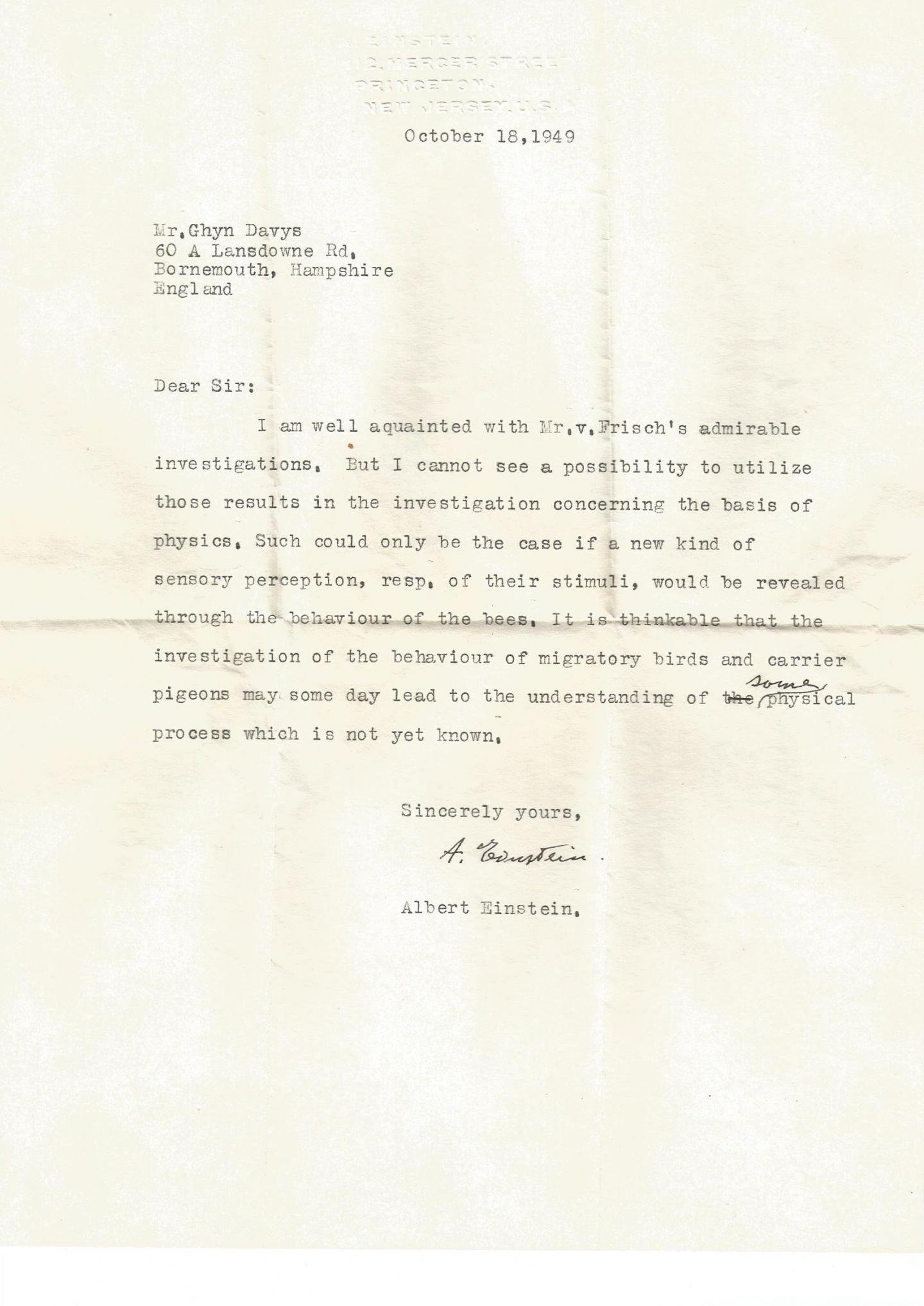
A recently discovered letter written by Albert Einstein discusses a link between physics and biology, seven decades before evidence emerges.
IMAGE

Credit: Dyer et al. 2021, J Comp Physiol A / The Hebrew University of Jerusalem

The 1949 letter by the physicist and Nobel laureate discusses bees, birds and whether new physics principles could come from studying animal senses.

It’s a position still being realised within physics to this day, with a growing body of research and understanding of how animals such as birds and bees find their way around.

Now a study led by RMIT University in Melbourne, Australia, discusses how recent discoveries in migratory birds back up Einstein’s thinking 72 years ago.

The previously unpublished letter was shared with researchers by Judith Davys – Einstein had addressed it to her late husband, radar researcher Glyn Davys.

RMIT’s Associate Professor Adrian Dyer has published significant studies into bees and is the lead author of the new paper on Einstein’s letter, published in the Journal of Comparative Physiology A.

Dyer said the letter shows how Einstein envisaged new discoveries could come from studying animals.

“Seven decades after Einstein proposed new physics might come from animal sensory perception, we’re seeing discoveries that push our understanding about navigation and the fundamental principles of physics,” he said.

The letter also proves Einstein met with Nobel laurate Karl von Frisch, who was a leading bee and animal sensory researcher.

In April 1949, von Frisch presented his research on how honeybees navigate more effectively using the polarisation patterns of light scattered from the sky.

The day after Einstein attended von Frisch’s lecture, the two researchers shared a private meeting.

Although this meeting wasn’t formally documented, the recently discovered letter from Einstein provides insight into what they might have talked about.

“It is thinkable that the investigation of the behaviour of migratory birds and carrier pigeons may someday lead to the understanding of some physical process which is not yet known,” Einstein wrote.

Professor Andrew Greentree, a theoretical physicist at RMIT, said Einstein also suggested that for bees to extend our knowledge of physics, new types of behaviour would need to be observed.

“Remarkably, it is clear through his writing that Einstein envisaged new discoveries could come from studying animals’ behaviours,” Greentree said.

More than 70 years since Einstein sent his letter, research is revealing the secrets of how migratory birds navigate while flying thousands of kilometres to arrive at a precise destination.

In 2008, research on thrushes fitted with radio transmitters showed, for the first time, that these birds use a form of magnetic compass as their primary orientation guide during flight.

One theory for the origin of magnetic sense in birds is the use of quantum randomness and entanglement. Both of these physics concepts were first proposed by Einstein.

###

The letter to Glyn Davys shows the openness of Einstein’s mind to novel possibilities observed in nature and the evidence that he took an interest in von Frish and his bee research.

‘Einstein, von Frisch and the honeybee: a historical letter comes to light’, with Adrian Dyer, Andrew Greentree, Jair Garcia, Elinya Dyer, Scarlett Howard and Fredrich Barth, is published in the Journal of Comparative Physiology A (DOI: 10.1007/s00359-021-01490-6).

Media Contact
Aeden Ratcliffe
aeden.ratcliffe@rmit.edu.au

Related Journal Article

http://dx.doi.org/10.1007/s00359-021-01490-6

Tags: Biomechanics/BiophysicsChemistry/Physics/Materials SciencesHistory
Share13Tweet8Share2ShareShareShare2

Related Posts

Review Outlines How Piezoelectric Fields Enhance Catalytic Reactions Across Diverse Materials

Review Outlines How Piezoelectric Fields Enhance Catalytic Reactions Across Diverse Materials

November 16, 2026
Subsoil Horizons Store Most Soil Carbon but Face Vulnerability Under Management

Subsoil Horizons Store Most Soil Carbon but Face Vulnerability Under Management

November 16, 2026

Machine Learning Drones Advance Predictive Surface Quality Management in Industry

November 16, 2026

Comprehensive Review Examines Multi-Platform Analytical Strategies Tracking Persistent Fluorinated Xenobiotics

November 16, 2026
Please login to join discussion

POPULAR NEWS

  • Review Assesses Biochar Membranes as Sustainable Candidates for Industrial Carbon Dioxide Capture

    Review Assesses Biochar Membranes as Sustainable Candidates for Industrial Carbon Dioxide Capture

    29 shares
    Share 12 Tweet 7
  • Stacking Machine Learning Model Detects Toddler Autism Signs With Ninety-Nine Percent Accuracy

    29 shares
    Share 12 Tweet 7
  • Engineered Statistical Features Drive Network Anomaly Detection Over Complex Deep Architectures

    29 shares
    Share 12 Tweet 7
  • Integrated Camera and Laser Mapping Enables Automated 3D Tunnel Defect Inspection

    29 shares
    Share 12 Tweet 7

About

We bring you the latest biotechnology news from best research centers and universities around the world. Check our website.

Follow us

Recent News

Systematic Review Identifies Diverse Spider Venom Enzymes for Bioeconomic Applications

Portuguese Museum Bird Collections Show Severe Geographic and Temporal Data Gaps

Extreme Simulated Magnetic Fields Alter Carbohydrate Molecular Geometry and Reaction Sites

Subscribe to Blog via Email

Enter your email address to subscribe to this blog and receive notifications of new posts by email.

Join 87 other subscribers
  • Contact Us

Bioengineer.org © Copyright 2023 All Rights Reserved.

Welcome Back!

Login to your account below

Forgotten Password?

Retrieve your password

Please enter your username or email address to reset your password.

Log In
No Result
View All Result
  • Homepages
    • Home Page 1
    • Home Page 2
  • News
  • National
  • Business
  • Health
  • Lifestyle
  • Science

Bioengineer.org © Copyright 2023 All Rights Reserved.