Investigating the biophysical mechanisms through which plant-derived secondary metabolites neutralize resistant foodborne pathogens, researchers have mapped how specific chemical additions dictate whether antimicrobial phenolic compounds effectively penetrate and rupture lipid bilayer models. A study published in the Journal of Agriculture and Food Research demonstrates that while adding prenyl chemical groups promotes significantly deeper and thermodynamically more favorable insertion into lipid bilayers, deep membrane insertion alone is insufficient to induce physical membrane permeabilization. By pairing in vitro carboxyfluorescein dye leakage assays using synthetic and biologically derived liposomes with in silico umbrella sampling molecular dynamics simulations, the research team clarified structural rules governing how phenolic backbone variations, prenyl group numbers, and ring cyclization influence bacterial envelope disruption.
The investigation addressed a pressing food safety and public health challenge centered on Staphylococcus aureus, a major foodborne pathogen responsible for widespread outbreaks, including 158 verified foodborne incidents across the European Union in 2024. The persistent emergence of antimicrobial-resistant strains, particularly methicillin-resistant Staphylococcus aureus, or MRSA, has increasingly complicated hygienic control throughout agricultural production environments and livestock systems. Because livestock-associated MRSA strains frequently disseminate across farming facilities and food processing chains, investigators have sought novel antimicrobial agents capable of supplementing standard antibiotic regimens. Plant phenolics equipped with prenyl functional groups have emerged as promising candidates, exhibiting potent inhibitory efficacy against Gram-positive bacteria, yet the precise nanoscale interactions between these hydrophobic compounds and cellular lipid membranes had remained incompletely understood.
To establish rigorous comparative baselines, the researchers evaluated a library of structurally related phenolic compounds encompassing distinct subclasses, including isoflavones such as genistein, wighteone, 6,8-diprenylgenistein, neobavaisoflavone, and glabrone; flavanones including 8-prenylnaringenin, 6,8-diprenylnaringenin, and isobavachin; and the chalcone isobavachalcone. In baseline microbiological testing against methicillin-resistant Staphylococcus aureus strain 18HN, non-prenylated genistein and the flavanone isobavachin displayed minimum inhibitory concentrations exceeding 50 micrograms per milliliter and effective concentrations causing ten percent membrane permeabilization exceeding 100 micrograms per milliliter. Conversely, compounds carrying prenyl appendages showed markedly enhanced bioactivity. Di-prenylated flavanone 6,8-diprenylnaringenin displayed a minimum inhibitory concentration between 6 and 13 micrograms per milliliter, whereas the open-chain chalcone isobavachalcone demonstrated the most potent antibacterial profile, achieving a minimum inhibitory concentration of 3 micrograms per milliliter and an effective permeabilization threshold of 12 micrograms per milliliter.
To determine whether these bactericidal actions stem directly from physical disruptions of lipid bilayers rather than secondary metabolic cascades or protein targeting, the team constructed three distinct unilamellar liposome model systems. These experimental membranes comprised neutral, saturated 1,2-dipalmitoyl-sn-glycero-3-phosphocholine, known as DPPC, which remains in a rigid gel phase at 25 degrees Celsius; an unsaturated, negatively charged mixture of 1-palmitoyl-2-oleoyl-sn-glycero-3-phosphocholine and 1-palmitoyl-2-oleoyl-sn-glycero-3-phospho-(1′-rac-glycerol), designated POPC:POPG at a two-to-one molar ratio, which mimics bacterial surface charge; and a complex lipid extract derived directly from Escherichia coli consisting predominantly of phosphatidylethanolamine, phosphatidylglycerol, and cardiolipin. Liposomes were extruded to uniform 100-nanometer diameters while encapsulating 30 millimolar 5(6)-carboxyfluorescein, an internally self-quenching fluorescent dye whose concentration-dependent release serves as a direct metric of bilayer perforation.
Permeabilization measurements revealed clear structural divergences across the tested chemical analogues. Mono-prenylated isoflavone wighteone emerged as the most potent permeabilizing agent across all membrane compositions, generating fractional dye release exceeding 0.8 at 66 micromolar. In striking contrast, the addition of a second prenyl chain did not enhance membrane disruption; in POPC:POPG liposomes, 17 micromolar wighteone yielded a fractional release above 0.5, whereas 28 micromolar di-prenylated 6,8-diprenylgenistein produced fractional leakage below 0.2. Similarly, the mono-prenylated flavanone 8-prenylnaringenin induced a fractional release of 0.81 at 94 micromolar, whereas di-prenylated 6,8-diprenylnaringenin produced only 0.17 fractional leakage at 82 micromolar. Completely non-prenylated genistein failed to cause any detectable dye leakage across all liposome formulations, proving that prenylation is an absolute prerequisite for direct lipid bilayer disruption.
The physical geometry and cyclization of the prenyl moiety also exerted a dominant effect on bilayer integrity. When comparing the chain-prenylated isoflavone neobavaisoflavone to its ring-closed counterpart glabrone in POPC:POPG liposomes, neobavaisoflavone triggered extensive membrane rupture, yielding a fractional release of 0.84 at 94 micromolar, whereas glabrone remained virtually inert, registering an release of just 0.04 at 88 micromolar. Because both molecules share an identical phenolic backbone and an adjacent hydroxyl group, the complete suppression of leakage by glabrone directly highlights the functional penalty imposed by rigid cyclization. Furthermore, opening the molecular C-ring between the flavanone isobavachin and the chalcone isobavachalcone resulted in a pronounced surge in lytic potency within DPPC liposomes, driving fractional release from 0.12 up to 0.90, an outcome linked to heightened conformational flexibility.
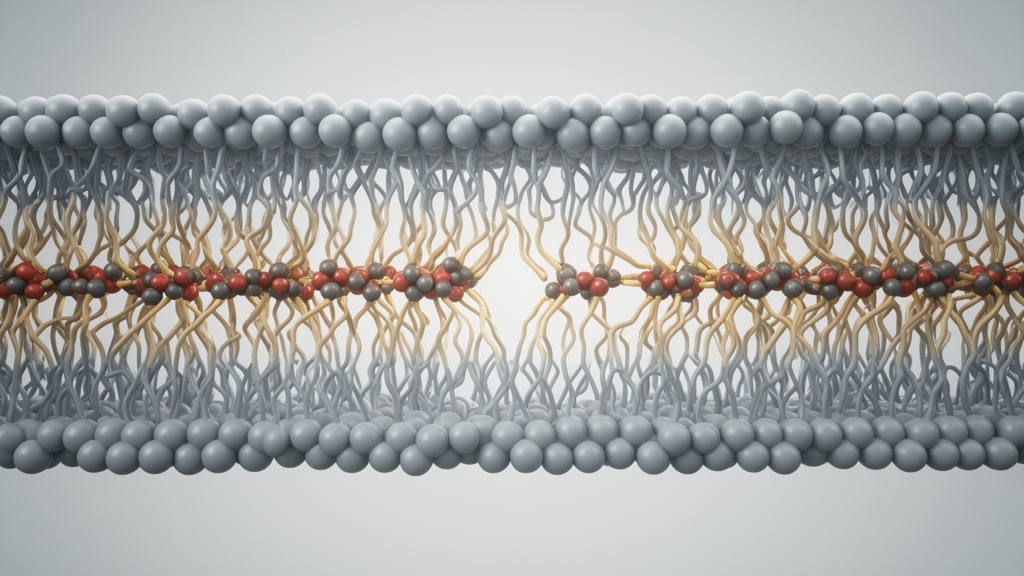
To uncover the atomic-scale interactions explaining why potent antibacterial molecules sometimes fail to cause liposomal leakage, the researchers conducted in silico molecular dynamics simulations employing the GROMOS 54A7 force field within the GROMACS 2023.3 simulation suite. Examining neutral forms of genistein, neobavaisoflavone, glabrone, and 6,8-diprenylgenistein within a hydrated, charge-neutralized 128-lipid POPC:POPG bilayer over 101 umbrella sampling windows, the team calculated potential of mean force profiles using the weighted histogram analysis method. These simulations allowed the quantification of insertion free-energy minima alongside the precise equilibrium depth of each phenolic molecule relative to the center of the membrane bilayer.
Free-energy profiling demonstrated that an increasing number of prenyl groups strongly enhances the thermodynamic drive for lipid bilayer insertion. Unmodified genistein displayed the shallowest, least favorable binding profile, exhibiting a free energy minimum of minus 35.9 kilojoules per mole positioned 1.30 nanometers from the bilayer center. In sharp contrast, di-prenylated 6,8-diprenylgenistein achieved a significantly deeper minimum of minus 73.1 kilojoules per mole, settling at only 0.80 nanometers from the hydrophobic bilayer core. Clustering analysis of trajectory frames further revealed that while non-prenylated genistein adopts a flat orientation parallel to the membrane surface with its polar carbonyl and hydroxyl groups interacting with phospholipid headgroups, all prenylated molecules embed their lipophilic prenyl groups vertically into the hydrophobic core.
Crucially, synthesizing the experimental and computational data revealed that trends in predicted membrane insertion depth align closely with whole-cell bacterial growth inhibition, but do not correlate with liposomal or bacterial membrane permeabilization. Highly inserted molecules like 6,8-diprenylgenistein and cyclized glabrone partition strongly into the core of the bilayer, yet induce minimal physical leakage. The authors hypothesize that efficient membrane permeabilization requires transient, perturbing interactions located near the outer phospholipid headgroup region, whereas deep, stable burial within the hydrocarbon core may permit smooth molecular accommodation that preserves structural membrane barrier function without generating lytic pores.
The study notes necessary interpretive boundaries, recognizing that single neutral molecules simulated within simplified in silico bilayers do not capture high-concentration self-assembly, multi-compound aggregation equilibria, or transmembrane cluster formation previously postulated for certain prenylated compounds. Additionally, experimental liposome leakage assays conducted in 7.5 percent dimethyl sulfoxide vehicle solutions operate at relatively high compound-to-lipid ratios that may involve non-specific solvent interactions. Overall, the findings establish that while prenylation is critical for membrane association and whole-cell bacterial inhibition, antibacterial activity in prenylated phenolics operates via nuanced biophysical mechanisms extending beyond sheer insertion depth, providing valuable structural templates for future natural antimicrobial development in agriculture and food preservation.
To ensure precise experimental exposure levels, the authors verified liposome integrity and phenolic concentrations through multi-step analytical protocols. Following extrusion, dynamic light scattering confirmed the dimensions of the unilamellar liposomes, while the Stewart assay established lipid concentrations prior to assay dilution. Because hydrophobic phenolics can exhibit variable solubility in aqueous test media, the researchers used reversed-phase ultra-high performance liquid chromatography coupled with photodiode array detection and electrospray ionization linear ion trap mass spectrometry to quantify the actual phenolic concentrations present during testing. Dose-dependent dye release across measured concentrations was subsequently evaluated using a four-parameter logistic model constrained between vehicle and detergent controls to determine the half-maximal effective concentrations governing bilayer disruption.
Beyond passive membrane lysis, the research team noted that the broader antimicrobial potency of prenylated phenolics may engage complementary cellular mechanisms. Earlier investigations demonstrated that these natural metabolites can disrupt bacterial proton motive force, alter membrane fluidity, inhibit antibiotic efflux pumps, or interact directly with intracellular targets. Furthermore, computational simulations purposefully utilized neutral molecular states to isolate structural variables, even though isoflavones such as genistein exhibit a dissociation constant near 7.3 and may undergo partial ionization under physiological conditions at neutral pH.
To resolve the precise divergence between membrane affinity and biological lethality, the authors highlighted specific experimental pathways for subsequent research. Distinguishing physical bilayer partitioning from functional membrane breakdown will require measuring unbound compound fractions in solution at non-permeabilizing doses, a task well suited to solid-phase microextraction fiber techniques. Combining these direct partitioning measurements with cellular membrane fluidity evaluations will help clarify how non-disruptive phenolic insertion impairs pathogen survival, refining the rational identification of plant-derived agents for food safety interventions.
Subject of Research: Biochemical mechanisms of membrane permeabilization by prenylated plant phenolics against resistant bacteria
Article Title: In vitro and in silico membrane interactions of antimicrobial phenolics: effect of prenyl number and cyclization
Article References: Ritsema, J. H., Calligari, P., Bombelli, A., Stella, L., Kramer, N. I., Vincken, J.-P., Bocchinfuso, G., & Araya-Cloutier, C. (2026). In vitro and in silico membrane interactions of antimicrobial phenolics: effect of prenyl number and cyclization. Journal of Agriculture and Food Research, 32, Article 103445. https://doi.org/10.1016/j.jafr.2026.103445
Image Credits: AI Generated
DOI: 10.1016/j.jafr.2026.103445
Keywords: Prenylated Phenolics, Staphylococcus aureus, MRSA, Membrane Permeabilization, Molecular Dynamics, Liposomes, Wighteone, Genistein, Isobavachalcone, Glabrone, Potential of Mean Force, Bacterial Membranes, Foodborne Pathogens, Antimicrobial Mechanisms, Biophysics, Structure-Activity Relationship
News Source: Alan Morgan. (November 16, 2026). Prenyl Groups Steer Phenolic Molecule Insertion and Disrupt Bacterial Membrane Models. Scienmag.