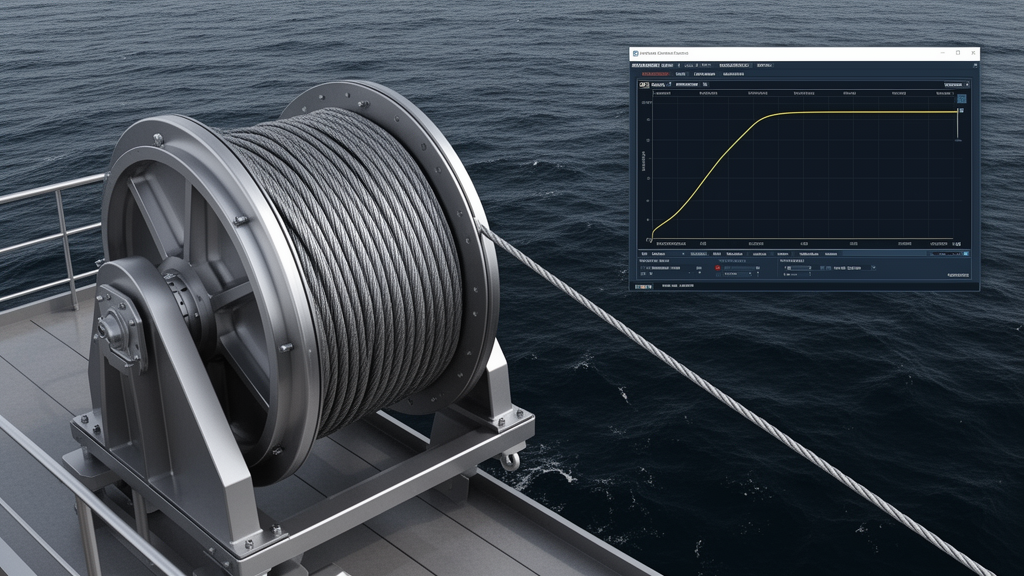
Researchers from China have developed a predictive control strategy for active heave compensation systems used in electric-driven marine winches, significantly reducing the vertical displacement of underwater equipment during offshore operations. Published in Mechanical Sciences, the study integrates dynamic analysis with model predictive control to address the complex six-degree-of-freedom motion of engineering ships caused by wave fluctuations. The team, led by Tiancai Xie and including Liangpei Huang, Shaoli Wang, and Chao Zhong, aimed to overcome the limitations of previous models that often treated the wire rope as a simple spring-damper system, thereby severing the relationship between dynamics and control.
The core challenge in marine operations is that wave-induced heave motion severely disturbs the stability of underwater equipment. While traditional compensation systems rely on the retraction of flexible wire ropes to decouple the relative motion between the ship and the equipment, these methods often suffer from dynamic modelling inaccuracies and electrical control delays. The authors argue that conventional simulations using empirical formulas or simple harmonic motion fail to represent the reality of complex wave motions. To address this, the study directly collected actual wave data from sea trials using ship attitude instruments, providing a more reliable external excitation for the mechanical system.
The research team established a virtual prototype model of the active heave compensation system, which includes an electric-driven marine winch, a frame, and a flexible wire rope. By using a bushing-force modelling method, they simulated the nonlinear stiffness and damping characteristics of the wire rope in three-dimensional space. This approach allowed for a more accurate representation of the mechanical properties of the rope, including its interaction with the rope-crossing device. The model was built using ADAMS, a dynamic simulation software, to verify the rationality of the system modelling and the effectiveness of the compensation function.
Simulation results under different loads and depths demonstrated that the static and dynamic characteristics of the wire rope were well simulated. For instance, when the load increased from 25 kN to 85 kN, the average load displacement shifted from approximately -0.05 m to -0.17 m, indicating that heavier equipment deviates more from the ideal position. Similarly, as the depth increased from 1000 m to 3000 m, the average heave displacement increased from -0.13 m to -0.18 m. These findings confirmed that the modelling method accurately captured the relationship between the heave displacement of the underwater equipment and the vertical motion of the engineering ship.
To improve the precision of heave compensation, the researchers implemented a model predictive control method based on the identified dynamic model. The control system uses a multi-motor driving structure with six asynchronous motors controlled by three frequency converters. The MPC method was chosen because it can effectively handle the time delays caused by electromagnetic interference, relay switching, and the rotational inertia of the drum. By replacing the traditional proportional-integration-differentiation control with MPC, the system was able to optimize the control variables using feedback correction, thereby reducing the deviation between predicted and theoretical values.
The simulation of the control system showed that the MPC method significantly improved the compensation performance compared to other strategies. When using position compensation with MPC, the large displacement observed at the initial stage of compensation in dynamic methods was eliminated. Under level-2 and level-3 sea conditions, the load displacement was reduced by an order of magnitude compared to systems with poor identification structures. The study also compared the MPC controller with a sliding-mode controller, finding that the MPC controller provided a more stable working position for the load, especially under harsher sea conditions and heavier loads.
To validate the simulation results, the team conducted indoor pool experiments on a test platform based on the JH-20/45 electric-driven marine winch. The experimental setup included a marine winch, steel wire rope, a mass block, and a remote control terminal, with the water in the pool dynamically supplied and drained to simulate currents. Wind turbines were also used to simulate sea breezes. The experiments were repeated three times with loads of 55 kN and 115 kN to ensure the reliability of the data. The results showed that the maximum load displacement was reduced from 0.95 m to 0.025 m for the 55 kN load, and from 1.17 m to 0.06 m for the 115 kN load.
The study highlights the importance of integrating dynamic analysis with intelligent control methods for marine equipment. Previous research often ignored the concrete model of the wire rope or used simplified state-space equations, which led to idealistic calculations of load motion and rope tension. By considering the mechanical properties of the wire rope and using actual wave data, this work overcomes the shortcomings of previous studies. The compensation rate increased from approximately 77% in the dynamic method to 96% with the MPC method, demonstrating the significant improvement in precision achieved by the proposed strategy.
However, the authors note several limitations of the study. The work was conducted under specific level-2 and level-3 sea conditions collected in a particular sea trial, meaning the active heave compensation function is aimed at these specific excitations. The function would need to be modified for other sea conditions. Additionally, the modelling effect of the flexible wire rope is closely linked to the knowledge of professionals, which may lead to differences in the mathematical model of the identified system. The indoor pool experiment, while reflecting nonlinear hydrodynamic effects to some extent, did not fully reflect the six-degree-of-freedom motion of a real engineering ship.
The findings provide new insights into the intelligence of marine hoisting equipment and the development of equipment for marine mineral resources. The path towards full-scale offshore implementation involves carrying out scenario-based tests under actual marine conditions using national marine test facilities.
Subject of Research: Predictive control strategy for active heave compensation in electric-driven marine winches
Article Title: A predictive control strategy of an active heave compensation system for an electric-driven marine winch based on dynamic analysis
Article References: Xie, T., Huang, L., Wang, S., & Zhong, C. (2026). A predictive control strategy of an active heave compensation system for an electric-driven marine winch based on dynamic analysis. Mechanical Sciences, 17(2), 1023-1037. https://doi.org/10.5194/ms-17-1023-2026
Image Credits: AI Generated
Keywords: marine winch, heave compensation, model predictive control, dynamic analysis, offshore operations, wire rope modelling, electric drive, ship motion, underwater equipment, control system, predictive, control
News Source: Denise Maddox. (November 9, 2026). Predictive Control Cuts Marine Winch Heave Displacement. Scienmag.