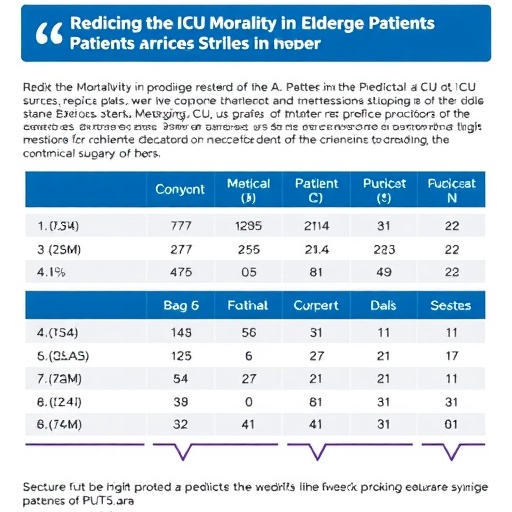
In a significant advancement in geriatric healthcare, researchers from several prestigious institutions have undertaken a study focused on the critical issue of hospital mortality among acute ischemic stroke patients over the age of 80. This demographic is particularly vulnerable due to a confluence of age-related health complications and the implications of stroke itself, necessitating tailored medical attention. The findings of the study, published in the journal BMC Geriatrics, provide invaluable insight into predictive models that may better inform clinicians and caregivers about outcomes for this high-risk group in intensive care units (ICUs).
The impetus behind this research lies in the alarming statistics surrounding acute ischemic strokes, especially in older adults. These strokes account for a significant percentage of disability and mortality among elderly populations globally. With an aging population, the pressures on healthcare systems are intensifying, and predicting outcomes for elderly stroke patients has never been more critical. As clinicians strive to optimize treatment protocols, effective mortality prediction becomes essential, weighing both the benefits and risks of interventions.
The study adopts a retrospective design, scrutinizing a comprehensive dataset of acute ischemic stroke patients admitted to ICU settings. By leveraging historical patient data, the researchers meticulously developed a predictive model that assesses various clinical parameters. These include vital signs, laboratory results, and demographic information that are known to influence mortality rates. The sophistication of the model lies not just in its statistical rigor, but also in its clinical applicability, as it stands to bridge the gap between theoretical research and real-world patient care.
Central to the model’s utility is its ability to provide prognostic assessments that can guide decision-making in clinical settings. For healthcare professionals, understanding the likelihood of mortality can be a potent tool. It influences how aggressive treatment plans are designed, and how family members are counseled about their loved ones’ prognosis. By accurately identifying high-risk individuals, the healthcare system can allocate resources more effectively, ensuring that critical care services are directed towards those who are most likely to benefit.
The researchers meticulously validated their model against another independent cohort to ensure its robustness and reliability. This validation step is crucial, as it helps eliminate biases or overfitting that could arise from relying solely on the initial dataset. The model’s performance metrics indicate a strong predictive capability, demonstrating a significant correlation between its assessments and actual patient outcomes. Such validation not only enhances the model’s credibility but also its acceptance among the medical community.
One of the most salient aspects of the study is its insistence on inclusivity. The aging population often presents unique challenges that younger adults do not face, including polypharmacy and concomitant chronic illnesses. By focusing on patients aged 80 and above, the researchers are underscoring the necessity to tailor health interventions uniquely suited to the elderly. This focus promotes a more personalized approach to care, enhancing the dignity and quality of life for these patients even in critical situations.
Furthermore, the study contributes to a growing body of evidence supporting the need for specialized training among healthcare providers who treat elderly patients. Just as pediatric care requires a different skill set than adult medicine, so too does geriatric care. Given that older adults may respond differently to therapeutic interventions, equipping clinicians with the necessary tools to navigate these complexities is paramount.
Among the technical aspects explored within the study is the application of machine learning algorithms in refining the predictive model. Using large datasets allows researchers to train algorithms that can identify patterns and correlations that traditional statistical methods might miss. Such innovations are setting the stage for a paradigm shift in how medical predictions are made, with the potential to transform patient management across various disciplines.
Notably, the implications of this research extend beyond the clinical realm. The broader societal context highlights our obligation to ensure that aging populations are afforded the best possible care options. With the increasing prevalence of strokes, understanding mortality risk becomes fundamentally tied to healthcare policy and resource allocation. Governments and healthcare institutions must take heed of evidence like this study to develop frameworks that address the specific needs of the elderly.
As families grapple with the emotional burden of caring for aging loved ones, access to predictive tools can alleviate some of the uncertainty surrounding treatment decisions. Empowering families with knowledge enhances their ability to make informed choices, facilitating discussions that are often laden with anxiety. In doing so, this research contributes not only to scientific knowledge but also to the emotional and psychological well-being of patients and their families.
The implications of this study also reverberate through the academic community. It invites further research into why older adults’ responses to strokes differ from younger counterparts and what measures can be taken to improve outcomes across various strata of elderly populations. Future investigations could delve deeper into the biological and environmental factors that contribute to these discrepancies, promoting a holistic understanding of geriatric health.
In conclusion, the study led by Xu et al. marks a pivotal moment in geriatric medicine, where empirical research collaborates with clinical practice to forge a path toward improved outcomes for elderly stroke patients. Developing reliable predictive models serves as a cornerstone for not just immediate patient care, but for long-term healthcare strategies aimed at managing the profound changes accompanying aging. The fusion of technology, empathetic healthcare, and rigorous scientific inquiry captures the essence of what modern medicine should strive to achieve – personalized, informed, and responsive care for every individual, regardless of age.
As society navigates the complexities posed by an aging world, the insights garnered from such studies will undoubtedly shape the frameworks within which healthcare is delivered, ensuring that our elders receive the best possible care during the life phases that necessitate it most.
Subject of Research: Predicting hospital mortality in acute ischemic stroke patients over 80 years.
Article Title: Development and validation of predicting hospital mortality of acute ischemic stroke patients over 80 years in ICU: a retrospective study.
Article References:
Xu, L., Chen, Y., Pitton Rissardo, J. et al. Development and validation of predicting hospital mortality of acute ischemic stroke patients over 80 years in ICU: a retrospective study.
BMC Geriatr (2026). https://doi.org/10.1186/s12877-025-06821-9
Image Credits: AI Generated
DOI: 10.1186/s12877-025-06821-9
Keywords: Acute ischemic stroke, elderly healthcare, mortality prediction, intensive care, machine learning.
Tags: acute ischemic stroke outcomes for seniorsage-related health complicationsgeriatric healthcare advancementshealthcare system pressures with aging populationsICU mortality prediction in elderly stroke patientsimproving clinician decision-making for high-risk patientsinsights from BMC Geriatrics study on stroke mortalitymortality statistics in elderly populationsoptimizing treatment protocols for elderly patientspredictive models in intensive careretrospective studies in stroke researchtailored medical attention for stroke patients