Trauma remains a critical challenge in emergency medicine, accounting for a leading cause of death among individuals under 40 in England and Wales. Among the myriad decisions faced by first responders and emergency clinicians, determining the optimal timing for interventions such as airway management is paramount. A groundbreaking study conducted by researchers at University College London (UCL) and the Severn Major Trauma Network, recently published in The Lancet Respiratory Medicine, sheds new light on the survival benefits of prehospital emergency anaesthesia combined with intubation in high-risk trauma patients. This research harnesses advanced artificial intelligence (AI) techniques to provide robust causal modeling, addressing a vital clinical uncertainty that has historically evaded randomized controlled trials due to ethical constraints.
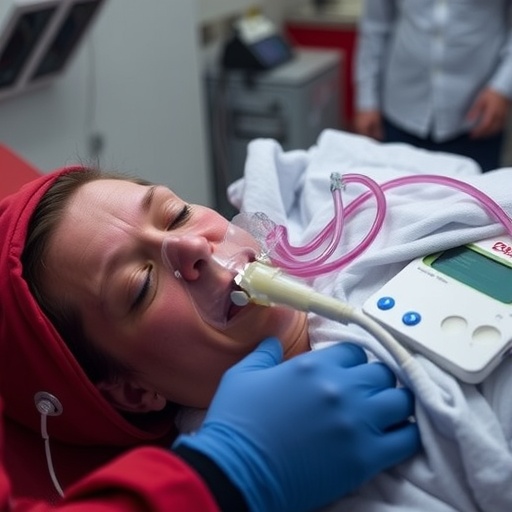
The study’s central inquiry pivots on whether inserting a breathing tube—the procedure known as endotracheal intubation—prior to hospital arrival improves survival outcomes for severely injured patients. Endotracheal intubation facilitates airway protection and mechanical ventilation, crucial for patients with compromised respiratory function or reduced consciousness following trauma. However, intubation is a complex procedure requiring profound clinical expertise, typically coupled with emergency anaesthesia to permit safe tube placement. While it is understood that some trauma patients critically require airway protection, the timing and setting for optimal intubation have been debated due to a lack of high-quality empirical evidence.
In this novel investigation, the research team overcame the absence of randomized trials by leveraging causal inference methodologies underpinned by machine learning. They developed a bespoke predictive model, termed ‘Intub-8,’ which integrates eight routinely collected prehospital clinical parameters to stratify trauma patients according to their need for intubation and their likelihood of survival. The dataset comprised 6,467 trauma cases managed at the Southmead Hospital Major Trauma Centre in Bristol, offering a substantial real-world patient cohort for analysis. By simulating counterfactual scenarios, the team isolated the direct impact of prehospital intubation from confounding variables such as injury severity and physiological derangement.
The modeling revealed a compelling survival advantage for high-risk patients receiving airway management before hospital arrival. Among the subgroup predicted to need intubation—229 patients—prehospital intubation was associated with a 10.3% absolute increase in 30-day survival compared to similar patients intubated post-admission or not at all prior to hospital care. This effect size is clinically significant, surpassing many accepted benchmarks for life-saving emergency procedures. When extrapolated nationally, the researchers estimate that ensuring timely prehospital intubation could save approximately 170 lives annually in the UK, equating to roughly one life every other day.
Beyond clinical impact, the study incorporated a detailed health economics analysis. The findings suggest that prehospital intubation of high-risk trauma patients could yield annual cost savings in the region of £101 million for the UK healthcare system. These savings emerge from reduced downstream medical interventions, shortened hospital stays, and decreased long-term morbidity. This economic dimension adds weight to arguments advocating for the expansion and resourcing of specialist prehospital critical care teams capable of performing this technically demanding intervention outside the hospital environment.
A crucial contextual factor in this research is the operational model of prehospital care in the UK, where intubation and emergency anaesthesia are almost exclusively delivered by advanced critical care teams, such as physician-paramedic units deployed via air ambulances. This concentration of expertise ensures a high procedural success rate and patient safety during field intubation. The authors caution that the survival benefit observed may depend substantially on such specialized personnel and may not be directly transferable to healthcare systems with different prehospital care configurations or varying training standards among ambulance personnel.
The innovative application of AI in this research represents a watershed moment in trauma care studies. Traditional randomized controlled trials in this area are ethically fraught, as withholding potentially life-saving airway management from critically ill patients to create a control group is not permissible. The machine learning-based causal modeling circumvents this challenge by reconstructing ‘what-if’ scenarios from observational data, enabling rigorous estimation of treatment effects under complex biological and operational conditions.
Several experts external to the research team have recognized the study’s significance. Professor David Lockey, Immediate Past Chair of the Faculty of Pre-hospital Care at the Royal College of Surgeons of Edinburgh, highlighted the high-quality evidence now established for prehospital emergency anaesthesia’s life-saving effect and cost efficiency. Such endorsements may influence policy decisions and clinical guidelines, potentially prompting increased funding for air ambulance services or expanded training programs for ground-based paramedics to deliver advanced airway interventions.
Despite the transformative potential, the authors stress the need for cautious interpretation and further research. Assessing long-term survival, neurological outcomes, and possible complications related to prehospital anaesthesia and intubation remains essential to fully characterize the risk-benefit profile. Additionally, replication of findings in diverse geographic and healthcare contexts will be key to determining the generalizability of this approach.
This study exemplifies the power of integrating modern AI tools with clinical expertise to resolve longstanding medical dilemmas. By corroborating that timely prehospital airway management can substantially improve survival for major trauma patients, it paves the way for revising emergency care paradigms worldwide. The corroboration of clinical decision-making through data-driven causal models heralds a future where advanced computational methodologies become integral to shaping life-saving interventions in urgent care settings.
As trauma continues to impose an immense global health burden, innovations such as the ‘Intub-8’ model offer promising avenues not only for enhancing patient survivorship but also for optimizing resource allocation within strained healthcare systems. This convergence of technology, medicine, and health policy signals an exciting frontier in emergency medicine, one with profound implications for practitioners, patients, and policymakers alike.
—
Subject of Research: People
Article Title: Survival effect of prehospital emergency anaesthesia with intubation in risk-stratified patients with major trauma: a causal modelling study
News Publication Date: 11-Feb-2026
Web References:
DOI link
Keywords: Emergency medicine, Traumatic injury, Machine learning
Tags: Artificial Intelligence in Medicinecausal modeling in healthcareclinical decision-making in traumaemergency anaesthesia techniquesemergency medicine challengesendotracheal intubation benefitshigh-risk trauma patient outcomesintubation in emergency settingspre-hospital airway managementsurvival rates in trauma casestrauma care innovationsUniversity College London research