Routine postmortem examinations of fallen livestock delivered to rendering plants in Austria and Germany have identified severe, externally visible lesions indicative of prolonged pain and suffering in substantial proportions of pig carcasses. Under Council Directive 98/58/EC, livestock owners and caretakers remain legally obligated to ensure that animals under their supervision are not subjected to unnecessary pain, suffering, or injury, which entails the early identification of pathology, the provision of adequate veterinary medical treatment, and the timely euthanasia of compromised animals when recovery is improbable. Nevertheless, rendering facilities, which serve as essential logistical exit bottlenecks through which all fallen farm stock must pass at the end of life, have historically been overlooked as functional observation points for systemic animal welfare oversight. In a comprehensive investigation published in Porcine Health Management, researchers evaluated whether standardized external visual inspections conducted at the point of carcass disposal could serve as an effective retrospective diagnostic tool to systematically detect serious on-farm animal welfare non-compliance.
The collaborative survey synthesized observational data collected from two distinct field studies conducted across commercial rendering facilities in Lower Austria and multiple federal states in Germany. The Austrian investigation spanned twenty collection days during the summer season at a single regional facility, where examiners evaluated 978 pig carcasses arriving from 100 commercial delivery truckloads. In the parallel German investigation, field assessments were executed over nineteen days during the winter and spring across four regional rendering plants situated in six federal states characterized by variable regional herd sizes and pig densities. The German sampling protocol comprised two components: an initial unselected cohort designated as sample A, containing 632 pigs from 57 transport truckloads utilized to measure representative prevalence rates, and an enriched cohort designated as sample B, which combined 101 animals from sample A with 362 targeted carcasses selected from more than 100 additional high-volume delivery loads. Because acute space constraints within active rendering plants required examiners to focus on top-layer carcasses displaying obvious external abnormalities, sample B served exclusively to provide detailed phenotypic characterizations rather than baseline population prevalences.
Across the baseline representative cohorts, gross external examinations demonstrated that significant fractions of delivered fallen pigs exhibited physical trauma and pathological alterations compatible with intense suffering prior to death. In the Austrian study, 20.8 percent of all delivered carcasses presented with pathological lesions judged to be potentially associated with substantial pain and suffering. Within the German representative sample A, 16.0 percent of examined carcasses displayed conditions indicative of substantial pain or suffering. The modest statistical discrepancy between the two national figures is directly attributable to the distinct scoring thresholds employed by the research protocols. The Austrian evaluation categorized any observable lesion exceeding an unimpaired score of zero as a condition potentially linked to substantial suffering. Conversely, the German protocol applied more conservative thresholds, classifying mild weight loss, superficial abrasions, and minor tail biting with slight bleeding as welfare impairments that did not reach the threshold of substantial pain or suffering.
Severe emaciation, clinically described as cachexia, represented one of the most prominent pathological conditions recorded during external evaluations, documented in six Austrian carcasses and 215 German carcasses. Carcasses were formally diagnosed with emaciation when subcutaneous adipose deposits and musculature had degraded to such a marked degree that skeletal contours became acutely prominent, exposing the ribs, pelvic bones, scapular spines, and vertebral spinous processes. In the most advanced cases of cachectic degradation, severe atrophy of the thigh musculature and the longissimus dorsi muscle left pelvic tuberosities clearly delineated beneath the skin, a clinical diagnosis corroborated during subset necropsies by the profound atrophy of coronary adipose tissue. German carcasses displaying marked emaciation exhibited statistically significant associations with secondary physical complications, including prolonged rough hair coats, extensive ulcerative skin sores, destructive ear and tail biting trauma, and severe claw pathologies compared to fallen animals arriving in unimpaired nutritional condition.
The biological mechanisms connecting extreme wasting to substantial welfare impairment are supported by comparative veterinary and medical literature examining chronic nutritional deprivation. In pigs, studies investigating periweaning failure-to-thrive syndrome demonstrate that severe emaciation induces profound multi-organ disturbances, including lethargy, progressive muscle degradation, advanced dehydration, superficial gastritis, and marked villous atrophy throughout the small intestine and colon. Parallel laboratory evaluations reveal severe disruptions in systemic homeostasis, characterized by elevated hematocrit and hemoglobin levels alongside depleted circulating concentrations of glucose, sodium, and phosphorus. These systemic manifestations parallel the physiological disruptions observed in monogastric human patients undergoing advanced anorexia nervosa, who routinely suffer from hypothermia, severe muscular weakness, and extensive electrolyte imbalances. The researchers noted that profound emaciation cannot be considered an asymptomatic reduction in body mass; rather, it constitutes an agonizing systemic breakdown marked by progressive physical weakening, persistent lethargy, and compounding metabolic failure that significantly compromises baseline biological function.
Joint swellings and purulent musculoskeletal inflammations formed another major category of severe clinical findings, documented in 30 Austrian carcasses and 169 German carcasses. In the Austrian cohort, deep surgical incisions executed across a subsample of 14 swollen joints confirmed the presence of active purulent arthritis in every sampled instance, a result matched in the German cohort where all 19 incised enlargements revealed purulent joint exudate. Furthermore, 38 German carcasses exhibited extensive swelling across multiple independent anatomical joints, and 43 carcasses presented severe joint enlargements accompanied by advanced decubital ulcerations. Statistical evaluations revealed that carcasses exhibiting substantial joint enlargements were significantly more likely to display ulcerative skin lesions and severe tail biting wounds than animals without articular enlargement. In ambulatory pigs, joint enlargements and active arthritis induce severe lameness, abnormal spinal curvature, asymmetrical limb loading, and behavioral self-isolation, confirming that such extensive physical damage produces intense and protracted physical suffering prior to death.
Severe foot pathologies and claw abnormalities were systematically documented in 23 Austrian carcasses and 60 German carcasses, with breeding stock displaying the highest proportional susceptibility to debilitating lesions. Across the German investigation, 21 out of 54 examined breeding pigs presented with severe claw deformities, and deep coronary band infections, clinically known as bush foot, were diagnosed in 18 carcasses. Statistical comparisons established that mature breeding sows were significantly more likely to develop deep coronary band lesions than younger commercial pigs. Because active gait and locomotive postures cannot be evaluated directly in fallen stock, examiners restricted their pain evaluations to structural pathologies that indisputably cause severe lameness, including torn horn shoes, complete claw avulsions, and extensive coronary necrosis. Markedly overgrown claws, which frequently involve all four limbs simultaneously, prevent animals from adopting a physiological standing posture, severely restricting their willingness to access feed, prolonging abnormal recumbency, and accelerating the formation of secondary decubitus.
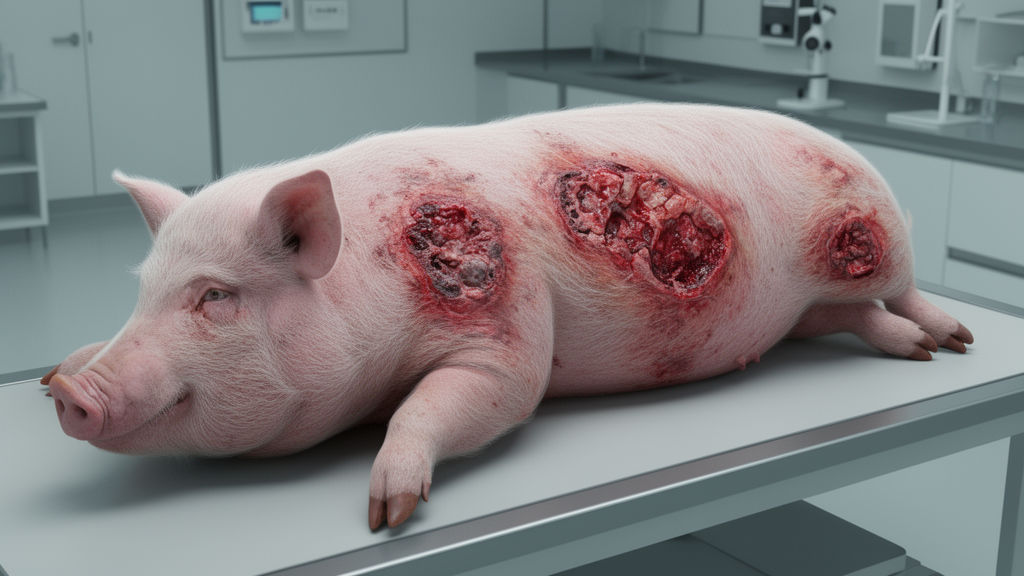
Ulcerative skin lesions, encompassing pressure decubitus and extensive erosive dermal lesions, were categorized according to depth and surface diameter across both national cohorts. Superficial dermal erosions were identified in 13 Austrian carcasses and 101 German carcasses, whereas deep perforating ulcers extending through the subcutis to the underlying osseous tissue were documented in 67 Austrian animals and 82 German animals. In the German study, while most recorded ulcers measured below five centimeters in diameter, multiple carcasses exhibited extensive perforating ulcers exceeding five centimeters across. Research examining sow shoulder ulcers confirms that deep dermal lesions trigger acute pain responses upon mechanical palpation, leading to fragmented resting cycles, frequent postural adjustments, and elevated standing times. Because the mammalian nociceptive systems of swine and humans share comparable neurobiological pathways, and histological sections of deep ulcers reveal active neurovascular trauma and inflammation, deep perforating lesions in fallen stock reflect protracted periods of unmanaged distress.
Cannibalistic biting injuries to the tail, ears, and surrounding tissues were prevalent across the examined carcasses, reflecting unmanaged herd distress and environmental deficiencies. Tail biting lesions were recorded in 103 Austrian carcasses and 206 German carcasses, with 131 German cases exhibiting extensive tissue loss complicated by purulent inflammation and deep necrosis. Because routine tail docking remains widespread in conventional Austrian and German pig production, the overwhelming majority of bitten animals had experienced early docking, though total anatomical loss frequently precluded exact physical verification. Severe tail trauma is known to produce acute systemic complications, as ascending bacterial pathogens migrate through vascular and neurological channels to cause purulent polyarthritis, spinal abscessation, and internal visceral lesions. Ear biting lesions were documented in 118 German carcasses, with 22 displaying localized necrosis without clear mechanical biting patterns, further demonstrating that unattended injuries frequently deteriorated into severe secondary infections before the animals succumbed.
Specialized abdominal pathologies, including massive umbilical outpouchings and chronic rectal strictures, were uniquely quantified within the German cohort to assess their contribution to pre-mortem suffering. Massive umbilical outpouchings exceeding twenty centimeters in diameter, arising from hernias or herniated enterocystomas, were recorded in 28 carcasses, with 13 cases exhibiting extensive necrosis and ulceration along their ventral surfaces. The Danish Veterinary Health Council establishes that umbilical lesions exceeding fifteen centimeters or displaying skin ulcerations necessitate immediate euthanasia due to mechanical trauma, impaired recumbency, and heightened risks of visceral adhesions. In parallel, twelve German carcasses exhibited extreme abdominal distension indicative of chronic rectal stricture, a condition resulting from cicatricial annular scarring following rectal prolapse or bacterial proctitis. Because progressive bowel obstruction causes severe megacolon, internal visceral compression, and protracted metabolic starvation, all twelve affected carcasses exhibited advanced emaciation, confirming that chronic obstructive distress was permitted to persist untreated.
To contextualize these findings, the authors stressed that external visual surveys inherently capture only the visible tip of on-farm welfare deficiencies, as internal respiratory disorders and non-visible gastrointestinal illnesses escape external detection entirely. Furthermore, examination environments at rendering plants present distinct physical challenges, requiring personnel to untangle dense piles of carcasses under strict operational time constraints while carefully differentiating between genuine ante-mortem lesions and post-mortem transport artifacts or autolytic degradation. The authors concluded that the high frequency and severe nature of the observed chronic pathologies demonstrate that systemic care failures cannot be dismissed as isolated anomalies or attributed solely to a few negligent farmers. To convert rendering plants into effective early-warning monitoring nodes, the researchers recommended establishing standardized inspection protocols, training transport drivers to flag conspicuous carcasses with secondary ear tags, and mandating traceable identification tags for all dead livestock to enable targeted regulatory intervention.
Subject of Research: Retrospective pig welfare assessments at rendering plants
Article Title: Retrospective pig welfare assessment at rendering plants – a useful tool for monitoring and inspection
Article References: grosse Beilage, E., Maschat, K., & Baumgartner, J. (2026). Retrospective pig welfare assessment at rendering plants – a useful tool for monitoring and inspection. Porcine Health Management, 12(1), Article 27. https://doi.org/10.1186/s40813-026-00504-6
Image Credits: AI Generated
DOI: 10.1186/s40813-026-00504-6
Keywords: pig welfare, rendering plants, carcass inspection, animal welfare monitoring, swine health, emaciation, purulent arthritis, ulcerative skin lesions, tail biting, ear biting, foot lesions, umbilical outpouchings, rectal stricture, veterinary inspection, Council Directive 98/58/EC, euthanasia timing, livestock transport, postmortem assessment
News Source: William Thompson. (November 19, 2026). Postmortem Render Inspections Detect Severe Welfare Lesions in Austrian and German Pigs. Scienmag.