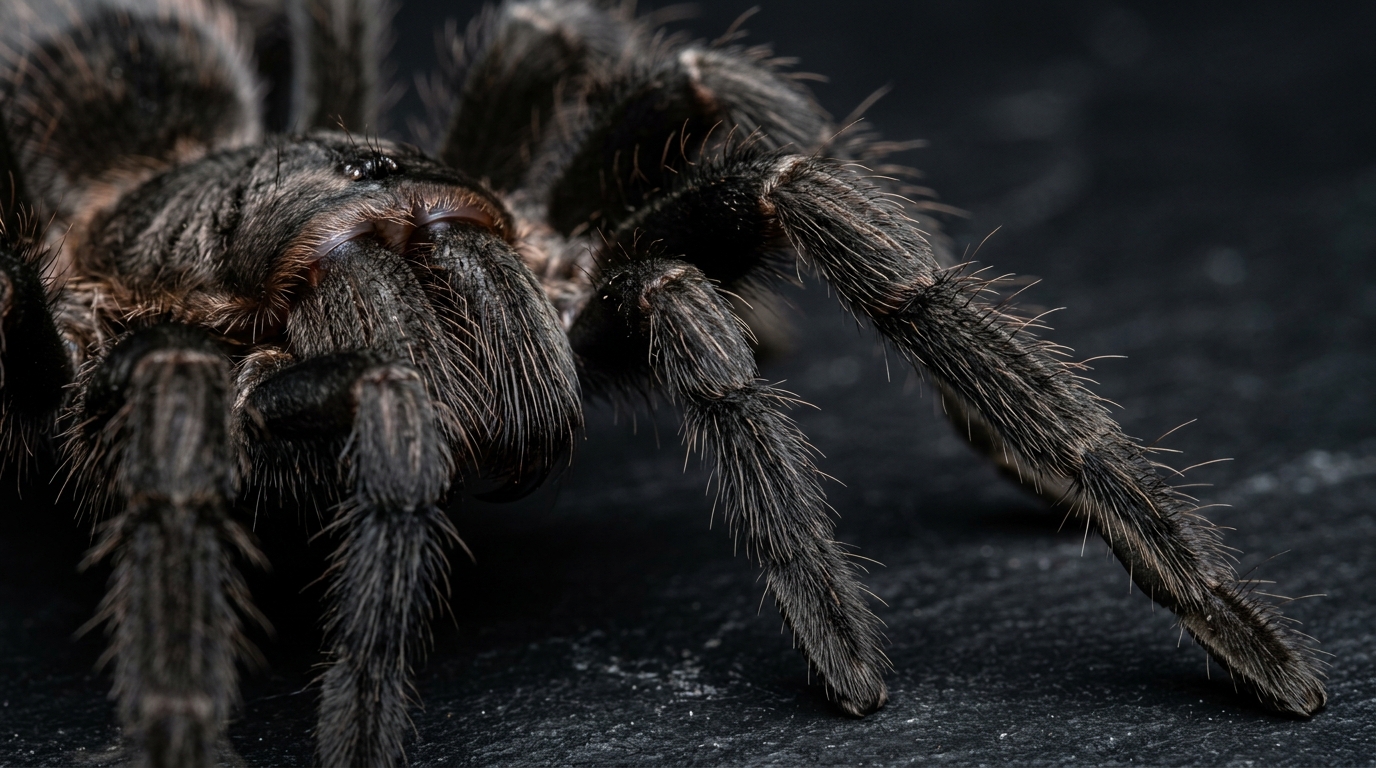
Developmental biologists investigating posterior Hox gene expression in spiders have uncovered evidence indicating that subtle regulatory alterations in the homeotic selector genes abdominal-A (abdA) and Abdominal-B (AbdB) are responsible for distinct anatomical differences between true spiders and mygalomorph tarantulas. Spiders represent an evolutionary successful lineage of chelicerate arthropods whose body plan is divided into two primary tagmata: an anterior prosoma bearing head appendages and four pairs of walking legs, and a posterior opisthosoma whose segments either lost their limbs during evolution or modified them for silk production, reproduction, and gas exchange. While homeotic selector genes have long been recognized for shaping segmental identity across arthropods, comparative developmental research has historically concentrated on true spiders. By analyzing embryonic transcription of posterior Hox genes in the Brazilian whiteknee tarantula, Acanthoscurria geniculata, and the curly hair tarantula, Tliltocatl albopilosum, researchers have established how divergence in duplicated Hox gene expression correlates with the evolutionary reduction and transformation of opisthosomal appendages.
Arthropods represent the most dominant animal group in both individual abundance and species count, an evolutionary success largely attributed to morphological diversity supported by their segmented body axis. In the last common ancestor of arthropods, each body segment carried a single pair of nearly identical appendages, but subsequent evolutionary transitions led anterior segments to specialize for sensory perception, food capture, and locomotion, while posterior segments frequently underwent limb loss or structural remodeling. Concurrently, segments carrying related appendages formed functional body units termed tagmata, exemplified by the insect head, thorax, and abdomen. The genetic mechanisms directing arthropod segmentation, tagmosis, and appendage patterning have been characterized in detail in the vinegar fly, Drosophila melanogaster, where a hierarchical cascade of segmentation genes defines segmental boundaries. At the bottom of this cascade, homeotic selector genes define the developmental fate of each segment. In Drosophila, these selector factors reside within the Antennapedia and Bithorax complexes and typically obey spatial and temporal collinearity, linking genomic cluster position to expression timing and anterior boundaries.
Although the ancestral arthropod Hox cluster contained ten genes, certain lineages underwent structural reorganization, such as Drosophila where Hox3 and fushi-tarazu lost homeotic selector roles to acquire alternative developmental functions. Across chelicerates, myriapods, crustaceans, onychophorans, and tardigrades, the regulatory roles of Hox genes remain deeply conserved, with posterior genes acquiring repressive or modifying influences over limb development. Within spiders and scorpions, an ancestral whole genome duplication in Arachnopulmonata generated duplicated copies of developmental regulators, endowing spiders with two paralogs for each posterior Hox gene, designated with suffixes A and B. While spider evolutionary developmental research has historically focused on true spiders (Araneomorphae)—particularly entelegyne models like Parasteatoda tepidariorum and Cupiennius salei, alongside haplogyne species such as Pholcus phalangioides—comparative data from Mygalomorphae have remained scarce. Morphologically, tarantulas exhibit orthognath chelicerae, retain a second pair of book lungs on opisthosomal segment three (O3) where true spiders evolved tracheae, and develop only rudimentary anterior spinnerets on segment four (O4) that regress during embryogenesis.
To uncover the genetic mechanisms underlying these morphological divergences, researchers conducted bioinformatic, phylogenetic, and expression analyses targeting the posterior Hox complement of Acanthoscurria geniculata. Reciprocal basic local alignment search tool queries (tBLASTn) were executed against published embryonic transcriptomes of Acanthoscurria geniculata, Pholcus phalangioides, and Cupiennius salei, using Hox protein sequences from Parasteatoda tepidariorum as queries. Candidate tarantula Hox amino acid sequences were aligned using T-Coffee in MacVector, followed by Bayesian phylogenetic inference implemented through MrBayes using Metropolis-coupled Markov chain Monte Carlo simulations running for half a million cycles. Embryonic gene fragments were amplified through reverse transcription polymerase chain reaction (RT-PCR) using cDNA synthesized from mixed-stage total embryonic RNA, followed by nested PCR to ensure amplification specificity. Amplified products bridging non-overlapping contigs for Antp_B and abdA_B were ligated into pCR-II vectors and confirmed via bidirectional sequencing. Embryos from Acanthoscurria geniculata, Tliltocatl albopilosum, Cupiennius salei, and Pholcus phalangioides were staged according to established protocols, with in situ hybridization documented under stereomicroscopy.
The resulting phylogenetic reconstructions resolved two distinct paralogs for each posterior Hox gene in Acanthoscurria geniculata: Antennapedia (Antp_A and Antp_B), Ultrabithorax (Ubx_A and Ubx_B), abdominal-A (abdA_A and abdA_B), and Abdominal-B (AbdB_A and AbdB_B). Each isolated tarantula sequence clustered with complete statistical support, displaying a posterior probability value of 1.0, with its respective orthologous gene class from Parasteatoda tepidariorum. This phylogenetic evidence confirmed that all four posterior Hox genes were duplicated during the ancestral arachnopulmonate genome duplication and retained in the mygalomorph genome. Notably, this resolved an omission in prior chelicerate surveys that had identified only one copy of AbdB in Acanthoscurria geniculata transcriptomic datasets. The confirmation of the complete paralogous set established that the anatomical disparities separating tarantulas from true spiders do not stem from the secondary loss of posterior Hox genes in mygalomorphs. Instead, these morphological contrasts must arise from regulatory shifts in temporal onset or modified spatial distribution across embryonic tissues during opisthosomal outgrowth and appendage differentiation.
Spatial expression analyses of Antennapedia and Ultrabithorax paralogs revealed broad conservation alongside specific segmental nuances between tarantulas and true spiders. In Acanthoscurria geniculata, Antp_A transcription begins around stage 7 across the segment addition zone, persisting within newly formed opisthosomal units with strongest accumulation in O1 and O2, the ventral sulcus, dorsal field, and ventral nervous system. Unlike true spiders, where Antp_A is expressed in the fourth walking leg pair (L4), tarantula Antp_A is absent from L4 limbs. Tarantula Antp_B emerges later during embryogenesis, extending into L4 leg rings, but remains undetectable in O4 and O5 spinnerets, contrasting with Parasteatoda tepidariorum where Antp_B marks both spinneret pairs. For Ultrabithorax duplicates, Ubx_A begins at stage 6 to 7 within the segment addition zone, establishing an anterior boundary across the midpoint of O2 and later localizing within the developing heart. Ubx_B exhibits a slightly more posterior boundary in O2, with prominent expression across O3 and O4 that persists throughout dorsal tissues during dorsal closure.
The most consequential developmental divergence identified in the study involves the spatial distribution of abdominal-A paralogs within opisthosomal limb buds. In true spiders, including Parasteatoda tepidariorum, Cupiennius salei, and Pholcus phalangioides, both abdA_A and abdA_B are expressed continuously throughout the developing spinneret limb buds of segments O4 and O5. In Acanthoscurria geniculata, abdA_A similarly appears in O4 and O5 limb buds as well as the ventral nervous system. However, tarantula abdA_B exhibits a striking spatial exclusion: while detected across dorsal O4 tissue and throughout O5 and posterior segments, abdA_B is completely absent from the ventral region of O4, including the rudimentary anterior spinneret limb buds. Hybridization assays in Tliltocatl albopilosum demonstrated identical transcript distributions, confirming that the absence of abdA_B in O4 limb buds is conserved in tarantulas. Because tarantula anterior spinneret limb buds initially emerge during embryogenesis but subsequently regress and disappear, this localized absence of abdA_B represents a compelling candidate mechanism for the evolutionary loss of functional anterior spinnerets in mygalomorphs.
Corroborating evidence for the regulatory role of abdA_B was uncovered through the examination of abnormally developing embryos in tarantulas. Under certain developmental conditions, embryos of Tliltocatl albopilosum and Acanthoscurria geniculata spontaneously develop ectopic, elongated anterior spinnerets on segment O4 that structurally resemble normal posterior spinnerets. Previous research demonstrated that this phenotypic rescue is accompanied by the ectopic reactivation of Distal-less (Dll), an essential homeobox gene governing limb outgrowth across arthropods. In the present study, in situ hybridization in these abnormal embryos revealed that abdA_B transcription was distinctly activated within the ectopic O4 spinneret buds. In Drosophila, AbdA functions as a direct repressor of Dll, suppressing abdominal limb development. The authors hypothesized that duplicated spider abdA paralogs evolved divergent functions: AbdA_A may retain repressive capacity against Dll, whereas AbdA_B could act as a passive positive regulator. If AbdA_B binds shared Dll regulatory elements with higher affinity without repressing transcription, its presence protects Dll expression, whereas its absence in wild-type tarantulas allows AbdA_A to repress Dll and arrest anterior spinneret growth.
The investigation of Abdominal-B paralogs and respiratory organ patterning provided further insights into chelicerate developmental genetics. In Acanthoscurria geniculata, AbdB_A is activated around stage 9 in the segment addition zone and O5, with ventral nervous system expression extending anteriorly into O1. AbdB_B begins expression at stage 7 in the segment addition zone, violating temporal collinearity, and extends into O5 and posterior tissues with ventral nervous system signals reaching O3. Crucially, neither AbdB paralog is expressed in the prospective genital opening on O2 in Acanthoscurria geniculata, contrasting with true spiders where AbdB_B marks this region. This indicates either that tarantulas do not utilize AbdB in genital specification, or that genital development is delayed given their multi-year maturation timeline. Furthermore, because tarantulas form book lungs on O2 and O3 without expressing AbdB_B, the authors refuted proposals that AbdB_B directs book lung development. Concurrently, tarantula book lungs on O3 lack abdA_A, whereas true spiders express abdA_A in O3 where book lungs evolved into tracheae, suggesting AbdA_A may repress book lungs and promote tracheal identity.
These findings demonstrate how homeotic gene duplication following whole genome duplication in ancestral arachnopulmonates provided developmental flexibility for the evolution of novel morphological structures. By decoupling duplicated paralogs, regulatory mutations could modify specific limb fields—such as silencing abdA_B in O4 to repress anterior spinnerets, or activating abdA_A in O3 to promote tracheal formation—without disrupting essential body axis organization. However, the authors emphasize that spatial and temporal expression patterns alone cannot establish absolute causality. Definitive confirmation of whether AbdA_B competitively protects Dll or whether AbdA_A acts as a regulator of tracheal identity will require direct functional testing. Because duplicated paralogs often exhibit overlapping or partially redundant functions, single-gene perturbations may be insufficient, necessitating simultaneous double-knockdown protocols. Building upon established double-knockdown RNA interference methodologies in Parasteatoda tepidariorum, the implementation of embryonic RNAi alongside emerging tools like CRISPR/Cas9 gene editing will be crucial to experimentally dissecting how duplicated Hox cascades control the formation, modification, and loss of opisthosomal appendages across spiders and related chelicerate lineages.
Subject of Research: Posterior Hox gene expression and opisthosomal appendage development in spiders
Article Title: Expression of posterior Hox genes and opisthosomal appendage development in a mygalomorph spider
Article References: Janssen, R., & Pechmann, M. (2023). Expression of posterior Hox genes and opisthosomal appendage development in a mygalomorph spider. Development Genes and Evolution, 233(2), 107-121. https://doi.org/10.1007/s00427-023-00707-9
Image Credits: AI Generated
DOI: 10.1007/s00427-023-00707-9
Keywords: developmental biology, Hox genes, Acanthoscurria geniculata, spider embryogenesis, morphological evolution, gene duplication, opisthosomal appendages, Distal-less, Expression, posterior, genes, opisthosomal
News Source: Juliet Wilcox. (November 7, 2026). Posterior Hox Gene Expression Explains Appendage Divergence in Tarantulas and True Spiders. Scienmag.