CHAMPAIGN, Ill. — A point-of-care COVID-19 test developed by researchers at the University of Illinois Urbana-Champaign can now detect and differentiate the alpha variant of the SARS-CoV-2 virus from earlier strains in saliva samples.
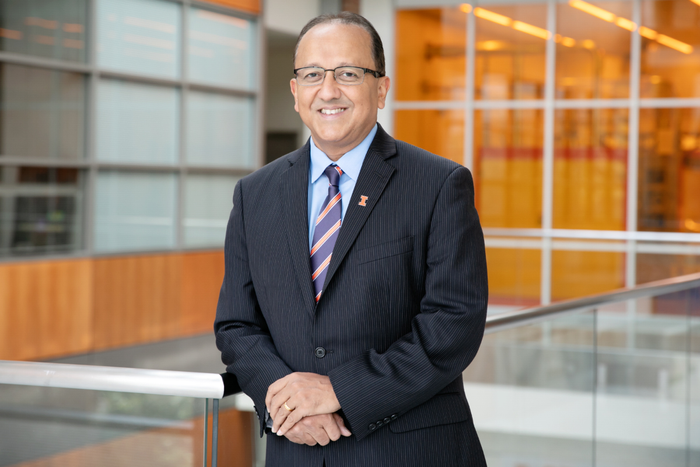
Credit: Photo by L. Brian Stauffer
CHAMPAIGN, Ill. — A point-of-care COVID-19 test developed by researchers at the University of Illinois Urbana-Champaign can now detect and differentiate the alpha variant of the SARS-CoV-2 virus from earlier strains in saliva samples.
The new test builds on the group’s previous developments, which allowed samples to bypass the laboratory – first using nasopharyngeal swabs, then with saliva samples. The point-of-care amplification and testing process, called LAMP, is more efficient than PCR because it does not require expensive thermal cycling machines. The researchers said the assay does not need RNA extraction and purification steps, similar to the Illinois saliva test.
The results of the study, co-led by Rashid Bashir, a professor of bioengineering and the dean of the Grainger College of Engineering at Illinois, mechanical science and engineering professor Bill King and bioengineering professor Enrique Valera, are published in the journal Lab on a Chip.
“Our study shows that it is possible to test for variants of the same coronavirus strain in a single point-of-care test that takes 30 minutes using a portable handheld device,” Bashir said. “The new test is scalable to suit future pandemics, COVID-19 or otherwise, and could be used at home or other settings.”
The updated process takes advantage of a genetic phenomenon called S-gene target failure – which is present in the alpha variant but not in the SARS-CoV-2 virus early strains – to differentiate between the two alpha variants, the researchers said.
“The new omicron variant also exhibits S-gene target failure and could be tested for by adapting the approach developed in this study,” Valera said.
During the new testing process, specially selected genetic primers are placed onto additively manufactured cartridges and dried before adding the patient samples. The chosen primers are set against the S-gene and are specific for detecting the S-gene target failure against 69–70 deletion in the alpha variant, the study reports.
The study confirmed the device’s effectiveness by testing 38 clinical saliva samples, including 20 samples positive for alpha variant.
The researchers said they would like to refine their method to test up to five different viruses, viral strains and variants in a single test, compatible with nasal swab and saliva mediums.
Co-authors of the paper were graduate students Jongwon Lim and Robert Stavins, and Karen White and James Kumar from Carle Foundation Hospital.
The Foxconn Interconnect Technology-sponsored Center for Networked
Intelligent Components and Environments at the University of Illinois Urbana-Champaign, the National Science Foundation and the National Institutes of Health supported this study. Clinical samples were obtained from Carle Foundation Hospital and the U. of I. COVID-19 detect study.
The authors are also affiliated with electrical and computer engineering, the Beckman Institute for Advanced Science and Technology, the Carle Illinois College of Medicine, the Holonyak Micro and Nanotechnology Lab, the Cancer Center at Illinois, the Materials Research Laboratory and the Carl R. Woese Institute for Genomic Biology.
Editor’s notes:
To reach Rashid Bashir, email [email protected].
To reach Bill King, email [email protected].
The paper “Microfluidic point-of-care device for detection of early strains and B.1.1.7 variant of SARS-CoV-2 virus” is available online and from the U. of I. News Bureau. DOI: 10.1039/d2lc00021k.
Journal
Lab on a Chip
DOI
10.1039/d2lc00021k
Method of Research
Experimental study
Subject of Research
Cells
Article Title
Microfluidic point-of-care device for detection of early strains and B.1.1.7 variant of SARS-CoV-2 virus
Article Publication Date
29-Mar-2022
COI Statement
W. P. K. is a co-founder and Chief Scientist at Fast Radius Inc., where the additively manufactured cartridge was produced. The research was conducted in compliance with the conflict of interest policies at Fast Radius and the University of Illinois Urbana-Champaign. R. B. is co-founder of Prenosis, Inc. and LabSimply, Inc. but there is no overlap with this work and the company.