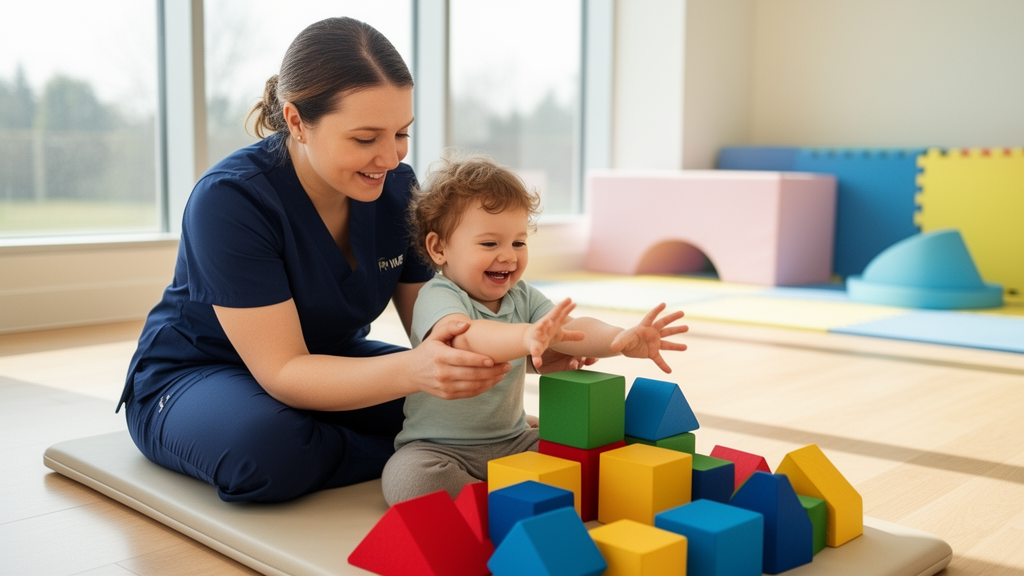
A randomized comparative trial evaluating therapeutic interventions for children diagnosed with spastic diplegic cerebral palsy demonstrated that while both reflex integration and play therapy produced functional improvements, play therapy generated significantly superior outcomes across self-care, mobility, and cognitive domains. Published in the Bulletin of Faculty of Physical Therapy, the clinical study assessed pediatric patients aged three to seven years who were classified under Gross Motor Function Classification System levels I and II. Over a six-week intervention period comprising four weekly forty-minute sessions, researchers administered standardized protocols to compare a bottom-up neurological model against a top-down, functional skill-building approach. Utilizing the validated WeeFIM assessment instrument to measure daily functionality, the comparative analysis identified statistically significant between-group differences favoring play therapy in every measured domain, providing actionable empirical evidence for optimizing pediatric neurorehabilitation protocols.
First described by William Little over 170 years ago, cerebral palsy encompasses a heterogeneous group of permanent neurodevelopmental disorders affecting movement and posture caused by non-progressive disturbances within the developing fetal or infant brain. The condition exhibits a global prevalence between 1.6 and 3.4 per 1,000 live births, depending on socioeconomic factors and recognized risk factors including prematurity, birth asphyxia, maternal infections, and placental complications. Cerebral palsy is classified by motor type, topographical distribution, and functional severity. Spastic cerebral palsy represents the most prevalent clinical subtype, characterized by hypertonia, impaired voluntary motor control, compromised coordination, and the retention of primitive reflexes. While primitive reflexes naturally integrate as higher cortical centers mature in typical development, their persistence in cerebral palsy interferes with voluntary movement. This disruption leads to substantial functional restrictions across independent mobility, personal self-care tasks, and cognitive development, necessitating targeted therapeutic strategies.
Within pediatric rehabilitation, clinicians have debated the relative merits of two distinct interventions that address movement impairments through contrasting theoretical mechanisms. The Reflex Integration Approach operates on a bottom-up neurodevelopmental model targeting subcortical neural pathways to suppress retained primitive reflexes and encourage normalized motor control. In contrast, Play Therapy utilizes a top-down, functional skill-building framework that leverages structured, engaging activities to promote motor coordination, cognition, and psychosocial well-being through intrinsic motivation and task-oriented practice. Despite widespread clinical use of both modalities, direct comparative evidence evaluating their relative efficacy has remained limited in pediatric rehabilitation literature. This clinical study was designed to resolve uncertainty by evaluating whether reflex integration, play therapy, or a strategic combination achieves superior functional gains across self-care, mobility, and cognitive domains in children with cerebral palsy.
Conducted over one year at various physiotherapy outpatient departments, this randomized controlled trial focused on children diagnosed with spastic diplegic cerebral palsy. Sample size determination was based on a ten-subject pilot study yielding an effect size of 1.135. Using G*Power software version 3.1.9.4 with an alpha level of 0.05 and 80 percent statistical power, the required enrollment was established at 22 participants and adjusted to 24 to accommodate a projected five percent dropout rate. Following ethical approval from the Institutional Ethical Committee and permission from clinic heads, 31 children were screened for eligibility, resulting in the exclusion of seven candidates. The final cohort of 24 participants, comprising 11 males and 13 females, was randomly assigned to two equal groups of 12 using a lottery method. All participants completed the six-week trial without dropouts or withdrawals, providing a complete dataset for analysis.
The selection criteria included children aged three to seven years diagnosed with spastic diplegic cerebral palsy classified under Gross Motor Function Classification System levels I and II whose parents or guardians provided informed consent. Exclusion criteria eliminated individuals presenting with significant cognitive impairments, behavioral disorders, or sensory deficits, including blindness, deafness, or mutism. Children who had undergone surgical procedures, such as selective dorsal rhizotomy, surgical tendon lengthening, or botulinum toxin injections within the preceding six months, were likewise excluded to prevent confounding intervention effects. Demographic and clinical data were recorded using a structured assessment proforma. Baseline functional status was recorded before intervention using the WeeFIM scale, an 18-item ordinal assessment evaluating independence across self-care, mobility, and cognition on a 7-point scale, with established reliability ranging from Cronbach’s alpha 0.93 to 0.98 in cerebral palsy cohorts.
Participants assigned to Group A received the Reflex Integration Approach for 40 minutes per session, four days weekly across six weeks. Sessions incorporated sensory-motor exercises targeting primitive reflex suppression, including the asymmetrical tonic neck reflex, symmetrical tonic neck reflex, and Moro reflex. Exercises featured five minutes of vestibular stimulation through physio ball rocking in forward, backward, and side-to-side directions, alongside trunk control and weight-shifting routines in sitting and wheelbarrow positions. Therapists incorporated visual tracking tasks with colored lights to strengthen visual pathways, as well as balance board training across forward-backward and lateral planes. Movement transitions, including sit-to-stand repetitions and obstacle walking, were performed for ten minutes to promote lower limb dissociation and trunk control. Each session began with five minutes of warm-up stretching targeting the hamstrings, adductors, and calf muscles, and concluded with a prone cool-down.
Group B received Play Therapy under an identical schedule of 40-minute sessions four days weekly for six weeks, engaging in structured activities designed to enhance motor and cognitive skills. Five-minute exercise blocks were paired with standardized warm-up and cool-down intervals. Children completed clay molding tasks that required pulling clay into pieces, rolling spherical balls, and sticking clay balls onto a back wall to promote fine motor dexterity and hand-eye coordination. Ball games incorporating throwing balls into buckets during sit-to-stand transitions and kicking balls toward targets were used to train gross motor control and dynamic balance. Additionally, therapists administered bead sequencing, sponge-and-water play, suspended swinging, and string manipulation exercises, delivering consistent verbal instructions and supportive assistance to ensure children accomplished tasks within allocated intervals while cultivating intrinsic motivation.
Statistical computations were conducted using JAMOVI software version 2.3.28 alongside Microsoft Excel, analyzing data from all 24 enrolled participants. Descriptive statistics summarized demographic characteristics, including age and Gross Motor Function Classification System distributions, presenting findings through percentages, means, and standard deviations. Because WeeFIM measurements yield ordinal data, non-parametric analyses were chosen without requirement for normality testing, setting statistical significance at an alpha level of 0.05 within a 95 percent confidence interval. Homogeneity of variance across datasets was evaluated using Levene’s test. Within-group pre- and post-intervention changes were assessed using the Wilcoxon signed-rank test to compare pre- and post-treatment scores, whereas the Mann-Whitney U test was applied to evaluate between-group differences in mean functional scores across all evaluated domains.
The statistical analysis revealed notable functional improvements within and between the therapeutic cohorts. Within-group evaluations using the Wilcoxon signed-rank test confirmed statistically significant gains (p < 0.05) in self-care and mobility domains for both treatment groups following the six-week intervention. However, the cognitive domain exhibited significant improvement exclusively within the Play Therapy group, showing no change in the Reflex Integration cohort and suggesting that reflex integration was ineffective for cognitive enhancement. Furthermore, between-group comparisons via the Mann-Whitney U test identified statistically significant differences (p < 0.05) favoring Play Therapy across all WeeFIM domains. These findings confirmed that while reflex integration supported physical gains, play therapy elicited broader and more substantial functional enhancements across self-care, mobility, and cognitive competencies in children with spastic cerebral palsy.
Discussing these outcomes, the authors noted that both modalities harness neuroplasticity to support motor learning and functional rehabilitation in cerebral palsy. Group A participants achieved meaningful gains in gross motor control, trunk stability, and balance through vestibular and visual stimulation alongside reflex suppression, consistent with reports by Wagh, Kruetzberg, and Tibichi regarding the suppression of asymmetrical tonic neck and tonic labyrinthine reflexes. Masgutova had proposed that repetitive integration tasks promote synaptic plasticity and latent brainstem motor memory. Nevertheless, the authors emphasized that reflex integration theory faces skepticism in the scientific community for being overly simplistic and lacking strong empirical support for enhancing cognitive function, memory, reasoning, or academic performance. The lack of cognitive progress in Group A aligns with literature noting that evidence for reflex integration remains derived from small-scale studies lacking standardized evaluative instruments.
In contrast, Play Therapy demonstrated comprehensive developmental benefits supported by neurodevelopmental and neuroimaging literature. Engaging play activities stimulate key cortical and subcortical regions, including the prefrontal cortex, cerebellum, and basal ganglia, which govern movement planning and sensory-motor integration, as documented by Schaefer and BBB Australia. Carroll demonstrated that structured play strengthens frontoparietal connectivity supporting executive function and goal-directed behavior, while Etokabeka highlighted how playful problem-solving promotes impulse control, attentional focus, and self-regulation. Furthermore, Pellis demonstrated that interactive play facilitates cortical synaptogenesis and dendritic branching. Clinically, these findings align with studies by Abdel Rahman, Nerurkar, and Mahnken, confirming that structured play enhances manual dexterity, adaptive functioning, and long-term functional independence by combining physical movement with cognitive decision-making and intrinsic motivation.
The authors noted key methodological limitations, primarily the small sample size of 24 participants recruited across outpatient clinics, which constrains broad generalizability across more diverse or severely impaired cerebral palsy populations. Furthermore, the six-week intervention window provides an evaluation of short-term progress rather than long-term retention, warranting extended follow-up in future research. The authors concluded that while both Reflex Integration and Play Therapy effectively enhance self-care and mobility in children with spastic cerebral palsy, Play Therapy demonstrates greater overall efficacy across all functional domains, particularly cognition. Combining both therapeutic approaches may offer an optimal, evidence-based neurorehabilitation strategy to maximize functional independence in pediatric practice.
Subject of Research: Comparative efficacy of play therapy and reflex integration approach in pediatric spastic cerebral palsy rehabilitation
Article Title: Effectiveness of reflex integration approach and play therapy on functionality in patients with spastic cerebral palsy: a comparative study
Article References: Patel, N. V., & Desai, A. R. (2025). Effectiveness of reflex integration approach and play therapy on functionality in patients with spastic cerebral palsy: a comparative study. Bulletin of Faculty of Physical Therapy, 30(1), Article 71. https://doi.org/10.1186/s43161-025-00333-8
Image Credits: AI Generated
DOI: 10.1186/s43161-025-00333-8
Keywords: spastic cerebral palsy, play therapy, reflex integration approach, WeeFIM scale, pediatric neurorehabilitation, primitive reflexes, motor coordination, functional mobility, self-care skills, cognitive development, Gross Motor Function Classification System, vestibular stimulation, sensorimotor integration, synaptic plasticity, spastic diplegia, fine motor dexterity, neurodevelopmental therapy
News Source: Ophelia Keating. (November 11, 2026). Play Therapy Exceeds Reflex Integration in Improving Spastic Cerebral Palsy Functionality. Scienmag.