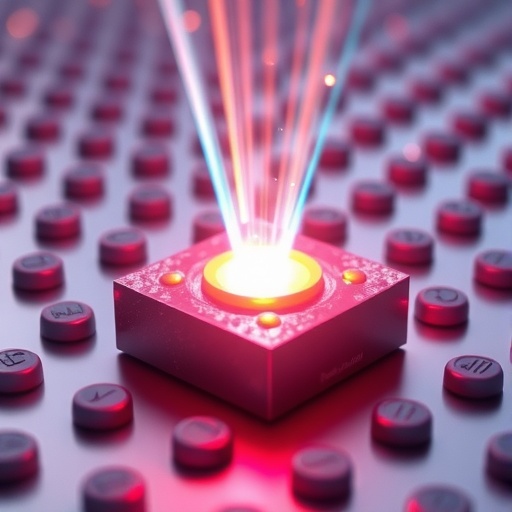
In a groundbreaking advancement that promises to reshape the landscape of two-dimensional (2D) materials research, a team of scientists has developed a novel plasmonic nanocavity technology capable of universally detecting layer-breathing vibrations in these ultrathin materials. This innovative approach not only unveils previously inaccessible vibrational modes but also significantly enhances the sensitivity and resolution of characterization techniques, marking a pivotal moment in nanomaterial science.
Two-dimensional materials, such as graphene and transition metal dichalcogenides, have captivated the scientific community due to their extraordinary electrical, optical, and mechanical properties. Understanding the layer-breathing modes—specific vibrational movements perpendicular to the 2D planes—is crucial because these vibrations profoundly influence interlayer coupling and thus the material’s overall performance and functionality. Despite their importance, detecting these modes has been notoriously challenging due to their weak Raman signals and the limitations of existing spectroscopy methods.
The innovative device designed by Wu, Lin, Yan, and their colleagues introduces a plasmonic nanocavity that effectively confines light at the nanoscale, intensifying the interaction between the electromagnetic field and the sample. This amplification allows for the clear detection of subtle vibrational signatures that previous techniques could often overlook. The researchers achieved this by engineering a nano-sized cavity that exploits localized surface plasmon resonances, enabling the precise probing of layer-breathing vibrations across a broad range of 2D materials.
What makes this discovery universally transformative is the method’s versatility. Unlike traditional vibration detection systems which are often limited to specific materials or require extensive sample preparation, the plasmonic nanocavity’s design accommodates various 2D substances without compromising the sensitivity or the integrity of the samples. This universality opens the door to systematic studies of interlayer dynamics, essential for tailoring material properties for specific applications in nanoelectronics, photonics, and beyond.
The technical heart of the method involves the detection of Raman scattering signals enhanced by the nanocavity’s plasmonic effect. When 2D material layers vibrate in their characteristic “breathing” mode, they induce subtle changes in scattering light that the nanocavity intensifies, making previously faint signals conspicuous. This level of control enables researchers to not only detect but also quantify vibrational frequencies, providing insight into interlayer coupling strengths and mechanics at an unprecedented level.
Additionally, this plasmonic nanocavity aids in overcoming a fundamental limitation encountered in conventional Raman spectroscopy. The traditional approach often fails when dealing with few-layered or heterostructured materials because of weak vibrational modes masked by background noise or overlapping signals. The researchers circumvented these issues, relying on the nanocavity-generated electromagnetic hotspots that bit into the problem at its root, ensuring signal clarity and robustness.
The implications of Wu and colleagues’ research extend far beyond basic spectroscopy. Understanding and controlling layer-breathing modes is critical for designing next-generation 2D devices, particularly where mechanical flexibility and precision electronic properties are paramount. Examples include flexible electronics, ultrafast photodetectors, and sensors that can react to mechanical stimuli at the atomic scale. Incorporating plasmonic nanocavities into these technologies could revolutionize how devices interact with their environment through vibrational modes.
Of particular note is the scalability of the method. Unlike many nanoscale experimental setups that require exceedingly complex instrumentation or rare conditions, the plasmonic nanocavity platform is compatible with existing fabrication and integration procedures. This ease of adoption could accelerate the refinement of 2D material-based products, potentially transitioning from experimental curiosities to commercial realities more swiftly.
Furthermore, this technique also introduces possibilities for in situ monitoring of 2D materials during synthesis or device operation. Real-time detection of layer-breathing vibrations could enable immediate adjustments to growth parameters or operational conditions, leading to higher quality materials and devices. Such capacity is crucial for reducing defects, enhancing performance, and extending the lifespan of devices reliant on 2D layered structures.
The research community is already abuzz about the broader potential applications. For instance, in quantum materials, where interlayer vibrations influence electron-phonon interactions crucial for superconductivity or topological properties, enhanced vibrational detection might unlock new quantum phenomena. Similarly, in energy storage and catalysis, subtle vibrations affect ion transport and catalytic sites’ efficacy, making the ability to monitor these vibrations a new tool for optimizing performance.
Technically, the team achieved this by designing the nanocavity to maximize the overlap between the plasmonic field and the 2D material’s surface. By tuning parameters such as cavity size, shape, and plasmon resonance frequency, they created an adaptable platform tailored for diverse material systems. Complemented by rigorous computational modeling, their experimental data precisely matched theoretical predictions, underscoring the robustness of their approach.
Importantly, the researchers have demonstrated that this method is not only sensitive but also nondestructive. Maintaining the integrity of delicate 2D materials is essential, especially since many can degrade under intense illumination or environmental exposure. The plasmonic nanocavity’s enhancement allows for the use of lower laser powers, reducing the risk of damage while still extracting high-quality vibrational spectra.
In summary, the plasmonic nanocavity-enabled detection method presented by Wu et al. epitomizes an elegant synthesis of nanophotonics and material science, providing a universal and precise tool for revealing the hidden dance of atoms in two-dimensional materials. With potential impacts spanning fundamental research to industrial innovation, this breakthrough may unlock the full promise of 2D materials in technology.
As researchers continue to explore the vast landscape of atomic-scale materials, the ability to universally and nondestructively detect vibrational modes represents a critical milestone. The work of Wu and colleagues sets a new standard in the characterization of low-dimensional systems, one that could inspire further innovations in device design and materials engineering.
Looking ahead, integrating plasmonic nanocavities with advanced microscopy and spectroscopy techniques could further enhance spatial and temporal resolution, providing a window into ultrafast atomic dynamics. The future of 2D materials research appears brighter—resonating with the vibrational signatures that these nanocavities so deftly unveil.
Subject of Research: Detection of layer-breathing vibrations in two-dimensional materials using plasmonic nanocavities.
Article Title: Plasmonic nanocavity-enabled universal detection of layer-breathing vibrations in two-dimensional materials
Article References: Wu, H., Lin, ML., Yan, S. et al. Light Sci Appl 15, 109 (2026). https://doi.org/10.1038/s41377-026-02203-x
Image Credits: AI Generated
DOI: 06 February 2026
Tags: 2D materials researchadvanced spectroscopy techniqueselectromagnetic field interactionenhanced sensitivity in nanomaterialsgraphene vibrational modeslayer-breathing vibrations detectionlocalized surface plasmon resonancesnanoscale light confinementplasmonic nanocavity technologytransition metal dichalcogenides propertiesultrathin materials characterizationweak Raman signal detection