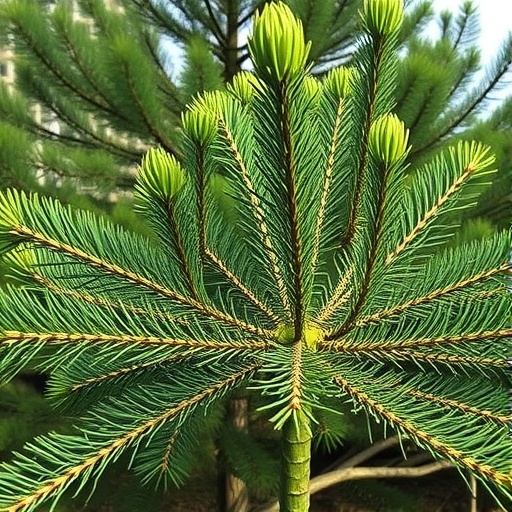
In an era where biodiversity is rapidly declining due to climate change and human activity, the resilience of ecosystems faces unprecedented challenges. Recent research led by Trujillo-Moya and colleagues sheds light on the intriguing relationship between the black pine tree, Pinus nigra, and its battle against the pathogenic fungus Diplodia sapinea. The study employs advanced gene and metabolic pathway analysis to unveil the complex strategies employed by this coniferous species in response to biotic stressors.
Black pine, known for its adaptability to varying environmental conditions, demonstrates remarkable mechanisms that facilitate its survival against fungal infections. The research team meticulously studied how Pinus nigra activates its induced defense arsenal, a crucial aspect of which involves the expression of specific genes. These genes play a vital role in orchestrating the plant’s defensive responses, allowing it to fend off the detrimental effects of pathogens such as Diplodia sapinea, better known for causing significant damage in pine forests worldwide.
At the heart of this investigation is the concept of induced plant defenses, which refers to the physiological changes triggered in response to pathogen attack. When Diplodia sapinea infiltrates the black pine, the tree activates a cascade of molecular responses. This research meticulously maps out that response, revealing a network of genes that are upregulated during infection. Among these genes are those involved in the synthesis of secondary metabolites, which serve as chemical barriers against invading pathogens. These findings hint at an evolutionary arms race between fungi and trees, a situation that underscores the importance of understanding plant defenses.
The use of metabolic pathway analysis enables the researchers to delve deeper into the biochemical processes occurring within Pinus nigra. Through this analytical lens, the team identified several pivotal pathways that are activated during a fungal assault. Pathways related to phenylpropanoid metabolism, for instance, play a significant role in the synthesis of flavonoids and lignins, compounds known for their antifungal properties. This insight not only expands our knowledge of plant biology but also paves the way for potential applications in sustainable forestry management.
Furthermore, the research underscores the significance of integrating genomic data with ecological understanding. It becomes apparent that the genetic makeup of Pinus nigra equips it with the tools necessary for a rapid response to adversities. This interplay between genetics and environment is crucial, especially as climate variability continues to influence forest health. As temperatures rise and precipitation patterns shift, the resilience of Pinus nigra and its capacity to respond to pathogens become ever more critical.
The study’s authors emphasize the importance of conservation efforts that focus on maintaining genetic diversity within tree populations. As they highlight, a more genetically diverse population of Pinus nigra will likely possess a broader range of defensive mechanisms, thus enhancing the overall resilience of forest ecosystems. This points to a proactive approach toward forest management, advocating for practices that support genetic variation in order to foster healthier, more resilient tree populations.
Moreover, the implications of this research extend beyond Pinus nigra itself. By understanding the defense strategies of one tree species, researchers can draw parallels to other coniferous trees that face similar threats. This line of inquiry can inspire future studies aimed at identifying genetic traits associated with resistance in various tree species across different ecosystems, further enriching our understanding of plant-pathogen interactions.
The findings from Trujillo-Moya et al. also resonate with ongoing debates around the importance of biocontrol methods in managing forest diseases. As reliance on chemical treatments poses long-term ecological risks, understanding the intrinsic defenses of trees can help inform more sustainable practices. Enhancing the natural resistance of trees through breeding or genetic modification may offer viable alternatives to combatting diseases like those caused by Diplodia sapinea.
In conclusion, the research presented by Trujillo-Moya and colleagues not only advances our understanding of the defensive capabilities of Pinus nigra but also acts as a clarion call for immediate action in forest conservation and management. The intricate dance between this resilient species and its pathogens serves as a reminder of the delicate balance within nature and the impacts of human interference. As we strive to safeguard our forests, lessons learned from such studies will be essential in maintaining the health of one of our planet’s most vital resources.
In summary, the exploration of Pinus nigra’s defense mechanisms against Diplodia sapinea through gene and metabolic pathway analysis embodies a crucial step forward in ecological research. As researchers continue to decode the genetic levers that trees pull in response to threats, we inch closer to bolstering the resilience of forests globally. Equipped with this knowledge, it is the hope of scientists that more informed decisions for conservation and forestry management will emerge, allowing us not only to coexist with our changing environment but to thrive within it.
Subject of Research: The induced defense mechanisms of Pinus nigra against Diplodia sapinea.
Article Title: Exploring Pinus nigra’s induced defense arsenal against Diplodia sapinea through gene and metabolic pathway analysis.
Article References:
Trujillo-Moya, C., Olsson, S., Mottinger-Kroupa, S. et al. Exploring Pinus nigra’s induced defense arsenal against Diplodia sapinea through gene and metabolic pathway analysis.
BMC Genomics (2026). https://doi.org/10.1186/s12864-026-12582-5
Image Credits: AI Generated
DOI:
Keywords: Pinus nigra, Diplodia sapinea, gene expression, metabolic pathways, plant defenses, biodiversity, fungal pathogens, forest management, ecological resilience.
Tags: adaptive strategies of Pinus nigraadvanced genetic research in forestrybiodiversity and ecosystem challengesbiotic stressors in forest ecosystemsblack pine tree survival strategiesDiplodia sapinea pathogen interactionsfungal infections in pine treesgene expression in conifersinduced plant defense responsesmetabolic pathways in black pinePinus nigra defense mechanismsresilience of ecosystems against climate change