


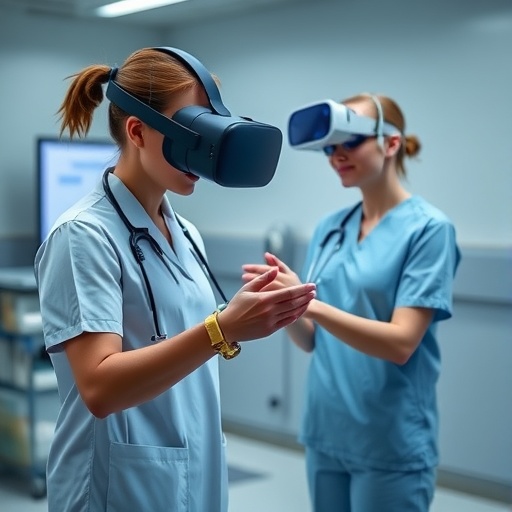
In an era where virtual reality (VR) is revolutionizing education, a pioneering study from a collaborative team has taken significant steps forward in enhancing the learning experiences of nursing students. Researchers Bozkurt, Doğu, and Çit, among others, have embarked on a bold mission to develop a state-of-the-art multi-skill, haptic-supported virtual reality simulation aimed specifically at first-year nursing students. This exciting pilot study promises not just to reshape the instructional landscape of nursing education but also to set a precedent in immersive learning methodologies.
The unprecedented need for well-trained healthcare professionals has prompted educational institutions to seek innovative ways to teach complex skills. Traditional methods, while effective, often fall short in providing students with a truly immersive experience that mirrors real-world medical scenarios. This is particularly critical in nursing, where students must not only learn theoretical concepts but also hone practical skills efficiently and effectively. The current pilot study offers a groundbreaking solution to bridge this gap.
By harnessing haptic feedback technology within the context of virtual reality, this new simulation allows nursing students to engage in lifelike scenarios where they can practice a range of clinical skills. The integration of haptic feedback ensures that learners can feel the physicality of their interactions, whether it’s performing a delicate procedure or administering care. This sensory experience is crucial, as it aids in the internalization of procedures, making learning more impactful and retention significantly higher.
One of the standout features of the VR simulation is its multi-skill capability. Unlike previous training programs that focused on individual skills, this simulation provides a holistic approach. Students can progress through various scenarios, from basic patient assessments to more complex interventions, all within the safety and control of a virtual environment. This method allows for repeated practice without the pressure of real-time consequences, facilitating a more robust learning experience.
Moreover, the research team conducted extensive user testing and feedback sessions to calibrate the effectiveness of the simulation. The feedback from first-year nursing students who participated in the pilot study has been overwhelmingly positive. Users reported increased confidence when handling clinical tasks in the simulation compared to their traditional training methods. This evolving landscape of educational technology indicates that the days of rote memorization may soon give way to immersive, hands-on learning.
A significant challenge faced by traditional nursing education is the accessibility of quality clinical experiences. Many first-year students struggle to find sufficient opportunities to interact with patients or practice critical skills. This virtual reality simulation tackles this pressing issue by providing students the chance to practice scenarios repeatedly, independent of location or resource constraints. The research highlights an urgent need for scalable educational tools that can reach a broad audience without compromising on training quality.
Perhaps one of the most exciting aspects of this study is the potential for scalability. The modular configuration of the VR simulation means that it can be continually updated and expanded. As medical knowledge evolves and new techniques and technologies emerge, the simulation can quickly adapt to incorporate these changes. This not only keeps the training relevant but also ensures that students are always learning the most current practices in healthcare.
Additionally, the researchers are keenly aware of the diverse backgrounds of nursing students. The virtual reality simulation includes features that cater to different learning styles, thus broadening its appeal. Visual, auditory, and kinesthetic learners alike can find effective ways to engage with the content, ensuring a comprehensive learning experience that respects individual differences in learning preferences.
This pilot study serves as a beacon of hope and innovation within nursing education. The integration of cutting-edge technology with foundational training builds a bridge between theoretical knowledge and practical skills that students will carry throughout their careers. As healthcare continues to advance at a rapid pace, the importance of equipping the next generation of nurses cannot be overstated. This research represents a forward-thinking approach to ensure students are not just prepared but are exceptional caregivers.
Moving forward, the research team plans to analyze long-term outcomes by following students who engage with the VR simulation throughout their studies. Understanding how early exposure to such technologies impacts their performance will provide invaluable insights. It may also offer a framework for other fields of study that require hands-on experience, potentially revolutionizing education across various disciplines.
In conclusion, Bozkurt, Doğu, and Çit have set a remarkable precedent with their multi-skill, haptic-supported virtual reality simulation for first-year nursing students. The study illustrates a transformative shift in how nursing education can leverage technology to enhance learning efficacy. As the healthcare landscape evolves, so too must the methods we employ to prepare future nurses. This innovative simulation not only addresses the critical challenges of nursing education but also positions it at the forefront of educational technology.
As we anticipate the findings and impacts of this study, one thing is certain: immersive technologies are here to stay in educational contexts, pushing the boundaries of how we learn, engage, and ultimately prepare for careers dedicated to caring for others.
Subject of Research: Development of a multi-skill, haptic-supported virtual reality simulation for first-year nursing students.
Article Title: Development of a multi-skill, haptic-supported virtual reality simulation for first-year nursing students: a pilot study.
Article References:
Bozkurt, R., Doğu, Ö., Çit, G. et al. Development of a multi-skill, haptic-supported virtual reality simulation for first-year nursing students: a pilot study.
BMC Nurs (2025). https://doi.org/10.1186/s12912-025-04260-w
Image Credits: AI Generated
DOI: 10.1186/s12912-025-04260-w
Keywords: Virtual Reality, Nursing Education, Haptic Feedback, Immersive Learning, Clinical Skills Training.
Tags: enhancing nursing student learning experiencesfirst-year nursing student traininghaptic feedback technologyhaptic VR for clinical skills practicehealthcare professional training methodsimmersive learning for nursing studentsmulti-skill simulations in healthcarenursing education innovationspilot study on VR simulationspractical skills development in nursingrevolutionizing nursing education through technologyvirtual reality in nursing education



