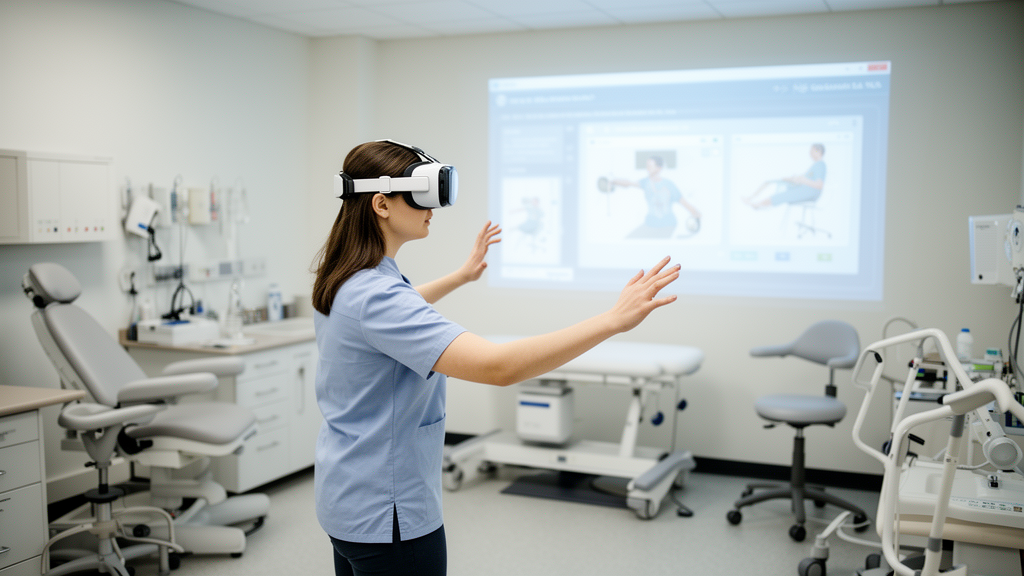
A quasi-experimental pilot study published in BMC Medical Education has evaluated the use of immersive virtual reality combined with guided reflection among undergraduate occupational therapy students, reporting mixed and exploratory outcomes that do not establish an intervention-specific effect. While the virtual reality technology demonstrated clear feasibility and acceptability, the pilot findings regarding student empathy, perspective-taking, and learning motivation remained preliminary and inconclusive.
The research team, based at Universidad Rey Juan Carlos, designed the investigation to address persistent educational difficulties in occupational therapy programs, where student disengagement and academic dropout present recurring obstacles. Because motivation and empathy represent essential attributes for health professionals, the researchers explored whether extended reality technologies and immersive headsets could provide realistic, interactive clinical simulations to bolster student engagement.
In the quasi-experimental setup, undergraduate occupational therapy participants were divided into distinct cohorts according to their level of clinical experience and their exposure to immersive virtual reality. The training intervention spanned four weeks and incorporated eight separate 15-minute learning sessions delivered twice per week, during which students wore immersive headsets to experience simulated real-world clinical environments.
The authors evaluated student outcomes both before and after the four-week intervention using several assessment instruments. They measured self-reported motivation and students’ subjective experience of the intervention through self-designed exploratory Likert-type questions, while empathy was assessed with the Interpersonal Reactivity Index and technical usability was measured through the System Usability Scale.
Students participating in the virtual reality groups reported high usability for the simulated clinical scenarios, yielding mean System Usability Scale scores of 76.5 and 80.75 across the two cohorts. Statistical analyses revealed exploratory post-intervention between-group differences across certain measures, with these distinctions appearing most notably among students who already had prior clinical experience.
Despite these observed differences, the authors emphasized that the between-group variations were affected by baseline imbalances across participant groups and were not accompanied by corresponding within-group pre-to-post improvements within the virtual reality cohorts. The investigators concluded that the findings must be interpreted strictly as exploratory rather than confirmatory, underscoring that small sample sizes and baseline imbalances necessitate future adequately powered studies.
The preliminary evidence demonstrates the feasibility and acceptability of combining immersive virtual reality with guided reflection in occupational therapy education, but the findings do not demonstrate an intervention specific effect. Although participants reported high usability across the simulation sessions, results concerning perspective taking, empathy, and motivation remained mixed and exploratory.
Furthermore, the authors emphasized that all observed differences require caution because of baseline imbalances, small sample sizes, and an exploratory design. Without corresponding within group differences, between group variations cannot confirm intervention effects. Future research studies with adequate statistical power are required to verify whether immersive extended reality simulations can reliably foster engagement and empathy in health professions education.
Subject of Research: Immersive virtual reality in undergraduate occupational therapy education
Article Title: Immersive virtual reality, motivation, empathy, and perspective-taking in undergraduate occupational therapy students: a quasi-experimental pilot study
Article References: Rodríguez-Pérez, M. P., Poveda-García, A., Bullón-Benito, E., Gonzalo-Ciria, L., Fernández-Gómez, G., Donovan, M., & Huertas-Hoyas, E. (2026). Immersive virtual reality, motivation, empathy, and perspective-taking in undergraduate occupational therapy students: a quasi-experimental pilot study. BMC Medical Education. https://doi.org/10.1186/s12909-026-10854-y
Image Credits: AI Generated
DOI: 10.1186/s12909-026-10854-y
Keywords: immersive virtual reality, occupational therapy education, undergraduate students, pilot study, quasi-experimental design, student motivation, student empathy, perspective-taking, System Usability Scale, Interpersonal Reactivity Index, clinical simulations, Universidad Rey Juan Carlos, extended reality, guided reflection, student disengagement, academic dropout, clinical experience
News Source: Courtney Benton. (November 19, 2026). Pilot Study Finds Mixed Virtual Reality Outcomes in Occupational Therapy Education. Scienmag.