A retrospective pilot comparative study evaluating two minimally invasive percutaneous disc decompression devices has demonstrated that Disc-FX and L’DISQ provide comparable short-term pain relief in adult patients suffering from single-level lumbar disc herniation. The investigation, conducted at Showa Medical University and published in JA Clinical Reports, tracked postoperative recovery trajectories across a six-month observation window to determine whether distinct engineering mechanisms translate into measurable clinical disparities. Lumbar disc herniation represents a substantial source of disabling radicular leg pain, lower back discomfort, and functional impairment, often prompting intervention when conservative management fails. While conventional open discectomy and microdiscectomy effectively relieve neural compression, percutaneous decompression strategies aim to alleviate symptoms with reduced surgical trauma, shorter operative times, and expedited rehabilitation. Although both Disc-FX and L’DISQ have previously documented clinical efficacy in separate evaluations, the authors noted an absence of direct comparative investigations assessing their clinical performance through validated metrics.
To evaluate the comparative performance of the two technologies, the clinical research team executed a single-centre retrospective cohort study reviewing consecutive adult patients treated between October 2018 and August 2023. Protocol approval was granted by the Institutional Review Board of Showa Medical University under approval number 2023-178-B, utilizing an opt-out consent mechanism in alignment with the Strengthening the Reporting of Observational Studies in Epidemiology reporting framework. Eligible participants presented with radicular symptoms matching magnetic resonance imaging findings of single-level lumbar herniation, accompanied by confirmed discogenic pathology via positive provocative discography or documented pain alleviation following targeted intradiscal injection. Patients were excluded if they presented with spinal trauma, active infections, underlying spinal oncology, or prior surgical interventions at the index vertebral level. Additional exclusion criteria eliminated individuals undergoing concurrent cervical interventions, those with spinal surgeries within the prior six months, individuals unable to complete the procedure due to intolerable intraoperative pain, and patients undergoing multi-level procedures on the same calendar day.
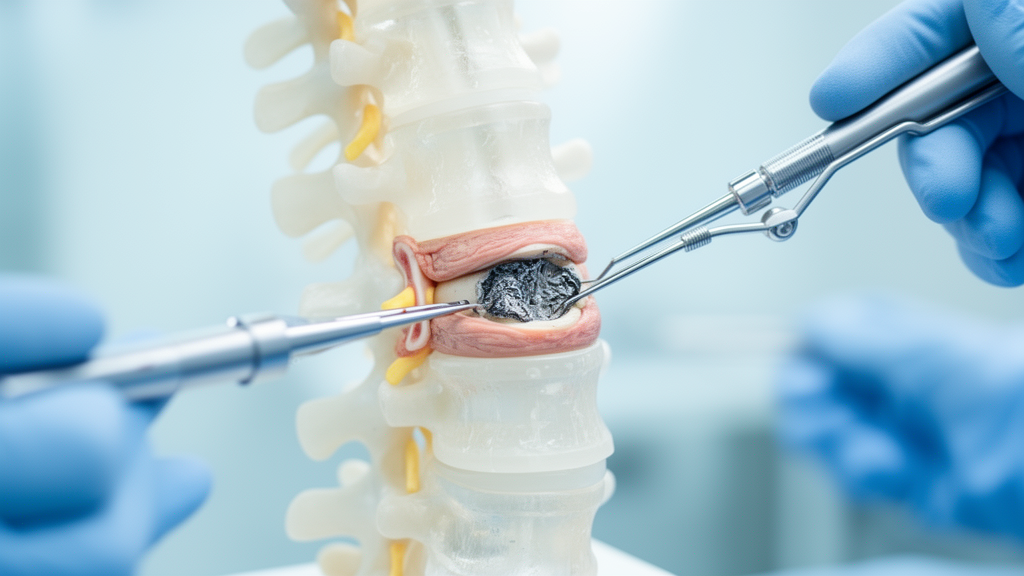
The study cohort comprised forty-two qualifying patients, with sixteen individuals undergoing decompression via the Disc-FX system and twenty-six receiving treatment with the navigable L’DISQ device. All surgical interventions were completed by two experienced pain specialists administering localized anesthesia supplemented by mild intravenous sedation using fifteen milligrams of pentazocine and one to two milligrams of midazolam, alongside one gram of prophylactic cefazolin. Under continuous fluoroscopic guidance, clinicians accessed the targeted intervertebral disc through Kambin’s triangle from the non-pathological anatomical side while maintaining verbal communication with the awake patient. The mechanical and electrical deployment protocols differed according to each device’s proprietary design. This manual extraction was systematically coupled with bipolar radiofrequency ablation applied in Turbo mode bursts, followed by annular thermal modulation in Hemo mode with incremental electrode rotation and continuous saline irrigation.
Prior to ablation, operators delivered short electrical stimulation bursts to verify electrode placement within the targeted lesion without triggering motor contraction or nerve root irritation, adjusting positioning whenever radicular sensations arose. Radiofrequency energy was then delivered in intermittent pulses without engaging coagulation mode, yielding total active ablation durations ranging between two hundred and four hundred seconds per disc. Following procedural completion, all forty-two patients underwent standard post-intervention neurological monitoring and vital sign tracking, with hospital discharge consistently accomplished within one to two days.
Clinical outcomes were systematically quantified at baseline, one week, one month, three months, and six months postoperatively by the two treating surgeons. Primary efficacy was defined as the between-group difference in pain score reduction on the eleven-point Numerical Rating Scale from baseline to six months. Key secondary endpoints encompassed six-month changes in general health-related quality of life measured through the EuroQOL Five-Dimension Five-Levels questionnaire, alongside the proportions of patients achieving prespecified minimal clinically important difference thresholds. The investigation defined these clinical response boundaries as a reduction of at least two points on the pain rating scale and an improvement of at least zero-point-zero-eight points on the quality-of-life index. Exploratory endpoints recorded temporal score trajectories, analgesic consumption patterns, post-discography responses, and subsequent requirements for secondary interventions such as pulsed radiofrequency therapy or open spinal revision surgery.
Analysis of the primary outcome demonstrated marked pain relief across both treatment groups over the six-month follow-up period without a statistically significant difference between the two devices. In the Disc-FX cohort, mean pain scores decreased from a baseline of seven-point-one-three points to four-point-one-nine points at six months, reflecting a mean improvement of two-point-nine-four points. Within the L’DISQ cohort, pain scores fell from a baseline mean of five-point-six-five points to four-point-zero-four points at six months, representing an average decrease of one-point-six-two points. The between-group mean difference in six-month pain change was one-point-three-two points favouring Disc-FX, but the ninety-five percent confidence interval ranged from minus zero-point-three-six to positive three-point-zero-one points with a p-value of zero-point-zero-nine-six-nine. Similarly, achievement of the minimal clinically important difference for pain relief was reached by eleven of sixteen patients receiving Disc-FX and thirteen of twenty-six patients receiving L’DISQ, a difference that did not reach statistical significance.
Secondary evaluations of health-related quality of life, conducted among thirty-eight participants with complete baseline records, revealed divergent score trajectories favouring the Disc-FX cohort. While baseline index values did not differ significantly between cohorts, the Disc-FX group demonstrated a mean six-month improvement of zero-point-two-three points compared to zero-point-one-zero points in the L’DISQ group. This represented a statistically significant between-group mean difference of zero-point-one-three-four points, supported by a ninety-five percent confidence interval spanning zero-point-zero-one-three to zero-point-two-five-five points and an effect size of zero-point-seven-one. Furthermore, eighty-three-point-three percent of Disc-FX patients achieved the quality-of-life minimal clinically important difference threshold compared to fifty-point-zero percent in the L’DISQ arm. However, this responder disparity yielded a p-value of zero-point-zero-seven-seven, falling short of conventional significance, while multivariable linear regression adjusting for baseline characteristics attenuated the between-group quality-of-life difference to zero-point-zero-four points.
Patterns of postoperative pharmacological dependence and secondary therapeutic interventions remained largely comparable between the two technical approaches. Reductions in daily tramadol consumption were verified in ten overall patients at the six-month evaluation, comprising four individuals in the Disc-FX group and six individuals in the L’DISQ group. Preoperative utilization of oral neuropathic agents, including pregabalin, mirogabalin, and duloxetine, declined from sixty-two-point-five percent to thirty-one-point-three percent in the Disc-FX cohort, and from fifty-seven-point-seven percent to thirty-four-point-six percent among L’DISQ recipients. Secondary intervention rates within the initial postoperative month showed that sixteen patients underwent adjunctive high-frequency pulsed therapy, encompassing five Disc-FX cases and eleven L’DISQ cases without statistical divergence. Over the complete six-month period, subsequent spinal operations occurred at the index disc level in one Disc-FX patient who received laminectomy, and four L’DISQ patients who underwent posterior discectomy, spinal fusion, or laminoplasty.
In examining the physiological mechanisms that could potentially explain the observed divergence in quality-of-life improvement, the study authors highlighted differences in tissue extraction and thermal treatment modalities. Experimental literature indicates that L’DISQ plasma ablation typically extracts approximately one-point-three-five grams of nucleus pulposus, whereas Disc-FX removes approximately zero-point-eight grams through radiofrequency ablation alongside variable amounts extracted via manual forceps discectomy. Beyond volumetric decompression, Disc-FX incorporates an annular modulation mode utilizing radiofrequency energy to apply localized thermal coagulation directly to the annulus fibrosus. The authors theorized that this thermal application could potentially promote collagen shrinkage, tighten annular fissures, and induce a functional sealing effect akin to dedicated annular closure devices. However, because postoperative radiological assessments were not systematically conducted, the authors stressed that structural sealing mechanisms remain entirely hypothetical explanations rather than confirmed physical outcomes.
The authors underscored multiple methodological constraints that require cautious interpretation of the findings, emphasizing the exploratory nature of this non-randomized single-centre pilot cohort. Baseline imbalances were prominent, notably regarding provocative discography, which yielded positive findings in eighty-eight-point-five percent of L’DISQ patients compared to fifty percent of Disc-FX patients, reflecting non-random treatment selection in routine clinical practice. Furthermore, clinical outcome assessments were recorded by the same two attending surgeons who performed the procedures without blinding, introducing potential observer and information bias. The patient-reported scales employed, including the Numerical Rating Scale and EuroQOL questionnaire, are bounded instruments inherently subject to ceiling effects that can distort measured recovery increments in subjects presenting with differing baseline symptom severity. Analgesic regimens were managed at the discretion of referring physicians rather than standardized protocols, introducing potential medication-related confounding.
The study also lacked long-term follow-up beyond six months and did not incorporate objective imaging examinations such as follow-up magnetic resonance scans to monitor disc height maintenance, residual herniation volume, or recurrent structural protrusion. Consequently, whether the statistical quality-of-life advantage detected for Disc-FX reflects genuine physiological superiority or artifactual observational bias remains unproven. The researchers concluded that while both Disc-FX and L’DISQ represent feasible, minimally invasive options providing substantial and comparable pain alleviation for single-level lumbar disc herniation, any apparent superiority in quality-of-life metrics must be considered preliminary. Definitive conclusions regarding comparative clinical efficacy, durable functional gains, and structural disc preservation will require adequately powered, prospective randomized controlled trials incorporating standardized magnetic resonance imaging evaluations and blinded clinical assessors.
Subject of Research: Comparative clinical evaluation of Disc-FX and L’DISQ percutaneous disc decompression devices for lumbar disc herniation
Article Title: Evaluation of Disc-FX versus L’DISQ for percutaneous disc decompression: pilot comparative study using the minimal clinically important difference
Article References: Takaoka, H., Kobayashi, R., Okano, I., Taketomi, A., Hara, E., Mera, H., Ishikawa, M., Kudo, Y., & Oe, K. (2026). Evaluation of Disc-FX versus L’DISQ for percutaneous disc decompression: pilot comparative study using the minimal clinically important difference. JA Clinical Reports, 12(1), Article 14. https://doi.org/10.1186/s40981-026-00846-8
Image Credits: AI Generated
DOI: 10.1186/s40981-026-00846-8
Keywords: lumbar disc herniation, percutaneous disc decompression, Disc-FX, L'DISQ, radicular pain, Numerical Rating Scale, EQ-5D-5L, minimal clinically important difference, radiofrequency ablation, annuloplasty, spine surgery, pain management, fluoroscopic guidance, retrospective cohort, intervertebral disc, Kambin's triangle, discectomy
News Source: Ophelia Keating. (November 25, 2026). Pilot Study Finds Comparable Pain Relief for Disc-FX and L’DISQ. Scienmag.